What Is Natural Language Processing and Why Is It Important?
TL;DR
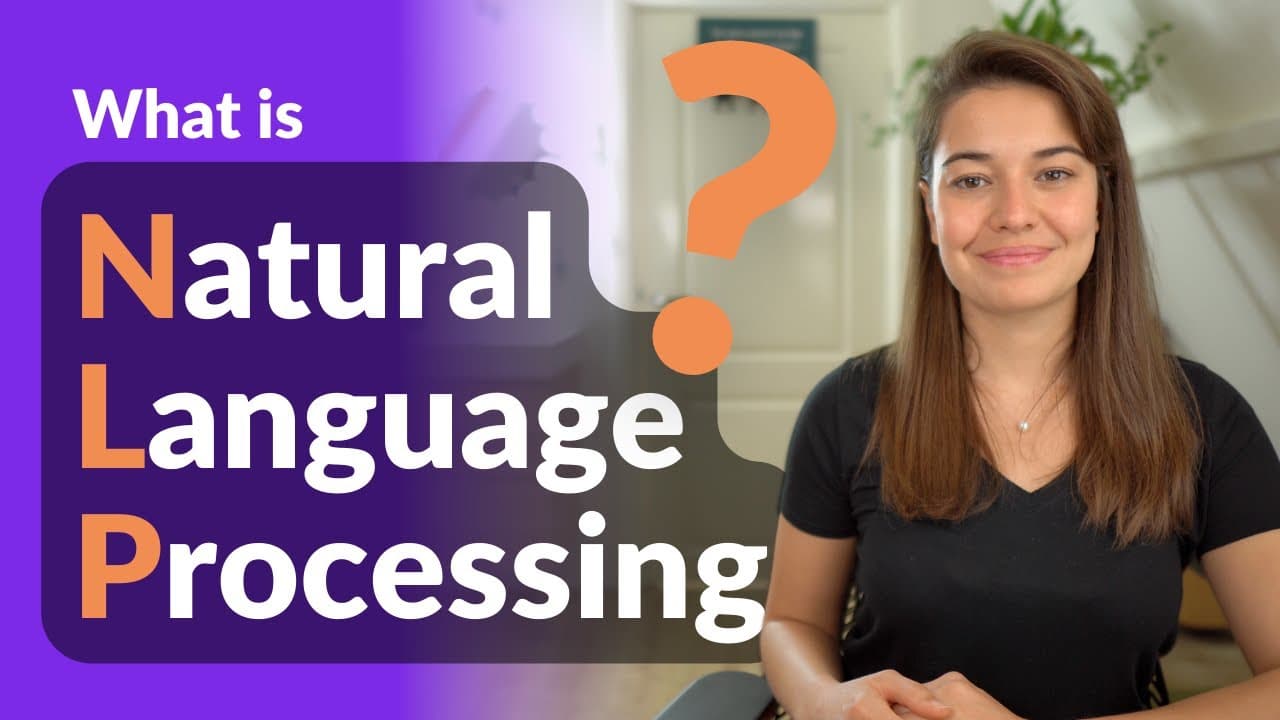
Natural Language Processing (NLP) enables computers to understand and interpret human language through techniques like tokenization and sentiment analysis. It is crucial for leveraging the vast amounts of unstructured data available and facilitates seamless communication between humans and machines. Recent advancements, especially through Transformer models, have significantly enhanced NLP capabilities.
Transcript
Ellen Turing argued in the 1950s that when a machine is able to converse with a human being seamlessly that would be the point to stop questioning its intelligence since then computers have come a long way to achieve this goal mainly thanks to the advancements in the field of natural language processing or NLP for short today we will learn about wh... Read More
Key Insights
- 📛 NLP decodes natural language through techniques like tokenization, stemming, and named entity recognition.
- 😌 The significance of NLP lies in utilizing unstructured data and enabling seamless human-computer communication.
- ▶️ Advancements in AI, specifically through Transformer architectures, have propelled NLP capabilities forward.
- 🫠 Challenges in NLP include deciphering sarcasm, idioms, and evolving language nuances.
- 👨🔬 Historically, NLP research focused on logic-based systems, transitioning to machine learning techniques for language understanding.
- 🧑💻 Notable NLP libraries and services include NLTK, spaCy, Hugging Face, and NLP capabilities offered by major tech companies like IBM and Google.
- 🌥️ The future of NLP may involve a fusion of linguistics and deep learning techniques, alongside the development of increasingly large models.
Install to Summarize YouTube Videos and Get Transcripts
Explore YouTube Video Summarizer or Get YouTube Transcript Extractor
Questions & Answers
Q: What is natural language processing (NLP)?
Natural language processing is the practice of making sense of naturally spoken language, often in text form. It includes techniques and tasks that help computers interpret, classify, translate, filter, and summarize language.
Q: What is tokenization in NLP?
Tokenization separates a piece of text into smaller units called tokens. These tokens can be words, subwords, or individual characters.
Q: What is the difference between stemming and lemmatization?
Both stemming and lemmatization aim to reduce a word to its root form. The transcript notes that they use slightly different approaches but does not explain those differences further.
Q: What are common NLP tasks?
Common tasks include text classification, machine translation, content moderation, topic detection, sentiment analysis, and summarization. Simpler techniques also include tokenization, stemming, lemmatization, word-sense disambiguation, and named entity recognition.
Q: Why is natural language processing important?
NLP helps people use the large amount of written, unstructured data that exists alongside structured data. It can extract structured information from text and reduce friction by enabling computers to understand and respond through natural language.
Q: Why is natural language difficult for computers to understand?
Language contains sarcasm, hidden meanings, idioms, and phrases that evolve over time. Words and sentences can also have multiple meanings that change with context, and these challenges begin again when working with another language.
Q: How have NLP techniques evolved?
Before the 2000s, researchers focused on logic- and linguistics-based systems built from written language rules. During the 2000s, research shifted toward machine-learning and statistical techniques, while later progress used neural networks and especially Transformer architectures with attention mechanisms.
Q: How can someone start using NLP in a project?
Building an accurate custom NLP model from scratch requires substantial expertise and time, so many companies fine-tune publicly available models or use NLP service APIs. The transcript also identifies libraries such as NLTK, spaCy, TextBlob, Gensim, and Stanford CoreNLP as starting points.
Summary & Key Takeaways
-
NLP decodes and analyzes spoken or written language through techniques like tokenization, stemming, and entity recognition.
-
The relevance of NLP lies in harnessing unstructured data and enabling seamless communication between humans and computers.
-
Advancements in AI, particularly through models like Transformers, have propelled NLP capabilities forward, bridging the gap in language understanding.
Read in Other Languages (beta)
Share This Summary 📚
Summarize YouTube Videos and Get Video Transcripts with 1-Click
Try YouTube Summary with ChatGPT & Claude or YouTube Transcript Generator
Explore More Summaries from AssemblyAI 📚






Summarize YouTube Videos and Get Video Transcripts with 1-Click
Try YouTube Summary with ChatGPT & Claude or YouTube Transcript Generator