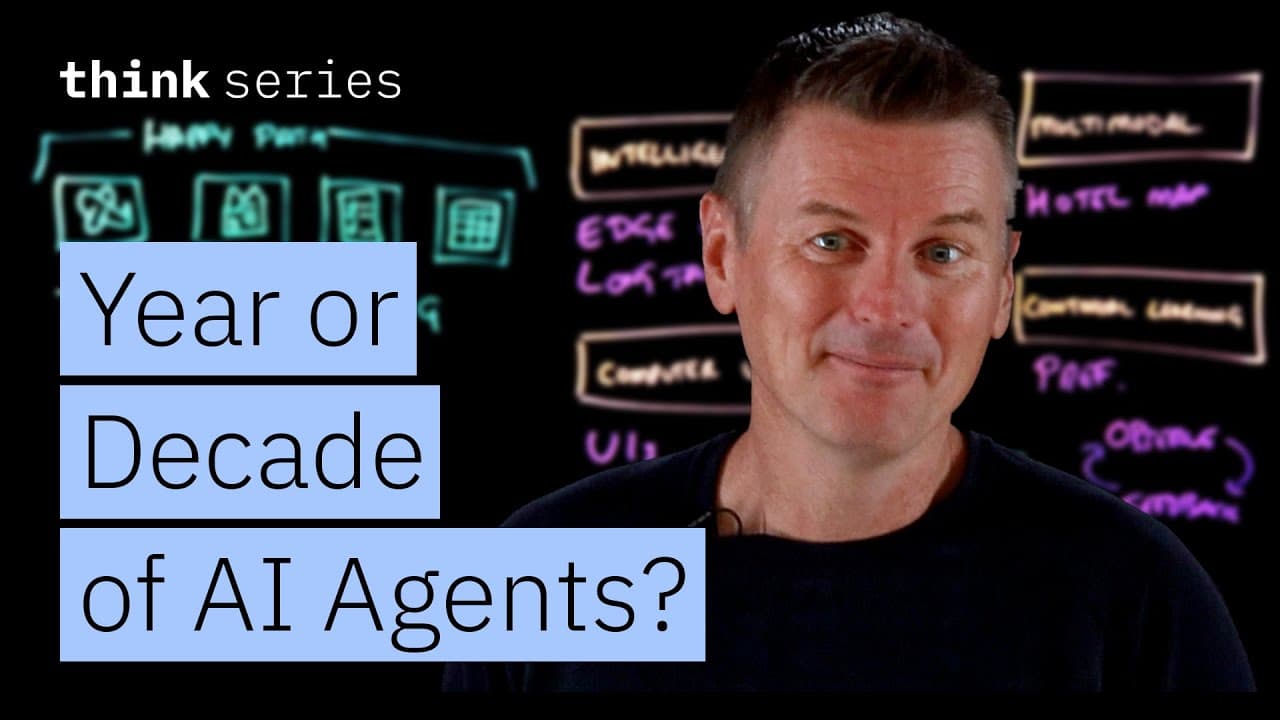
Is This the Decade of AI Agents?
TL;DR
AI agents are currently effective in structured tasks like coding assistance but struggle with real-world complexities such as travel booking and IT support. Over the next decade, advancements are expected to improve their capabilities in handling complex, unpredictable tasks. Current limitations include insufficient intelligence, challenges with computer use, and lack of continual learning.
Transcript
You might have heard that this is the year of AI agents, but some prominent voices in the AI community, such as OpenAI Co-Founder Andrej Karpathy, they paint a bit of a different picture. They're actually saying that this is the decade of AI agents, and that today's AI agents, they kind of struggle with some basic tasks. They are being a bit overso... Read More
Key Insights
- AI agents excel in structured environments like coding assistance, where tasks have clear right and wrong answers.
- Current AI agents struggle with complex real-world tasks due to insufficient intelligence and inability to handle edge cases.
- Travel booking showcases limitations in AI agents due to varied UIs and the need for multimodal understanding.
- Automated IT support remains aspirational due to the unique setups of individual machines and the need for reliable computer use.
- Coding assistance benefits from AI agents' pattern matching abilities across millions of code examples.
- AI agents face challenges with continual learning, especially in adapting to user preferences and feedback over time.
- Multimodal capabilities are not yet fully developed, limiting agents' effectiveness in tasks requiring visual or verbal input.
- The decade will see advancements in AI agents' ability to handle complex, messy problems with reliable intelligence and adaptability.
Install to Summarize YouTube Videos and Get Transcripts
Explore YouTube Video Summarizer or Get YouTube Transcript Extractor
Questions & Answers
Q: How do AI agents perform in coding assistance?
AI agents perform well in coding assistance due to their ability to match patterns across millions of code examples. They operate in structured environments with clear right and wrong answers, such as whether code compiles and passes tests. These agents work effectively within integrated development environments (IDEs), which have well-defined interfaces.
Q: Why do AI agents struggle with travel booking?
AI agents struggle with travel booking due to the complexity and variability of real-world scenarios. They face challenges with diverse user interfaces, edge cases like flight delays or visa requirements, and the need for multimodal understanding. Additionally, travel booking requires continual learning from user preferences, which current models find difficult to adapt to.
Q: What are the limitations of AI agents in automated IT support?
AI agents in automated IT support face limitations due to the unique setups of individual machines and the complex nature of diagnosing and resolving issues. They struggle with navigating diverse operating systems and application UIs, and their current computer use capabilities are not reliable enough for autonomous control over user devices.
Q: What is the role of multimodal capabilities in AI agents?
Multimodal capabilities in AI agents involve processing and understanding inputs beyond text, such as visual or verbal information. These capabilities are essential for tasks like interpreting hotel maps or understanding verbal descriptions of issues. Current AI agents have limited multimodal capabilities, hindering their effectiveness in tasks requiring such understanding.
Q: How do AI agents handle continual learning?
Continual learning for AI agents involves adapting to user preferences and feedback over time. This requires observing user behavior, learning from outcomes, and adjusting actions accordingly. Current models struggle with this aspect, as they often rely on initial training data and lack the ability to dynamically learn from real-world interactions and feedback loops.
Q: What advancements are expected for AI agents in the next decade?
In the next decade, advancements for AI agents are expected to focus on improving their capabilities in handling complex, unpredictable tasks. This includes enhancing their intelligence to deal with edge cases, developing reliable computer use capabilities, and achieving true multimodal understanding and continual learning to adapt to specific user environments and preferences.
Q: Why are AI agents effective in structured tasks?
AI agents are effective in structured tasks because these environments have clear rules and defined outcomes. Tasks like coding assistance benefit from the agents' pattern matching abilities across numerous examples and the structured nature of programming languages. These tasks provide immediate feedback, allowing agents to perform well without needing advanced reasoning or adaptability.
Q: What are the challenges in AI agents' computer use capabilities?
The challenges in AI agents' computer use capabilities include navigating diverse user interfaces, dealing with authentication flows, and overcoming intentional automation barriers. These challenges are significant in tasks like travel booking and IT support, where agents must interact with various systems and applications, often with inconsistent or intentionally difficult interfaces.
Summary & Key Takeaways
-
AI agents are currently effective in structured environments like coding assistance, where tasks are well-defined and rely on pattern matching. They struggle with real-world tasks that require handling edge cases, diverse user interfaces, and multimodal inputs. Over the next decade, advancements are expected to improve their capabilities in these areas.
-
Travel booking and automated IT support highlight current limitations of AI agents. These tasks require handling complex scenarios, diverse interfaces, and continual learning from user preferences and feedback. Current models lack the intelligence and adaptability needed for these unpredictable, real-world tasks.
-
The future of AI agents lies in their ability to handle messy, real-world problems with reliable intelligence and adaptability. While they excel in structured tasks today, advancements over the next decade will focus on improving their capabilities in handling complex, unpredictable scenarios with true multimodal understanding and continual learning.
Read in Other Languages (beta)
Share This Summary 📚
Summarize YouTube Videos and Get Video Transcripts with 1-Click
Try YouTube Summary with ChatGPT & Claude or YouTube Transcript Generator
Explore More Summaries from IBM Technology 📚




Summarize YouTube Videos and Get Video Transcripts with 1-Click
Try YouTube Summary with ChatGPT & Claude or YouTube Transcript Generator