How to Learn Full Stack Java Development for Beginners
TL;DR
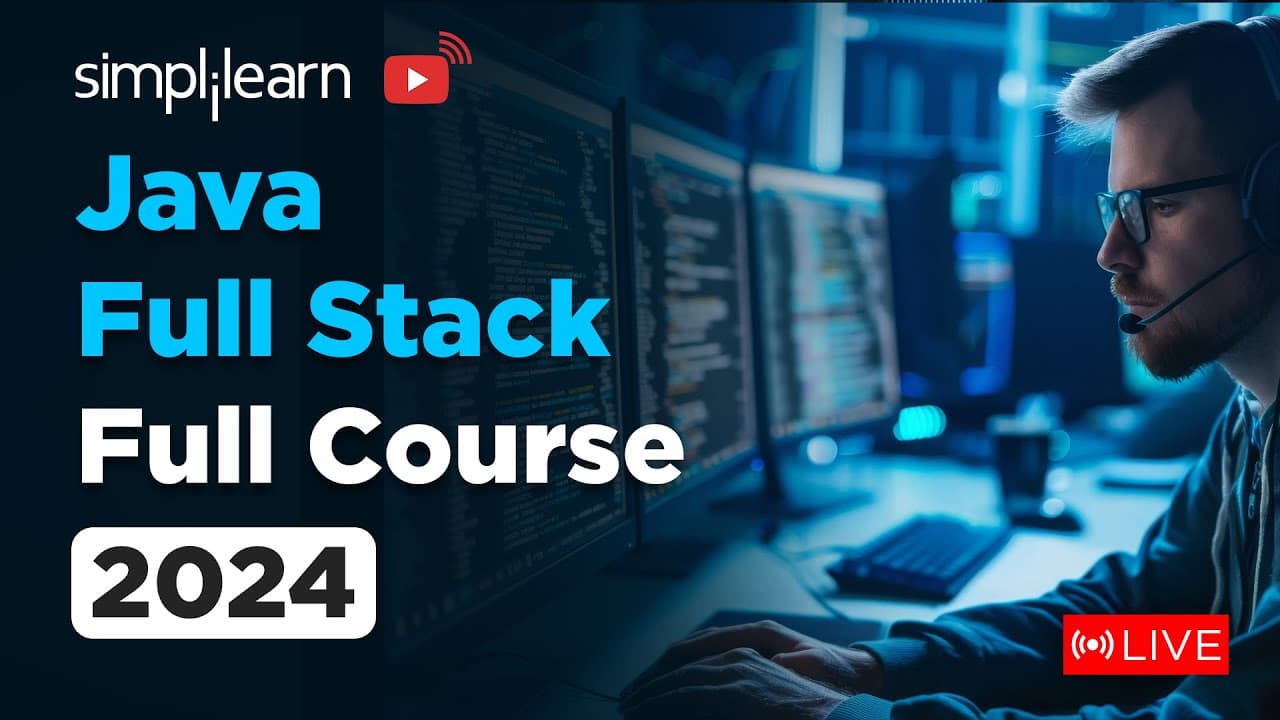
Full stack Java development combines front-end technologies (HTML, CSS, JavaScript, Angular) with back-end Java, Spring Boot, and databases like SQL and MongoDB. The course opens with Git, a distributed version control tool that lets you commit and manage code locally without a network connection, then share repositories through servers like GitHub, Bitbucket, or GitLab.
Transcript
Hello everyone and welcome to today's video on Java fullstack course at simply learn. Do you know friends that projected Java developer job growth is 13% increase from 2018 to 2028 with about 20,900 new jobs expected over the next decade. Java developer salaries have also increased by 11% in the last 5 years. With that I welcome you all in today's ... Read More
Key Insights
- Git is a distributed version control tool that lets users perform version control tasks locally without needing a network connection, making it one of the most popular such tools of recent times.
- Git bash (the git client) is the minimum requirement to start working with Git; it installs as a command-line utility on Windows, Linux, Mac OS, and other operating systems.
- A Git server is required for one user to share a repository with another; popular options include GitHub, Bitbucket, and GitLab, some free and some licensed.
- GitHub comes in two variants: the cloud-hosted github.com and an enterprise server installed in an organization's own data centers when source code cannot be placed on the cloud.
- GitLab is gaining popularity because it provides not just a Git server but also a runner, part of a continuous integration strategy that builds a project as soon as a source code check-in occurs.
- HTTPS authentication uses a username or email and password to connect to a Git server, while SSH authentication uses a public and private key pair protected by a passphrase.
- Git must be configured for first-time use with 'git config --global user.name' and 'git config --global user.email' to set the identity Git works with.
- The full stack Java program from Simplilearn in collaboration with IBM teaches industry skills like Angular, Spring Boot, Hibernate, and JSPs plus MVC and web services for building scalable web applications.
Install to Summarize YouTube Videos and Get Transcripts
Explore YouTube Video Summarizer or Get YouTube Transcript Extractor
Questions & Answers
Q: What topics does the full stack Java course cover?
The course covers full stack web development using Java, including front-end technologies like HTML, CSS, JavaScript, and Angular, as well as back-end development with Java, Spring Boot, and databases. The session agenda specifically starts with Git commands, then core Java concepts, a Maven tutorial for beginners, front-end technologies, a comprehensive Angular tutorial, and database technologies including SQL and MongoDB. By the end, learners are meant to be proficient in building and managing full stack applications.
Q: What is Git and why is it popular?
Git is one of the most popular distributed version control tools of recent times. Like any other distributed version control tool, it allows users to perform various version control tasks without really needing a network connection, so you can create repositories, add files, and commit changes locally. According to the instructor, branching and merging are the killer features of Git, which is why it has become so widely used for collaboration among developers.
Q: What do you need to start working with Git?
The bare minimum needed to start working with Git is something called git bash or the git client. It comes as an installer for all popular operating systems including all flavors of Windows, Linux, Mac OS, and others. Once installed, you get a command-line utility from which you can fire up git commands, bring up repositories, add files, and commit changes. To share a repository with another user, you additionally need a Git server.
Q: What are the popular Git servers available?
Several Git servers are available, some free and some licensed. GitHub is one of the most popular and comes in two variants: the cloud-hosted github.com and an enterprise server installed in a data center. Bitbucket, from Atlassian, integrates well with other Atlassian products like Jira. GitLab is increasingly popular because it provides not just a Git server but also a runner for continuous integration, plus a nearly free community edition.
Q: What is the difference between HTTPS and SSH authentication in Git?
HTTPS authentication uses a username or email ID and a password to register and connect to the Git server, allowing you to push and pull repositories with those credentials. SSH authentication instead relies on creating a private and public key pair on the client machine. When creating the keys you set a passphrase, then post the public key to your Git server account. On future connections the server challenges you for that passphrase to authenticate.
Q: How do you configure Git for first-time use?
After installing git bash, you configure it for first-time use by setting a username and email ID. The command is 'git config --global user.name' followed by the name in double quotes, which sets a global setting. You also run 'git config --global user.email' with the email ID, which does not need double quotes. In the demonstration, the instructor uses the official Simplilearn account for these values and then verifies the configurations were set correctly.
Q: Why is a Git server needed to collaborate?
You can create and work with a repository locally using only git bash, but sharing it with another user requires a Git server. For one user to share a repository with another who also has git bash installed, both must be set up on a common Git server. The first user pushes the repository to the server and grants appropriate access, so the second developer, once properly registered with valid credentials, can pull down and work with that repository.
Q: How large is the Java developer job market according to the video?
The video cites that projected Java developer job growth is a 13% increase from 2018 to 2028, with about 20,900 new jobs expected over the next decade. It also notes that Java developer salaries have increased by 11% in the last 5 years. These figures are presented at the start as motivation for learning full stack Java development and pursuing a career in the field.
Summary & Key Takeaways
-
The course covers full stack web development using Java, spanning front-end technologies like HTML, CSS, JavaScript, and Angular alongside back-end development with Java, Spring Boot, and databases, aiming to make learners proficient at building and managing full stack applications.
-
The session agenda begins with Git commands, then moves through core Java concepts, a Maven tutorial for beginners, front-end technologies including HTML, CSS, and JavaScript, a comprehensive Angular tutorial, and database technologies including SQL and MongoDB.
-
The Git section, taught by Chidanand from the SimplyLearn team, explains installing and configuring git bash, the client-server working model, sharing repositories via HTTPS or SSH authentication, and branching and merging as the tool's killer features.
Read in Other Languages (beta)
Share This Summary 📚
Summarize YouTube Videos and Get Video Transcripts with 1-Click
Try YouTube Summary with ChatGPT & Claude or YouTube Transcript Generator
Explore More Summaries from Simplilearn 📚



Summarize YouTube Videos and Get Video Transcripts with 1-Click
Try YouTube Summary with ChatGPT & Claude or YouTube Transcript Generator