What Is the KNN Algorithm and How Does It Work?
TL;DR
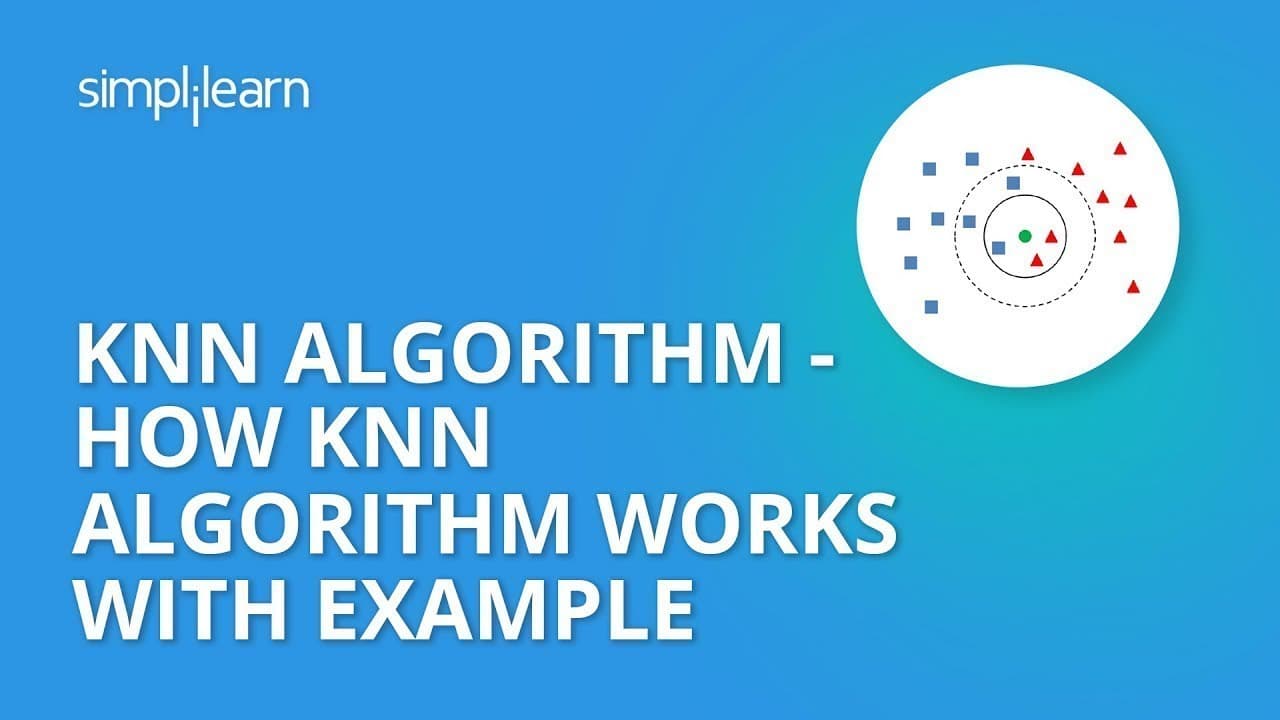
The K-Nearest Neighbors (KNN) algorithm is a simple supervised machine learning method used for classification based on feature similarity, typically via Euclidean distance. It classifies data points by examining the majority class of their K nearest neighbors. Choosing the value of K is crucial, as it impacts the model's accuracy and can be determined using the square root of the number of data points.
Transcript
hello and welcome to k-nearest neighbors algorithm tutorial my name is Richard Kirchner and I'm with the simply learned team today we're gonna cover the K nearest neighbors a lot refer to as K in n and k n n is really a fundamental place to start in the machine learning it's a basis of a lot of other things and just the logic behind it is easy to u... Read More
Key Insights
- 🤔 K-nearest neighbors (KNN) is a fundamental algorithm in machine learning and is commonly used for classification tasks.
- 🔎 KNN classifies data points based on the classification of its neighbors, using a similarity measure like Euclidean distance.
- 📊 The choice of the value of K is an important parameter in KNN algorithm and can be determined through parameter tuning.
- 🐱 The KNN algorithm can be used to differentiate between cats and dogs based on their characteristics like sharpness of claws and length of ears.
- 📏 Euclidean distance is calculated to determine the proximity of a data point to its neighbors in the KNN algorithm.
- ⚙️ The KNN algorithm works by finding the K nearest neighbors to a data point and classifying it based on the majority class among its neighbors.
- 🔍 When choosing the value of K, it is important to avoid bias and overfitting, and the square root of the number of data points is a common method for selection.
- 💡 KNN is suitable when the data is labeled, noise-free, and small in size, making it a good starting point for machine learning projects.
Install to Summarize YouTube Videos and Get Transcripts
Explore YouTube Video Summarizer or Get YouTube Transcript Extractor
Questions & Answers
Q: How does the K-Nearest Neighbors (KNN) algorithm work?
The KNN algorithm works by classifying a data point based on the classification of its nearest neighbors. It stores all available cases and classifies new cases based on a similarity measure, such as the Euclidean distance.
Q: Why is choosing the right value of K important in the KNN algorithm?
Choosing the right value of K is crucial because it affects the accuracy of the KNN algorithm. If K is too low, the model may be too sensitive to noise and overfit the data. If K is too high, the model may oversimplify the data and underfit it.
Q: In what scenarios is the KNN algorithm commonly used?
The KNN algorithm is commonly used when the data is labeled, noise-free, and the dataset size is small. It is a lazy learner that doesn't learn a discriminative function, making it suitable for simpler datasets.
Q: How is the KNN algorithm used to predict diabetes?
In the diabetes prediction use case, the KNN algorithm is trained on a dataset of 768 people with known diabetes status. It then takes in new data, like glucose levels and blood pressure, and predicts whether a person will be diagnosed with diabetes or not.
Q: What is the significance of the confusion matrix in evaluating the KNN model?
The confusion matrix helps evaluate the performance of the KNN model by showing the number of true positives, true negatives, false positives, and false negatives. It provides insights into the accuracy and misclassification of the model.
Q: What is the difference between accuracy and the F1 score in model evaluation?
Accuracy measures the overall correct predictions out of the total predictions, while the F1 score considers both precision and recall. The F1 score gives a more balanced evaluation, especially when there is class imbalance or false positives/negatives are of concern.
Q: Can the KNN algorithm handle large datasets?
The KNN algorithm can handle large datasets, but it may become computationally expensive and resource-intensive as the number of data points increases. It is more commonly used with smaller datasets due to its simplicity and ease of implementation.
Summary & Key Takeaways
-
The K-Nearest Neighbors (KNN) algorithm is a simple supervised machine learning algorithm used for classification based on the similarity of features.
-
Choosing the value of K is an important parameter tuning process that affects the accuracy of the KNN algorithm.
-
The tutorial demonstrates a use case of predicting diabetes using KNN, where a dataset of 768 people is used to train a KNN model and make predictions.
Read in Other Languages (beta)
Share This Summary 📚
Summarize YouTube Videos and Get Video Transcripts with 1-Click
Try YouTube Summary with ChatGPT & Claude or YouTube Transcript Generator
Explore More Summaries from Simplilearn 📚

![Digital Marketing Full Course 2026 [FREE] | Digital Marketing Tutorial for Beginners | Simplilearn thumbnail](/_next/image?url=https%3A%2F%2Fi.ytimg.com%2Fvi%2F5altc8xTzBg%2Fhqdefault.jpg&w=750&q=75)



Summarize YouTube Videos and Get Video Transcripts with 1-Click
Try YouTube Summary with ChatGPT & Claude or YouTube Transcript Generator