How to Master Data Structure Patterns for LeetCode Interviews
TL;DR
Most coding interview problems reduce to a loop, a condition, and a few variables, so recognizing patterns beats brute force. Arrays give O(1) index access but O(n) middle inserts, sets check existence in O(1), and hashmaps store key-value pairs in O(1) average time, making them the most useful tools to learn.
Transcript
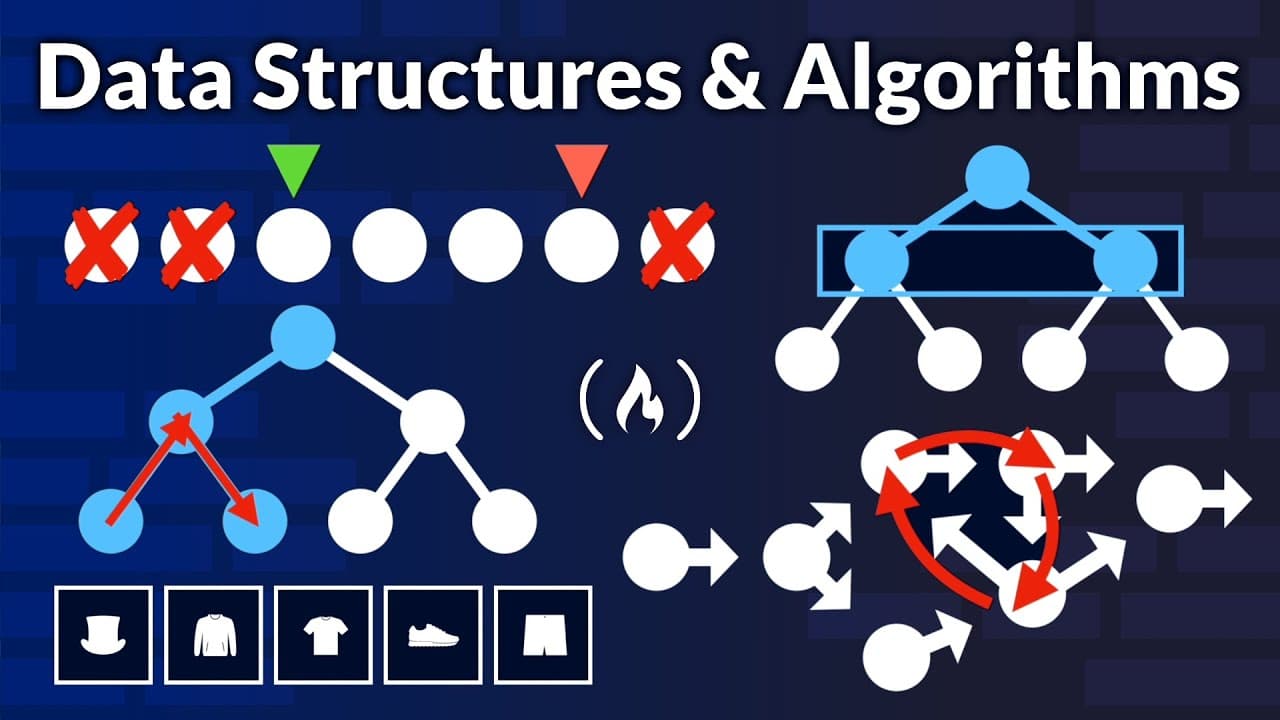
Welcome to this comprehensive course on data structures and algorithms. Whether you're preparing for coding interviews or looking to strengthen your foundational programming skills, this is a great course for you. Sheldon Chai developed this course. Sheldon will break down the most essential data structures like arrays, strings, sets, hashmaps, and... Read More
Key Insights
- Arrays give constant-time O(1) access by index because they are stored in contiguous memory, but inserting or deleting at the front or middle costs O(n) since every following element must shift to make or fill space.
- Strings are arrays of characters but usually immutable, so concatenating in a loop creates a new string each iteration and can reach O(n squared); building a list of characters and joining at the end restores O(n).
- Sets store only unique values with no order and let you check existence in O(1) average time, making them the cleanest tool for detecting duplicates, tracking what you have seen, or verifying membership.
- Hashmaps store key-value pairs and do both lookup and insertion in O(1) on average by running a key through a hash function that points directly to a memory slot, independent of data size.
- Hash collisions occur when two keys like 'banana' and 'peach' produce the same hash number, but most languages have built-in hashmap implementations that handle collisions automatically for you.
- Big O notation measures how performance scales with input size, and you only need a few classes: O(1), O(log n), O(n), O(n log n), and O(n squared), which is usually too slow for large interview inputs.
- The rule of thumb is that inputs up to 10^5 need O(n log n) or better, inputs up to 10^4 can sometimes tolerate O(n squared), and anything larger must be optimized further.
- Most string problems like longest substring without repeating characters or checking anagrams are actually hidden sliding window or two-pointer problems, not brute force character checking exercises.
Install to Summarize YouTube Videos and Get Transcripts
Explore YouTube Video Summarizer or Get YouTube Transcript Extractor
Questions & Answers
Q: Why is array access by index so fast?
Arrays give you constant time O(1) access by index because they are stored in contiguous memory, meaning all elements sit next to each other like a row of houses. Since you know exactly how far to walk to reach a given position, you can jump straight to any index without scanning. This is what makes arrays fast for reading and indexing operations.
Q: When do arrays become slow or expensive to use?
Arrays break down when you insert or delete elements in the middle or at the front. For example, inserting a zero at the beginning of 1 2 3 4 5 forces you to shift every element one position to the right to make room, which is an O(n) operation. Deleting from the middle similarly requires shifting everything left to fill the gap. Accessing by index and appending at the end remain fast.
Q: Why is concatenating strings in a loop a mistake?
In most languages strings are immutable, so changing a string even slightly creates an entirely new one under the hood rather than modifying the original. When you concatenate strings inside a loop, a new string is built on every iteration, which can lead to O(n squared) time complexity. Instead you should build a list of characters and join them at the end, which brings the work back down to O(n).
Q: When should you use a set instead of a list?
You should use a set instead of a list whenever you care about uniqueness, such as checking for duplicates, existence questions like 'have I seen this before?', or fast membership checks asking 'is this value in the current group?'. A set stores only unique values and checks for existence in O(1) average time, far faster than looping through an entire list. Sets are not meant for storing key-value pairs.
Q: How does a hashmap achieve constant time lookup?
A hashmap stores data as key-value pairs and achieves O(1) average lookup and insertion by running each key through a hash function. Imagine a huge row of mailboxes: instead of searching every one, the hash function takes a key like the string 'banana' and returns a number such as 243 that points directly to a memory slot. You never scan all keys or sort anything, so performance stays the same whether you have 10 or a million elements.
Q: What is a hash collision and do you need to handle it?
A hash collision happens when two different keys produce the same hash number, for example if both 'banana' and 'peach' hash to 243. In practice you do not have to worry about handling collisions yourself because most programming languages provide built-in hashmap implementations that manage collisions automatically. Understanding collisions simply helps you grasp how hashing works internally, and digging deeper into it can be a fascinating optional study.
Q: What Big O classes do you actually need to know for interviews?
You do not need to memorize twenty Big O classes, just a few common ones. These are O(1) constant time like array indexing or set existence checks, O(log n) logarithmic time like binary search that halves the problem each step, O(n) linear time for single-pass loops, O(n log n) usually tied to sorting, and O(n squared) usually from nested loops doing brute force comparisons. O(n squared) is generally too slow for large interview inputs.
Q: How do input size limits tell you which time complexity you need?
The rule of thumb ties input size to required efficiency. For inputs up to 10^5 you probably need O(n log n) or better to pass. For inputs up to 10^4 you can sometimes get away with O(n squared). For anything larger than that you absolutely need to optimize your solution further. Seeing a nested loop should signal O(n squared) and likely too slow, while binary search signals O(log n) and fast.
Summary & Key Takeaways
-
Arrays are the default structure for anything linear and ordered, offering O(1) index access thanks to contiguous memory, with fast appends at the end. Their weakness is inserting or deleting at the front or middle, which forces shifting every other element and costs O(n). Nearly every clever interview problem depends on leveraging array structure to avoid unnecessary work.
-
Strings behave like arrays of characters but are immutable in most languages, so modifying one creates a new string. Concatenating inside a loop silently produces O(n squared) time; instead build a list of characters and join at the end for O(n). Sets store unique values and check existence in O(1) average time, ideal for duplicates and membership.
-
Hashmaps are the most useful pattern covered, storing key-value pairs with O(1) average lookup and insertion via a hash function that maps keys directly to memory slots. Keys must be hashable, such as numbers, strings, and tuples, while lists and dictionaries are not. Big O notation, focusing on a few common classes, guides which solutions are fast enough.
Read in Other Languages (beta)
Share This Summary 📚
Summarize YouTube Videos and Get Video Transcripts with 1-Click
Try YouTube Summary with ChatGPT & Claude or YouTube Transcript Generator
Explore More Summaries from freeCodeCamp.org 📚






Summarize YouTube Videos and Get Video Transcripts with 1-Click
Try YouTube Summary with ChatGPT & Claude or YouTube Transcript Generator