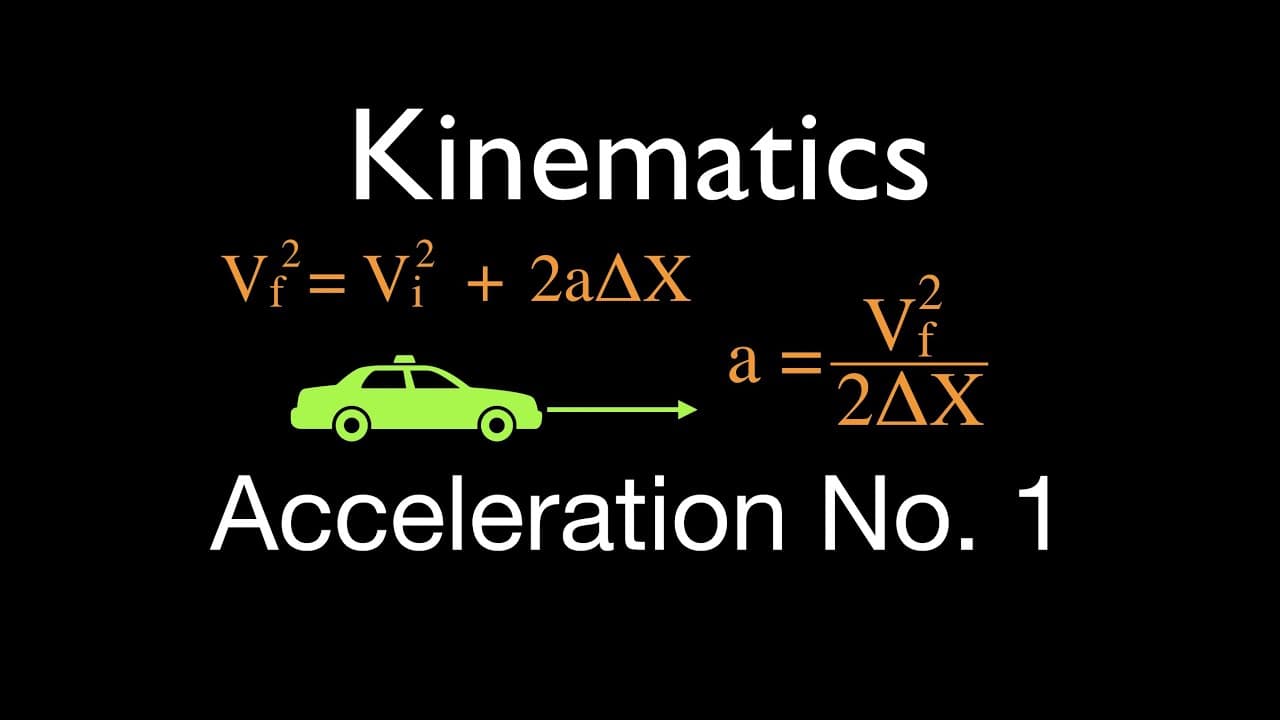
Physics, Kinematics (2 of 7) 1 D Horizontal Motion, Solve for Acceleration, No. 1
TL;DR
- Learn how to solve for acceleration in two examples using kinematic equations.
Transcript
okay in today's video I'm going to go over two examples of how we use the kinematic equations for onedimensional horizontal motion and in this video we're going to do two problems where we're going to solve for the acceleration and this is the first example example number one says we have a bicyclist who accelerates from rest to a speed of 7.15 m/ ... Read More
Key Insights
- 🆘 Kinematic equations help solve acceleration problems efficiently.
- ⌛ Initial and final velocities, distance, and time are crucial variables in acceleration calculations.
- 🍉 Simplifying calculations by recognizing zero terms can expedite the problem-solving process.
- 🐢 Negative acceleration values signify deceleration or slowing down.
- 🗯️ Understanding and selecting the right kinematic equation streamlines the problem-solving approach.
- ❓ Practice with additional kinematic problems enhances proficiency in solving acceleration scenarios.
- 💬 Thumbs up, positive comments, and subscriptions help support educational content creators.
Install to Summarize YouTube Videos and Get Transcripts
Explore YouTube Video Summarizer or Get YouTube Transcript Extractor
Questions & Answers
Q: How are kinematic equations used to solve for acceleration in the examples provided?
Kinematic equations are used by identifying known variables like initial and final velocities, distance, and time, and rearranging the equations to solve for acceleration.
Q: Why is the initial velocity squared term simplified to zero in the calculations?
The initial velocity is zero in the examples provided, making the initial velocity squared term equal to zero, simplifying the calculations.
Q: Why is the acceleration value negative for the car example where it is slowing down?
The negative acceleration value indicates that the car is slowing down, as acceleration and velocity changes in the opposite direction.
Q: What steps are followed to solve for acceleration in these kinematic problems?
The steps involve identifying known and unknown variables, selecting the correct kinematic equation with the known variables, rearranging the equation, plugging in values, and solving for acceleration.
Summary & Key Takeaways
-
Two examples are provided where acceleration is calculated using kinematic equations.
-
Initial and final velocities, distance, and time are key variables in solving for acceleration.
-
Understanding kinematic equations and rearranging them simplifies the process of finding acceleration.
Read in Other Languages (beta)
Share This Summary 📚
Summarize YouTube Videos and Get Video Transcripts with 1-Click
Try YouTube Summary with ChatGPT & Claude or YouTube Transcript Generator
Explore More Summaries from Step by Step Science 📚

Summarize YouTube Videos and Get Video Transcripts with 1-Click
Try YouTube Summary with ChatGPT & Claude or YouTube Transcript Generator