Quadratic inequalities | Polynomial and rational functions | Algebra II | Khan Academy
TL;DR
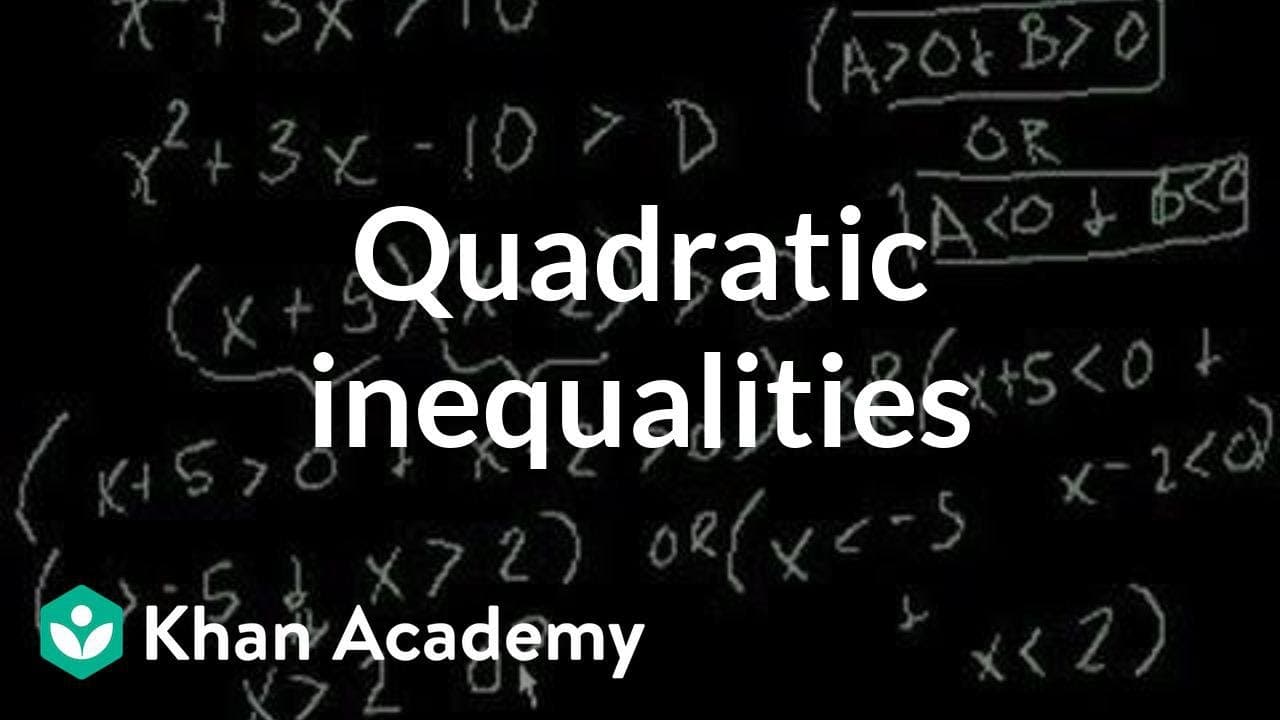
Learn how to solve quadratic inequalities by manipulating them into standard form and considering the signs of the expressions involved.
Transcript
Welcome to the presentation on quadratic inequalities. I know that sounds very complicated, but hopefully you'll see it's actually not that difficult. Or at least, maybe the problems we're going to work on aren't that difficult. Well, let's get started with some problems and hopefully you'll see where this is kind of slightly different than solving... Read More
Key Insights
- 😑 Solving quadratic inequalities requires manipulating them into standard form and considering the signs of the expressions involved.
- 😑 The signs of the expressions determine whether the solution is positive or negative.
- 🧡 Inequalities can have multiple solutions, including ranges or unions of different ranges.
- ❓ Quadratic inequalities cannot be solved using the same methods as linear equations.
- ☺️ The standard form helps handle both the x term and the x squared term effectively.
- 😑 Understanding the logic of multiplying two expressions and considering their signs is crucial in solving quadratic inequalities.
- 🈴 Quadratic inequalities are typically taught in higher grades, around 10th or 11th grade.
Install to Summarize YouTube Videos and Get Transcripts
Explore YouTube Video Summarizer or Get YouTube Transcript Extractor
Questions & Answers
Q: How do you solve quadratic inequalities?
Quadratic inequalities can be solved by manipulating them into standard form, factoring (if possible), and considering the signs of the expressions involved.
Q: Why can't you solve quadratic inequalities like linear equations?
Quadratic inequalities involve both an x term and an x squared term, making it impossible to solve them using the same methods as linear equations. The standard form helps handle both terms effectively.
Q: Why does the sign of the expressions matter in solving quadratic inequalities?
The signs of the expressions determine whether the product is positive or negative. If the product is positive, the expressions must have the same sign; if the product is negative, the expressions must have different signs.
Q: Can a quadratic inequality have multiple solutions?
Yes, a quadratic inequality can have multiple solutions, depending on the range of numbers that satisfy the inequality. Solutions can include single values, ranges, or the union of different ranges.
Summary & Key Takeaways
-
Solving quadratic inequalities involves manipulating the equation into standard form, with all terms on one side and a 0 on the other side.
-
To determine the solutions, analyze the signs of the expressions obtained through factoring or other methods.
-
Different solutions can arise based on whether the expressions have the same or different signs.
Read in Other Languages (beta)
Share This Summary 📚
Summarize YouTube Videos and Get Video Transcripts with 1-Click
Try YouTube Summary with ChatGPT & Claude or YouTube Transcript Generator
Explore More Summaries from Khan Academy 📚



Summarize YouTube Videos and Get Video Transcripts with 1-Click
Try YouTube Summary with ChatGPT & Claude or YouTube Transcript Generator