Impact velocity from given height | One-dimensional motion | Physics | Khan Academy
TL;DR
This video explains how to calculate the final velocity of an object when jumping or throwing it from a height, considering the effects of gravity and ignoring air resistance.
Transcript
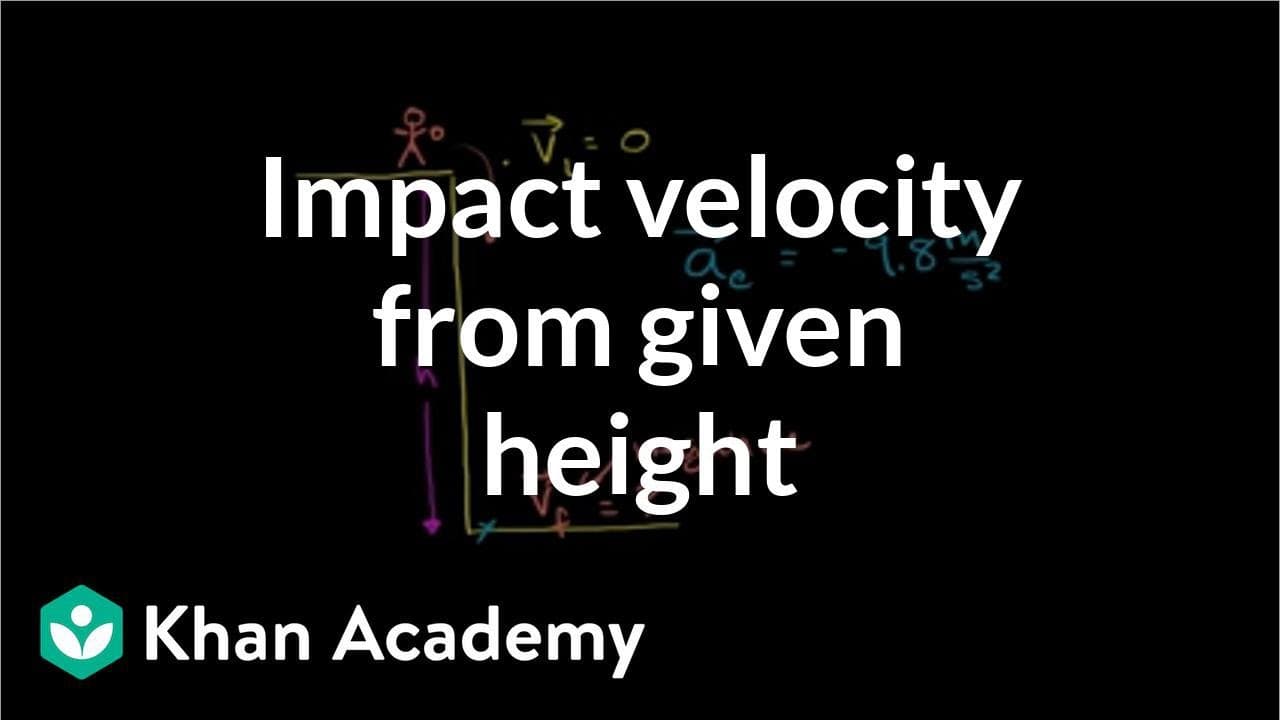
What I want to do in this video is answer an age-old question, or at least an interesting question to me. And the question is, let's say I have a ledge here-- I have a ledge or cliff, or maybe this is a building of some kind. And let's say it has height, h. So let's say it has a height of h, right over here. And what I'm curious about is if I were ... Read More
Key Insights
- 🙈 The calculation of final velocity when jumping or throwing objects from a height involves considering the effects of gravity and ignoring air resistance.
- 🖐️ Displacement plays a crucial role in determining the final velocity, with downward displacement being represented as negative.
- 📈 The convention of positive and negative velocity is used to indicate upward and downward motion, respectively.
- 🛩️ The calculations are valid for small heights and velocities or for aerodynamic and dense objects.
- 👱 Air resistance becomes more significant for greater heights or less aerodynamic objects.
- ❓ The derived equation incorporates the acceleration due to gravity, initial velocity, and displacement.
- 🍂 Final velocities are typically negative for falling objects.
Install to Summarize YouTube Videos and Get Transcripts
Explore YouTube Video Summarizer or Get YouTube Transcript Extractor
Questions & Answers
Q: How does air resistance affect the calculations of the final velocity?
Air resistance is ignored in these calculations, but it becomes more significant at higher heights or for less aerodynamic objects. However, for smaller heights and velocities or aerodynamic objects, ignoring air resistance is reasonable.
Q: What is the convention used to determine the sign of the final velocity?
The convention used is that positive velocity represents upward motion, while negative velocity represents downward motion. Since the video focuses on objects falling, the final velocity will typically be negative.
Q: Can these calculations be used for any height?
The calculations can be applied to any height as long as we are reasonably close to the surface of the Earth and ignore air resistance. However, if the height is too high or the object is not aerodynamic, air resistance will become more significant.
Q: How fast would a person fall when jumping off a one-story building (about 5 meters)?
Plugging in the height of 5 meters into the equation, we find that the final velocity, right before hitting the ground, would be approximately -9.9 meters per second.
Summary & Key Takeaways
-
The video explores the question of how fast a person or an object will fall when jumping or throwing it off a ledge or building.
-
It emphasizes that air resistance is ignored and that the calculations are applicable for small heights and velocities or for aerodynamic and dense objects.
-
The derived equation for calculating the final velocity involves the acceleration due to gravity, initial velocity (which is usually 0), and displacement.
Read in Other Languages (beta)
Share This Summary 📚
Summarize YouTube Videos and Get Video Transcripts with 1-Click
Try YouTube Summary with ChatGPT & Claude or YouTube Transcript Generator
Explore More Summaries from Khan Academy 📚



Summarize YouTube Videos and Get Video Transcripts with 1-Click
Try YouTube Summary with ChatGPT & Claude or YouTube Transcript Generator