Dividing rational expressions | Precalculus | Khan Academy
TL;DR
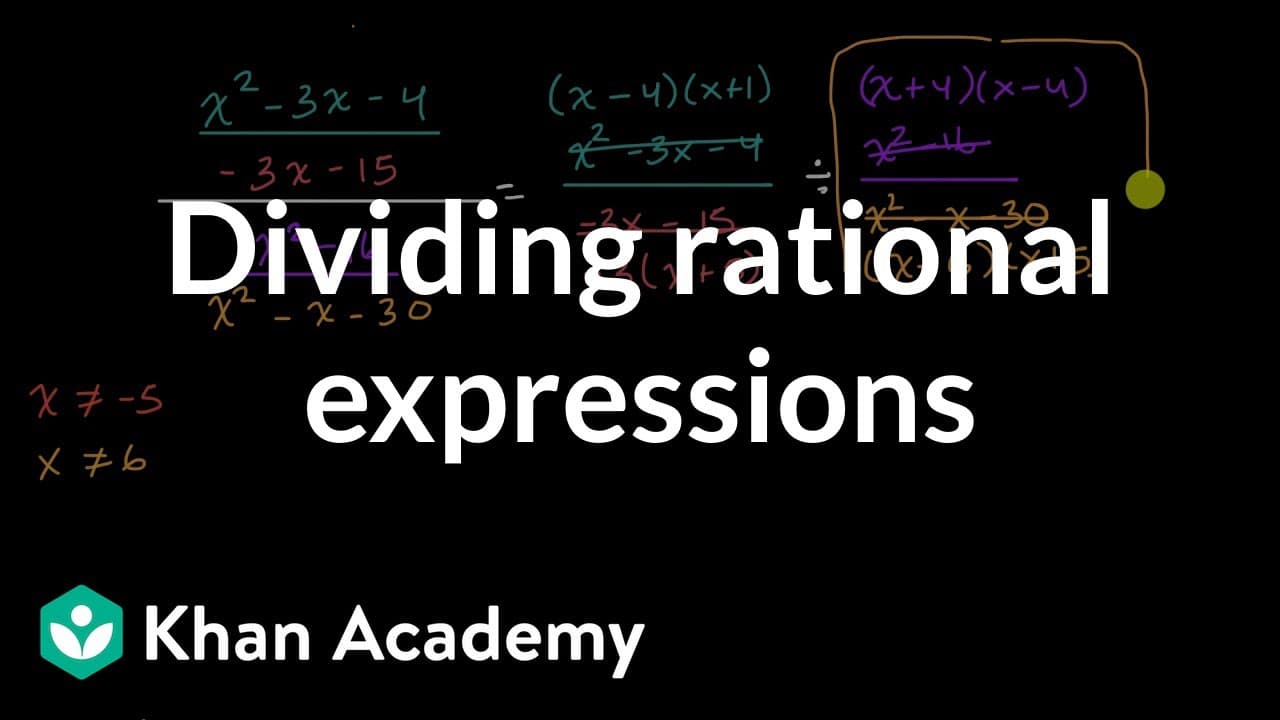
This video explains how to divide rational expressions, factor numerators and denominators, and consider domain constraints when reducing the expression.
Transcript
- [Instructor] The goal of this video is to take this big, hairy expression, where we are essentially dividing rational expressions and see if we can essentially do the division and then write it in reduced terms. So if you are so inspired, I encourage you to pause the video and work on this on your own before we do this together. All right, now le... Read More
Key Insights
- 😑 Dividing rational expressions involves rewriting them as multiplication and canceling out common factors.
- 😑 Domain constraints ensure that the expression does not have any values that would make it undefined.
- 😑 Factoring numerators and denominators helps simplify the expression and identify potential domain constraints.
Install to Summarize YouTube Videos and Get Transcripts
Explore YouTube Video Summarizer or Get YouTube Transcript Extractor
Questions & Answers
Q: How do we divide rational expressions?
To divide rational expressions, we rewrite the expression as multiplication and then factor the numerators and denominators. We then simplify the expression by canceling out common factors.
Q: Why is it important to consider domain constraints in division of rational expressions?
Domain constraints ensure that the resulting expression does not have any values that would make the expression undefined. By identifying x values that could make the denominators or the entire expression equal to zero, we exclude them from the domain.
Q: How do we factor numerators and denominators in rational expressions?
To factor numerators and denominators, we can use various techniques like factoring quadratic equations, recognizing difference of squares, or finding common factors. Factoring helps simplify the expression and identify potential domain constraints.
Q: What happens if we lose domain constraint information when reducing the expression?
If we lose domain constraint information when reducing the expression, the resulting expression may not be equivalent to the original one. It is crucial to keep track of domain constraints throughout the process to maintain the integrity of the expression.
Summary & Key Takeaways
-
The video demonstrates how to divide rational expressions by rewriting them as multiplication and factoring numerators and denominators.
-
It emphasizes the importance of keeping track of the x values that would make the expression undefined.
-
Domain constraints must be considered when reducing the expression, and any x values that make the denominators or the entire expression equal to zero should be excluded from the domain.
Read in Other Languages (beta)
Share This Summary 📚
Summarize YouTube Videos and Get Video Transcripts with 1-Click
Try YouTube Summary with ChatGPT & Claude or YouTube Transcript Generator
Explore More Summaries from Khan Academy 📚



Summarize YouTube Videos and Get Video Transcripts with 1-Click
Try YouTube Summary with ChatGPT & Claude or YouTube Transcript Generator