How to Calculate the Area of a Triangle Using Heron's Formula
TL;DR
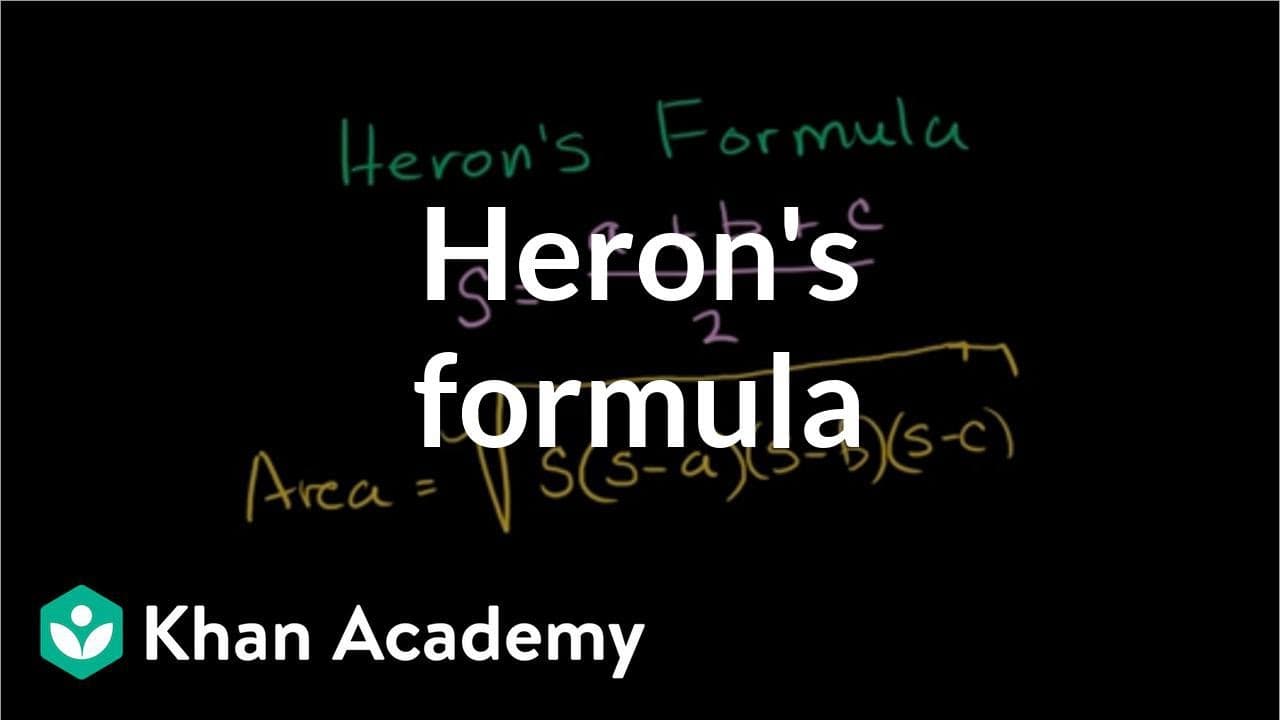
Heron's Formula allows you to calculate the area of a triangle when only the lengths of its sides are known. First, find the semiperimeter by dividing the perimeter by 2, then apply the formula: area = √(s × (s - a) × (s - b) × (s - c)), where 's' is the semiperimeter and 'a', 'b', 'c' are the side lengths.
Transcript
I think it's pretty common knowledge how to find the area of the triangle if we know the length of its base and its height. So, for example, if that's my triangle, and this length right here-- this base-- is of length b and the height right here is of length h, it's pretty common knowledge that the area of this triangle is going to be equal to 1/2 ... Read More
Key Insights
- ⚾ Finding the area of a triangle is commonly known when the base and height are provided.
- 🔺 Heron's Formula is a lesser-known method to find the area of a triangle using only the side lengths.
- 😑 Heron's Formula involves calculating the semiperimeter and then applying it in a square root expression to find the area.
- 🔺 Heron's Formula is useful when the height of a triangle is unknown or when only the side lengths are given.
- 🅰️ The formula can be applied to any type of triangle, regardless of its shape or symmetry.
- 😒 Heron's Formula requires basic algebraic calculations and the use of the Pythagorean theorem.
- 🔨 It is a useful tool for geometry and engineering applications.
Install to Summarize YouTube Videos and Get Transcripts
Explore YouTube Video Summarizer or Get YouTube Transcript Extractor
Questions & Answers
Q: How do you find the area of a triangle when only the lengths of its sides are given?
To find the area of a triangle with given side lengths, you can use Heron's Formula. First, calculate the semiperimeter (S) by adding all the side lengths and dividing the sum by 2. Then, use the formula: area = √(S * (S - a) * (S - b) * (S - c)), where a, b, and c are the side lengths.
Q: What is Heron's Formula?
Heron's Formula is a mathematical formula used to find the area of a triangle when only the lengths of its sides are known. It involves calculating the semiperimeter and using it in a square root expression to find the area.
Q: What are the advantages of using Heron's Formula?
Heron's Formula is advantageous because it allows you to find the area of a triangle without knowing its height. It is also applicable to any type of triangle, whether it is equilateral, scalene, or isosceles.
Q: How can Heron's Formula be applied practically?
Heron's Formula can be applied practically when you need to find the area of a triangle but only have access to its side lengths. It is particularly useful in geometry and engineering, where accurate area calculations are necessary.
Summary & Key Takeaways
-
The area of a triangle can be easily calculated if the base and height are given.
-
Heron's Formula allows you to find the area of a triangle when only the lengths of its sides are given.
-
Heron's Formula involves calculating the semiperimeter of the triangle and then using it to find the area.
Read in Other Languages (beta)
Share This Summary 📚
Summarize YouTube Videos and Get Video Transcripts with 1-Click
Try YouTube Summary with ChatGPT & Claude or YouTube Transcript Generator
Explore More Summaries from Khan Academy 📚



Summarize YouTube Videos and Get Video Transcripts with 1-Click
Try YouTube Summary with ChatGPT & Claude or YouTube Transcript Generator