What Are Micromouse Competitions and How Do They Work?
TL;DR
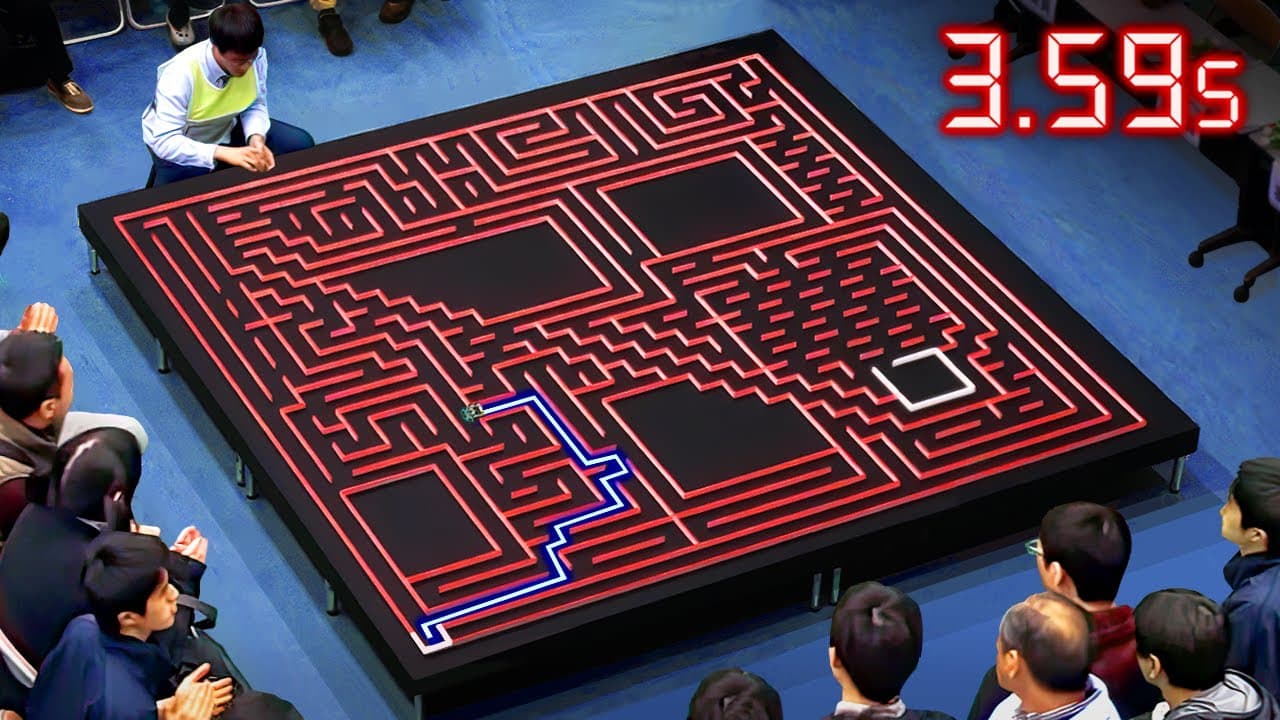
Micromouse competitions involve autonomous robots racing through mazes to find the fastest path to the goal. Originating in 1977, these events have evolved with innovations in algorithms, design, and control systems, enabling mice to achieve remarkable speeds and navigate complex layouts. Notably, techniques like the flood fill algorithm and the use of vacuum fans have significantly enhanced their performance.
Transcript
- [Derek] This tiny robot mouse can finish this maze in just six seconds. (dramatic music) Every year, around the world, people compete in the oldest robotics race. The goal is simple: get to the end of the maze as fast as possible. - The person who came second (announcer chattering) (people cheering) lost by 20 milliseconds. - [Derek] But competit... Read More
Key Insights
- 😲 Micromouse competitions have evolved from simple robots to fully autonomous, fast, and efficient maze-solving machines.
- 🫤 Diagonals and vacuum fans have been significant innovations in improving speed and control.
- 🎮 Control systems with gyroscopes and advanced sensors have increased precision and accuracy.
- 😲 The search algorithm flood fill is a popular strategy among Micromice for finding the fastest path in the maze.
- 🎨 Micromouse competitions require a combination of robotics, engineering, programming, and design skills.
- 💻 The competitions are still evolving, with ongoing experimentation and development in areas like omnidirectional movement and computer vision.
- 🚄 Challenges such as maintaining control during high-speed turns and minimizing friction continue to be areas of improvement.
Install to Summarize YouTube Videos and Get Transcripts
Explore YouTube Video Summarizer or Get YouTube Transcript Extractor
Questions & Answers
Q: How did the concept of Micromouse competitions come about?
Micromouse competitions were inspired by a misconception about electronic mice, which led IEEE to create their own contest in 1977.
Q: What challenges do Micromice face in the competitions?
Micromice have to navigate through complex mazes while avoiding walls and finding the fastest path to the goal. They must fit all their components in a limited space and rely solely on their internal systems.
Q: What strategies do Micromice use to solve the maze?
Micromice utilize various search algorithms, such as flood fill, which involves making optimistic journeys through the maze and updating their path based on encountered walls.
Q: How have technology and design advancements improved Micromouse competitions?
Technology advancements, such as gyroscopes, infrared sensors, and continuous DC motors, have allowed Micromice to improve their speed and control. Design innovations, such as incorporating diagonals and vacuum fans, have further enhanced their performance.
Key Insights:
- Micromouse competitions have evolved from simple robots to fully autonomous, fast, and efficient maze-solving machines.
- Diagonals and vacuum fans have been significant innovations in improving speed and control.
- Control systems with gyroscopes and advanced sensors have increased precision and accuracy.
- The search algorithm flood fill is a popular strategy among Micromice for finding the fastest path in the maze.
- Micromouse competitions require a combination of robotics, engineering, programming, and design skills.
- The competitions are still evolving, with ongoing experimentation and development in areas like omnidirectional movement and computer vision.
- Challenges such as maintaining control during high-speed turns and minimizing friction continue to be areas of improvement.
- Micromouse competitions serve as a reminder that apparently simple problems can be complex and require innovation and problem-solving skills.
Summary & Key Takeaways
-
Micromouse competitions began in 1977 as a contest for electronic mice, but soon evolved into fully autonomous robots navigating through mazes.
-
These robots, no larger than 25 centimeters, are designed to find the fastest path to the goal without any external help or interference.
-
Over the years, Micromouse competitions have seen innovations in search algorithms, mechanical design, and control systems to improve speed and efficiency.
Read in Other Languages (beta)
Share This Summary 📚
Summarize YouTube Videos and Get Video Transcripts with 1-Click
Try YouTube Summary with ChatGPT & Claude or YouTube Transcript Generator
Explore More Summaries from Veritasium 📚




Summarize YouTube Videos and Get Video Transcripts with 1-Click
Try YouTube Summary with ChatGPT & Claude or YouTube Transcript Generator