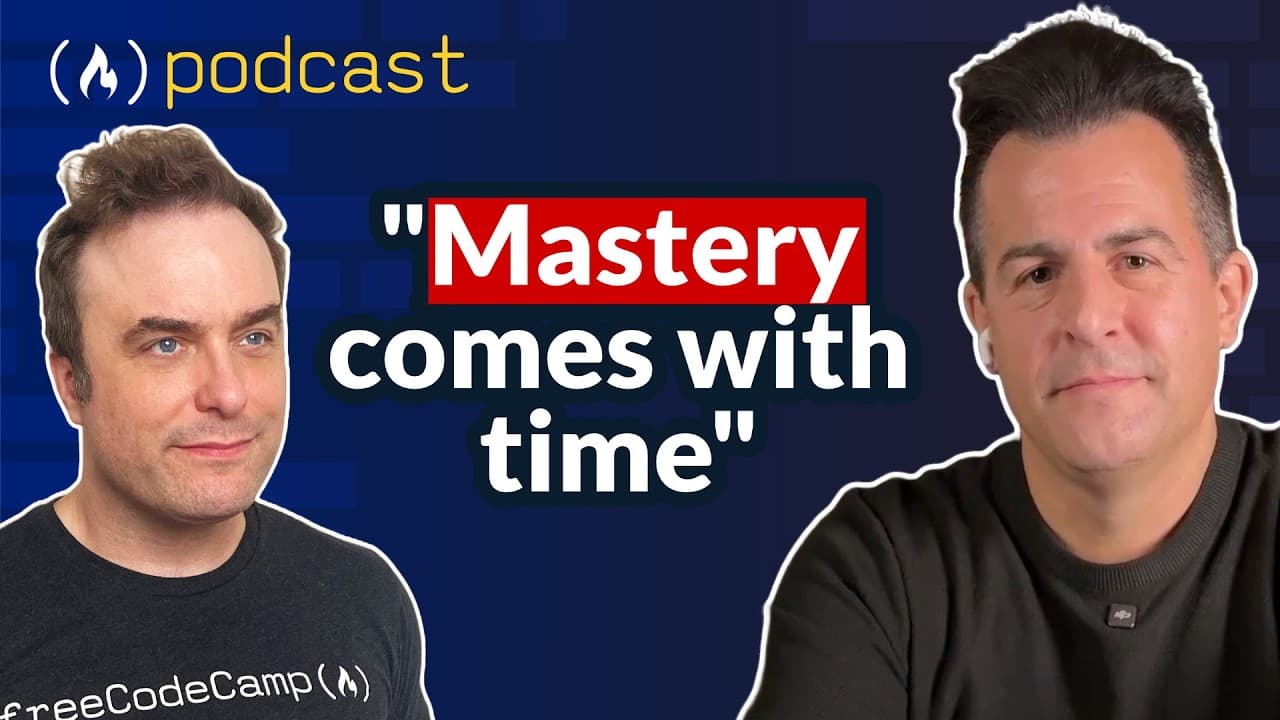
David Malan on Why You Should Learn Programming Slowly
TL;DR
Learning to code slowly builds the muscle memory and fundamentals that autocomplete and LLMs let you skip. Harvard's CS50 disables editor features like tab completion and auto-spacing by default so beginners must remember syntax themselves. Data structures and algorithms remain essential because they are the building blocks of engineering, even as AI writes boilerplate.
Transcript
Welcome back to the Free Code Camp podcast. I'm Quincy Larson, teacher and founder of free codecamp.org. And today we're talking with Harvard computer science professor and CS50 instructor David Men. He's taught millions of people programming and this is going to be quite an interview. Let's first take a look at some quick community news. Uh, Free ... Read More
Key Insights
- CS50 requires students to turn off code editor features like autocomplete, auto spacing, and tab completion by default, rather than merely encouraging it, so beginners build muscle memory and remember syntax themselves in their first days, weeks, and months of programming.
- Autocomplete and similar tools are meant to be productivity boosters once you already know what you are doing, not learning aids for beginners who still need to develop fundamentals by typing code manually.
- CS50 relaxes its restrictions over time: toward the end of the semester when covering HTML, students may have closing tags auto-generated because retyping the same tag is not intellectually interesting.
- By the end of the semester, students can offboard themselves from CS50's cloud-based environment (cs50.dev, a version of VS Code) and enable any tools they want for their final project.
- Data structures, algorithms, and fundamentals are what computer science and engineering fundamentally are: building blocks you assemble into your own projects, so they are not going away despite AI generating boilerplate quickly.
- The code and syntax itself was never the intellectually interesting part; memorizing specific APIs or function signatures has always been less interesting, and AI now handles that 'glue' so humans can focus on solving problems.
- Malan compares learning fundamentals to mastering basic hand tools like hammers and saws before using power tools such as chainsaws and jackhammers, applying the same logic to newcomers learning programming.
- In testing Copilot and Claude Code, Malan found AI output comparable to a junior developer's, requiring him to review code and override some design decisions, which cost time but still boosted productivity by getting him started.
Install to Summarize YouTube Videos and Get Transcripts
Explore YouTube Video Summarizer or Get YouTube Transcript Extractor
Questions & Answers
Q: Why does CS50 make students disable code editor features like autocomplete?
Malan says CS50 requires students to turn off features like autocomplete, auto spacing, and tab completion, or does so for them by default in its cloud-based VS Code environment. The goal is to enable and empower beginners to develop the muscle memory that experienced programmers take for granted. In the first days, weeks, and months, there is value in having to remember syntax and creating it yourself, which builds real fundamentals.
Q: When does CS50 let students turn coding tools back on?
CS50 relaxes restrictions as students progress. Toward the end of the semester when covering HTML, students are allowed to have closing tags automatically generated, since retyping the same tag you just opened is not particularly intellectually interesting. By the end of the semester, students can also offboard themselves from cs50.dev, the cloud-based environment, and turn on anything and everything of interest for their final project.
Q: How important are data structures and algorithms with AI writing code?
Malan says fundamentals like data structures and algorithms are not going away at all, because that is what computer science and engineering fundamentally are: an understanding of the building blocks you assemble into your own projects. What can remain less interesting is memorization of very specific APIs or function signatures. AI is helping with that glue, letting people do the fun part of solving problems and assembling building blocks.
Q: What does David Malan compare learning programming fundamentals to?
Quincy Larson offers an analogy that Malan agrees with: you need to learn to use your basic tools, your hammers and saws, before you break out the power tools like chainsaws and jackhammers. Applied to programming, people coming fresh to the field should learn the basics first, mastering fundamentals manually before relying on more powerful, automated tools like autocomplete and LLMs.
Q: How does David Malan use LLMs in his own software development?
Malan says his LLM use is increasing. He has a conversation with ChatGPT about one thing or another probably most every day. He has been experimenting more with GitHub Copilot, one of the in-IDE AIs, and tried Claude Code, another popular option. He expects his own usage to only go up and up, just as it is increasing within the CS50 course itself.
Q: What is it like reviewing code generated by AI tools like Copilot?
Malan describes a recent bug fix or feature he had Copilot implement as akin to the quality of a junior developer. As the human, he needed to review the code, override some of its design decisions, and redo some things himself. It was still helpful because it got him started and saved him slogging through documentation, so it was a productivity boost, but it did cost some time.
Q: Will developers spend more time reviewing code than writing it in the future?
Malan thinks the current heavy code-review period is probably short-term, where developers spend a disproportionate amount of time reviewing AI-generated code. He expects that to decrease as AI gets better and can be trusted like a good PM trusts an engineer to solve the problem as intended. He admits his own interest in software engineering would grind to a halt if all he did was review other code.
Q: What does David Malan think AI is helping developers with most right now?
Malan says AI is enabling developers to do the fun part of solving problems and assembling the building blocks without worrying about exactly what the glue looks like. While it is valuable to understand what you are typing or what the AI is doing, offloading specific APIs, function signatures, and boilerplate to AI lends itself to a better understanding of the solutions you create with AI's help.
Summary & Key Takeaways
-
Harvard CS50 professor David J. Malan explains that CS50 disables editor features like autocomplete, auto spacing, and tab completion by default so beginning programmers develop muscle memory and learn to write syntax themselves, treating these tools as productivity boosters reserved for after fundamentals are mastered.
-
Malan argues fundamentals such as data structures and algorithms remain the core of computer science and engineering because they are the building blocks assembled into projects, while memorizing specific APIs and syntax was never the interesting part and is exactly what AI now handles for developers.
-
Reviewing AI-generated code from tools like Copilot and Claude Code currently feels like reviewing a junior developer's work, requiring human oversight and design overrides; Malan sees this as a likely short-term period that will shrink as AI improves and can be trusted more.
Read in Other Languages (beta)
Share This Summary 📚
Summarize YouTube Videos and Get Video Transcripts with 1-Click
Try YouTube Summary with ChatGPT & Claude or YouTube Transcript Generator
Explore More Summaries from freeCodeCamp.org 📚
![The Most Important Skills Going Forward with CTO + Homebrew Maintainer Mike McQuaid [Podcast #204] thumbnail](/_next/image?url=https%3A%2F%2Fi.ytimg.com%2Fvi%2F58Tn2xB8kIE%2Fhqdefault.jpg&w=750&q=75)



Summarize YouTube Videos and Get Video Transcripts with 1-Click
Try YouTube Summary with ChatGPT & Claude or YouTube Transcript Generator