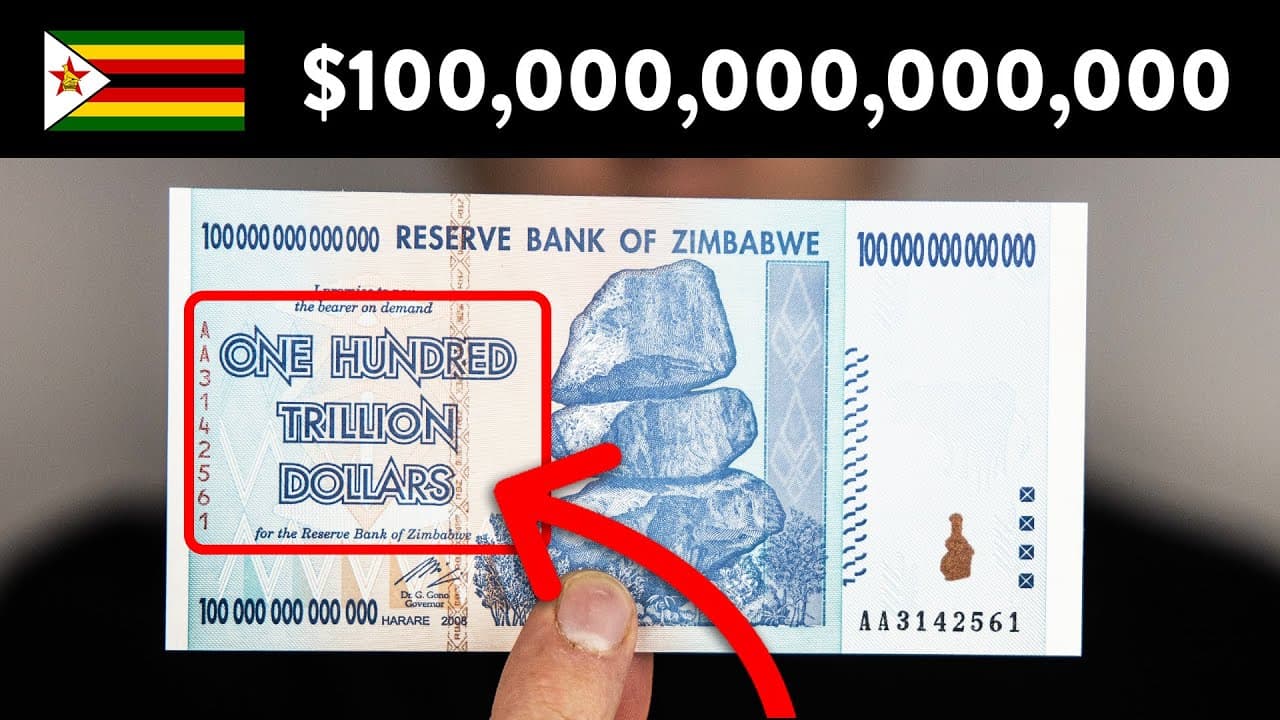
What Caused Zimbabwe's 100 Trillion Dollar Banknote?
TL;DR
Zimbabwe's 100 trillion dollar banknote emerged from hyperinflation driven by economic mismanagement, corruption, and excessive money printing under Robert Mugabe's regime. By 2008, inflation soared to an estimated 79.6 billion percent, rendering the currency nearly worthless and leading to the issuance of astronomical banknotes as a misguided attempt to address the crisis.
Transcript
i've got something cool to show you guys today something that came in the mail just the other day most people wouldn't get excited about this but i'm actually pretty excited about it i'll show you a close-up this is it that right there is a 100 trillion dollar zimbabwean banknote now what's special about this is it is the highest denomination bankn... Read More
Key Insights
- 🤑 Zimbabwe's hyperinflation crisis stemmed from economic mismanagement, corruption, and excessive money printing.
- 🏝️ Land reforms and political decisions under Robert Mugabe's rule worsened the economic situation in Zimbabwe.
- 💵 The 100 trillion dollar banknote symbolizes the peak of hyperinflation, backed by severe currency devaluation.
- 💱 Government attempts to curb hyperinflation with new currency regimes and measures like weekly auctions of foreign currencies.
- 😋 Hyperinflation in Zimbabwe led to food shortages, collapse of sectors, soaring unemployment, and widespread economic challenges.
- 💵 The 100 trillion dollar banknote holds novelty or collector's value, fetching higher prices as a historical artifact.
- 🥺 Reintroduction of the Zimbabwean dollar in 2019 initially led to high inflation rates, requiring measures to stabilize the currency.
Install to Summarize YouTube Videos and Get Transcripts
Explore YouTube Video Summarizer or Get YouTube Transcript Extractor
Questions & Answers
Q: What were the key factors contributing to Zimbabwe's hyperinflation crisis?
Zimbabwe's hyperinflation crisis was fueled by economic mismanagement, land reforms, corruption, and excessive money printing, eroding the currency's value rapidly.
Q: How did the government respond to hyperinflation, and what were the consequences?
The government printed higher denomination banknotes, worsening hyperinflation and eroding people's purchasing power, ultimately leading to the 100 trillion dollar banknote.
Q: What impact did hyperinflation have on Zimbabwean citizens and the economy?
Hyperinflation in Zimbabwe resulted in astronomical inflation rates, eroding people's salaries rapidly, causing food shortages, collapsing sectors like banking and manufacturing, and soaring unemployment rates.
Q: How did the introduction of a new Zimbabwean dollar in 2019 affect inflation?
The introduction of the new Zimbabwean dollar in 2019 initially led to high inflation rates, prompting the government to implement measures like weekly auctions of foreign currencies to curb inflation.
Summary & Key Takeaways
-
Zimbabwe's hyperinflation crisis began in 2000, escalating to 2008 due to economic mismanagement and land reforms.
-
Robert Mugabe's rule, corruption, and excessive money printing worsened hyperinflation, eroding the currency's value rapidly.
-
Government's response to hyperinflation was printing higher denomination banknotes, leading to the 100 trillion dollar banknote.
Read in Other Languages (beta)
Share This Summary 📚
Summarize YouTube Videos and Get Video Transcripts with 1-Click
Try YouTube Summary with ChatGPT & Claude or YouTube Transcript Generator
Explore More Summaries from New Money 📚



Summarize YouTube Videos and Get Video Transcripts with 1-Click
Try YouTube Summary with ChatGPT & Claude or YouTube Transcript Generator