Why Are Speculative Stocks Becoming Too Risky?
TL;DR
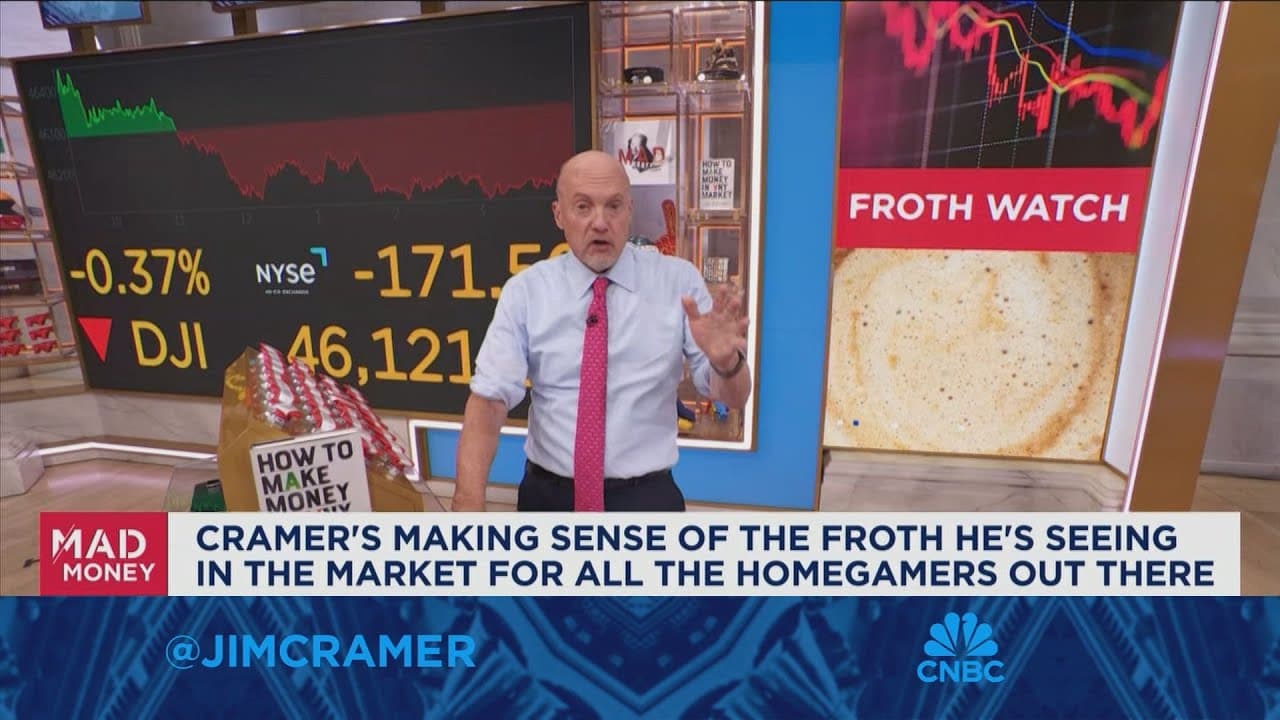
Speculative stocks deserve greater caution when prices soar without profits, revenue, or near-term business results to support them. Jim Cramer says investors may still hold one carefully chosen speculative position in a five-stock portfolio, but they must be prepared to lose the entire investment because a sharp decline from elevated levels can be devastating.
Transcript
All right. Thanks for watching. Fast Mad Money starts right now. >> Hey I'm Cramer. >> Welcome to Mad Money. Welcome to Cramerica. Other people make friends I'm just trying to save a little money. My job is not just to entertain you but to educate to teach you. So call me at one 807 43 CNBC or tweet me JimCramer. All right it's time. We need to ... Read More
Key Insights
- • Speculative-stock risk is highest when soaring prices are unsupported by profits, meaningful revenue, or visible near-term business results. Cramer says years of losses matter more now because elevated valuations leave investors vulnerable to severe reversals.
- • The broader S&P 500 is valued at roughly 25 times this year's earnings and 22 times next year's earnings. Cramer considers that valuation high but tolerable because earnings are increasing and could make the market appear cheaper next year.
- • Federal Reserve Chair Jay Powell's statement that equity prices are fairly highly valued helped change Cramer's outlook. Cramer believes the warning applies especially strongly to speculative companies whose valuations have moved far beyond what current earnings can justify.
- • A September momentum screen found 55 United States-listed stocks worth more than $500 million that had risen at least 50% during the month. Only six were profitable, which Cramer presents as evidence of widespread and concerning speculation.
- • Oklo's intraday reversal is a warning sign because positive news about a $1.68 billion Tennessee facility failed to preserve the stock's momentum. The shares reached 144 before finishing at 131, despite having gained 518% for the year.
- • Nuclear-power stocks can rise much faster than their businesses develop because constructing a new nuclear plant in the United States can take a decade. Cramer therefore questions Energy Fuels' gain of more than 215% for the year despite his support for nuclear power.
- • Quantum-computing companies may have compelling long-term prospects, but several continue losing substantial amounts of money. IonQ was up 77% for the year, while D-Wave had risen 230%, even though Cramer says their businesses could take ages to develop.
- • Portfolio speculation should be limited to one carefully selected risky stock within a five-stock portfolio. Cramer maintains this rule but says investors must recognize that some positions are now appropriate only if they can accept losing the entire investment.
Install to Summarize YouTube Videos and Get Transcripts
Explore YouTube Video Summarizer or Get YouTube Transcript Extractor
Questions & Answers
Q: Why are speculative stocks becoming too risky?
Speculative stocks are becoming too risky because many have soared despite producing little revenue, minimal profit, or years of losses. Elevated prices make investors more vulnerable to sharp declines when momentum weakens. Cramer also points to Jay Powell's observation that equity prices are fairly highly valued and to a screen showing that only six of 55 rapidly rising stocks were profitable.
Q: How many speculative stocks should a five-stock portfolio contain?
A five-stock portfolio can contain one speculative stock under Cramer's general guideline, provided the investment is chosen wisely and the investor understands the potential loss. He does not abandon that rule, but he becomes more selective about which companies qualify. At elevated prices, investors should speculate only when they are financially and emotionally prepared to lose the entire position.
Q: What did the September speculative-stock screen reveal?
The screen examined United States-listed stocks valued above $500 million that had gained at least 50% during September. It produced 55 names, but only six of those companies were profitable. Cramer considers that imbalance ridiculous and worrisome because it shows that rapid price appreciation was concentrated largely among companies without earnings to support their rising market values.
Q: Why does Jim Cramer view Oklo's reversal as a warning?
Oklo received favorable headlines concerning a $1.68 billion Tennessee facility where nuclear waste would be recycled into fuel for advanced reactors. Its shares reached a high of 144 but reversed and finished at 131. Cramer regards that failure to maintain momentum after good news as a bad sign, especially after the stock had already climbed 518% for the year.
Q: Why is Energy Fuels considered a speculative stock?
Energy Fuels is considered speculative because it loses money while its stock repeatedly reaches new highs. Its shares had risen more than 215% for the year, even though Cramer does not expect a near-term nuclear-power renaissance. He notes that building a new nuclear plant in the United States can take a decade, creating a mismatch between the stock's rapid rise and the industry's development timeline.
Q: Should investors buy crypto-linked stocks instead of crypto?
Cramer says investors seeking cryptocurrency exposure should buy crypto rather than companies designed to imitate the strategy of the business formerly called MicroStrategy and now called Strategy. These derivative plays depend on cryptocurrency continuing to rise. His stated view is that the best way to play crypto is with crypto, rather than adding company-specific risks through speculative stock substitutes.
Q: Why are quantum-computing stocks considered long-term speculations?
Quantum-computing companies may eventually build valuable businesses, but Cramer says their current cases rely heavily on hope and distant potential. IonQ had risen 77% for the year, and D-Wave had gained 230%, while both were losing substantial amounts of money. Rigetti Computing and Quantum Computing were also identified as money losers, so meaningful commercial development could still be ages away.
Q: What is the danger of a major speculative-stock decline?
A major decline from elevated levels can crush investors who cannot recover the lost capital, particularly if they concentrated too much money in risky names. Cramer warns that the experience could cause people to abandon stock ownership altogether, as some did after the market collapse in 2000. That reaction could prevent them from benefiting from the stock market over the long term.
Summary & Key Takeaways
-
Jim Cramer changes his stance on speculative stocks after Federal Reserve Chair Jay Powell describes equity prices as fairly highly valued. Although the S&P 500 trades at roughly 25 times current-year earnings and 22 times next-year earnings, Cramer sees greater danger among companies with little revenue, minimal profit, or persistent losses.
-
A screen of United States-listed companies valued above $500 million found 55 stocks that had gained at least 50% during September, but only six were profitable. Cramer identifies nuclear power, crypto derivatives, quantum computing, AI data-center pivots, flying vehicles, drones, rockets, and clinical-stage biotechnology as speculation-heavy areas requiring caution.
-
Cramer retains his guideline allowing one speculative stock in a five-stock portfolio, provided the investment is selected wisely and the investor understands the downside. He plans to become more circumspect, warning that some elevated stocks are suitable only for people prepared to lose their entire investment during a major reversal.
Read in Other Languages (beta)
Share This Summary 📚
Summarize YouTube Videos and Get Video Transcripts with 1-Click
Try YouTube Summary with ChatGPT & Claude or YouTube Transcript Generator
Explore More Summaries from CNBC Television 📚


Summarize YouTube Videos and Get Video Transcripts with 1-Click
Try YouTube Summary with ChatGPT & Claude or YouTube Transcript Generator