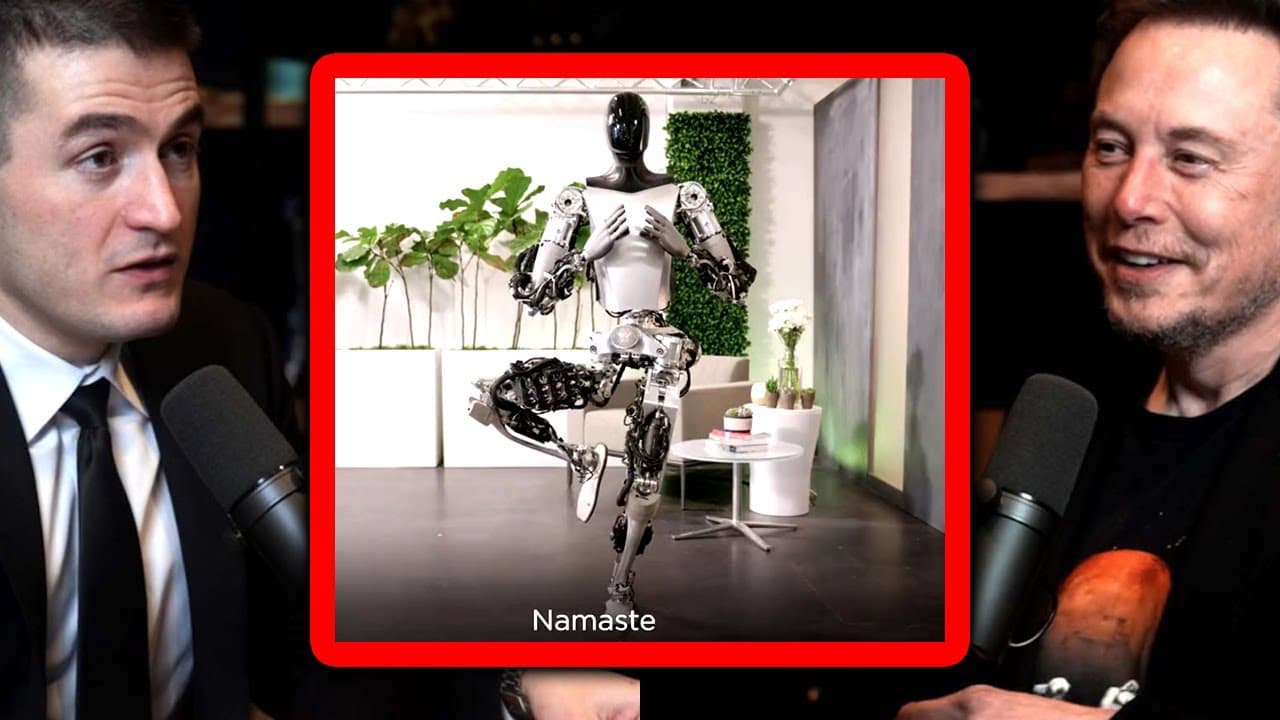
How is Tesla Developing the Optimus Humanoid Robot?
TL;DR
Tesla's Optimus humanoid robot is built from the ground up, requiring custom motors and sensors as no suitable off-the-shelf components exist. The goal is to produce a cost-effective robot with advanced manipulation skills, capable of delicate tasks like threading a needle.
Transcript
what have you learned about uh developing Optimus about applying integrating this kind of real world AI into the space of robotic manipulation just humanoid robotics what are some interesting tiny or big things you've understood I was surprised at the fact that we had to develop every part of the robot ourselves um that there were no of shelf Motor... Read More
Key Insights
- 🤖 Developing a humanoid robot like Optimus involves creating each component, including motors and sensors, from scratch.
- 🤖 Existing electric motors designed for other purposes are not suitable for humanoid robots.
- 😨 Optimus aims to be cost-effective, with a manufacturing process similar to cars.
- 🍦 It has advanced manipulation capabilities, including soft touch robotics and delicate tasks such as threading a needle.
- 😤 The team is optimistic that the learnings from developing Optimus can be applied to other robotic projects, particularly in perception and control systems.
- 😌 The challenge lies in designing a humanoid robot that is both mass-manufacturable and relatively inexpensive.
- 🖐️ Optimus has been designed to have hands and fingers capable of intricate manipulation tasks.
- 🎙️ More videos with Elon Musk:
Install to Summarize YouTube Videos and Get Transcripts
Explore YouTube Video Summarizer or Get YouTube Transcript Extractor
Questions & Answers
Q: What challenges did the team face in developing Optimus?
The team had to develop every part of Optimus themselves since there were no off-the-shelf components available, including motors and sensors. They couldn't find suitable electric motors designed for humanoid robots.
Q: How was the design of Optimus different from other mass-manufactured robots?
Optimus was designed to be manufactured in a similar way to cars. Despite having advanced manipulation capabilities, Optimus is expected to be less expensive than a car due to its smaller size and fewer actuators.
Q: Can Optimus perform delicate tasks like picking up a needle and threading it?
Yes, Optimus has advanced hands and fingers capable of soft touch robotics. It is projected that Optimus will be able to pick up a needle and thread it just by visually observing in about a year.
Q: How can the learnings from developing Optimus be applied to other robotics projects?
The team believes that the work done in the car industry, such as perception and control systems, can be translated to humanoid robots like Optimus. Although the controls may differ, the overall learning process can be adapted.
Summary & Key Takeaways
-
Developing Optimus required creating all components, including motors and sensors, from scratch.
-
Electric motors designed for other applications were not suitable for humanoid robots.
-
Optimus aims to be cost-effective and has advanced manipulation capabilities, including soft touch robotics.
Read in Other Languages (beta)
Share This Summary 📚
Summarize YouTube Videos and Get Video Transcripts with 1-Click
Try YouTube Summary with ChatGPT & Claude or YouTube Transcript Generator
Explore More Summaries from Lex Clips 📚




Summarize YouTube Videos and Get Video Transcripts with 1-Click
Try YouTube Summary with ChatGPT & Claude or YouTube Transcript Generator