What Are Target Networks and Replay Memory in Deep Q Learning?
TL;DR
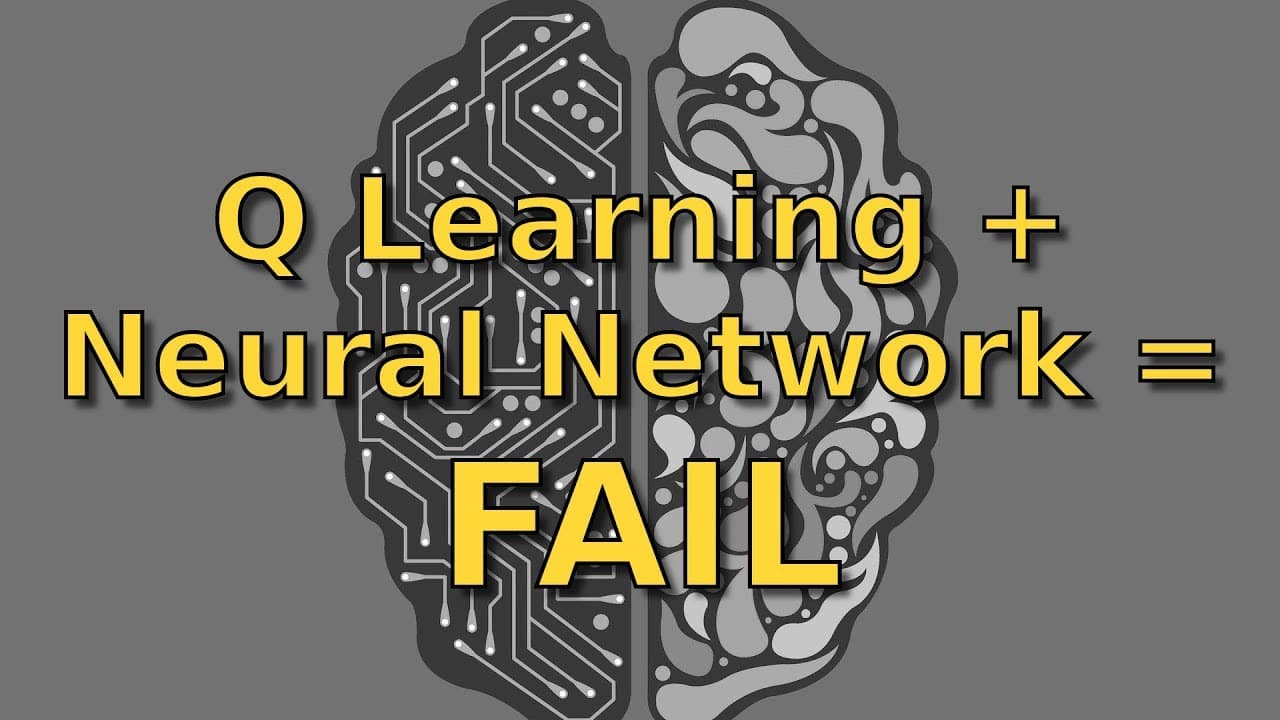
Target networks and replay memory are essential in Deep Q Learning to stabilize training and improve performance. Target networks help reduce the oscillation of value estimates, while replay memory allows the agent to learn from past experiences effectively, addressing issues like local minima and biased action evaluations. Together, they enhance the agent's ability to make better decisions over time.
Transcript
what is up everybody cyber monday has come early my new course is on sale for $9.99 for the next five days hit the link in the description and pin comment or you can find the course on your own and apply coupon code cyber monday 19 all caps please check out this free preview of the naive DQ Learning Network from scratch and I hope to see you inside... Read More
Key Insights
- 👾 Deep neural networks are essential for handling large or continuous state spaces in reinforcement learning environments.
- 🇨🇷 Deep Q Networks can approximate action value functions and optimize costs by adjusting model parameters.
- 🏛️ Implementing a DQN requires separate classes for the network and agent, with specific parameters and functions.
- 🔂 Challenges in DQN implementation include the limited learning from a single example and the bias introduced by evaluating only the maximum action.
Install to Summarize YouTube Videos and Get Transcripts
Explore YouTube Video Summarizer or Get YouTube Transcript Extractor
Questions & Answers
Q: What is the purpose of deep neural networks in reinforcement learning?
Deep neural networks are necessary to handle large or continuous state spaces in reinforcement learning environments.
Q: How are deep Q networks used to approximate action value functions?
In DQ learning, inputs are passed to the model to compute the cost associated with the action taken by the agent. The model parameters are then adjusted to minimize this cost.
Q: What are the key components of the network class for implementing a DQN?
The network class should have linear layers with hidden layers of 128 neurons, an atom optimizer with a specified learning rate, and a mean squared error loss function.
Q: What functionality is included in the agent class for a DQN implementation?
The agent class includes functions for choosing actions, learning from experiences, and decreasing epsilon over time. It also instantiates a linear deep network as a cue function.
Summary & Key Takeaways
-
The video discusses the need for deep neural networks to handle large or continuous state spaces in reinforcement learning.
-
Deep Q Networks (DQNs) can be used to approximate action value functions and minimize costs by varying model parameters.
-
The content provides coding instructions for implementing a DQN for an agent, including network and agent classes.
Read in Other Languages (beta)
Share This Summary 📚
Summarize YouTube Videos and Get Video Transcripts with 1-Click
Try YouTube Summary with ChatGPT & Claude or YouTube Transcript Generator
Explore More Summaries from Machine Learning with Phil 📚


Summarize YouTube Videos and Get Video Transcripts with 1-Click
Try YouTube Summary with ChatGPT & Claude or YouTube Transcript Generator