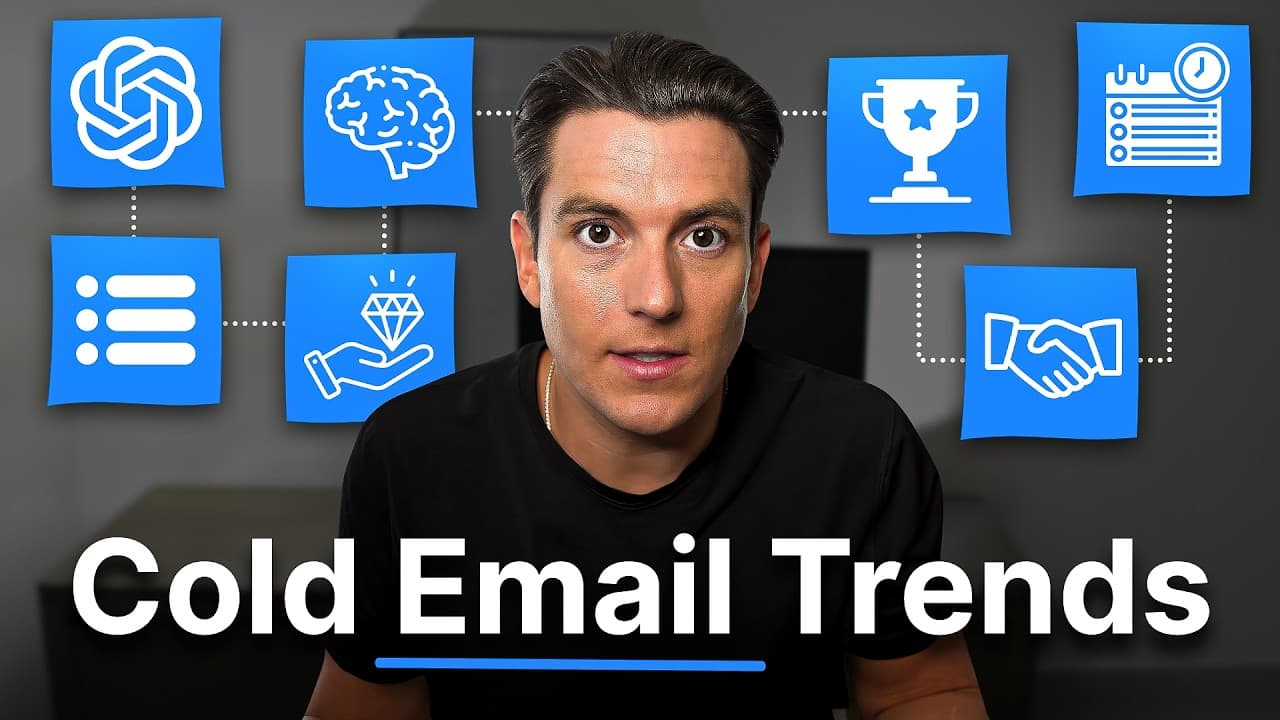
7 Cold Email Trends to Get More Clients in 2025
TL;DR
Cold email is not dead; businesses using it correctly are succeeding more than ever. The 2025 winners rely on AI personalization at scale, hyper-niche micro lists, value-first outreach, deliverability protocols, social proof, shorter permission-based emails under 100 words, and multi-channel follow-up across LinkedIn, phone, and SMS.
Transcript
Cold email is changing this year. And no, cold email is not dead. In fact, businesses that are using cold email the right way and understanding trends and using that to their advantage are having more success than ever. We've used cold email to scale two businesses to multiple seven figures. And in fact, in the last 2 months, we've generated over $... Read More
Key Insights
- Generic personalization is dead because everyone does it and prospects instantly recognize automation and delete emails before reading. Tools like Instantly merge data scraping with AI writing to personalize lines at scale, which raises response rates.
- Hyper-niche targeting means breaking one massive list into five or ten micro lists based on variables like revenue range, recent funding, or specific city, so copy, offers, and case studies resonate with each segment.
- Value-first outreach leads with genuine value instead of pitching a 30-minute call immediately. Offering a loom audit, a workshop invite, or a podcast guest spot builds trust and gets prospects to raise their hand.
- Deliverability-first thinking matters because your copy and offer are worthless if the email never lands in the inbox. Email providers filter stricter, so warm-up protocols and DKIM, SPF, and DMARC records are essential.
- Social proof is the highest persuasion technique because consumer trust is at an all-time low and cold email is faceless. Collect customer wins, screenshots, and case studies and never send a cold email without leveraging proof.
- Shorter permission-based emails win in 2025, ideally under 100 or even 50 words. Each line should be one sentence, and the call to action asks permission to send something of value rather than demanding a booked call.
- Long-winded introductions are now seen as spam, and prospects scan emails rather than read them, so short readable copy makes it easy for the person to say yes and feel a sense of control instead of being sold to.
- Multi-channel follow-up outperforms cold email in isolation. The highest-performing campaigns orchestrate LinkedIn, email, phone, and SMS together to increase the likelihood of getting a response from prospects.
Install to Summarize YouTube Videos and Get Transcripts
Explore YouTube Video Summarizer or Get YouTube Transcript Extractor
Questions & Answers
Q: Is cold email dead in 2025?
No, cold email is not dead. Businesses that use cold email the right way, understand current trends, and use them to their advantage are having more success than ever. The creator states they used cold email to scale two businesses to multiple seven figures and generated over $60,000 from cold email alone in the last two months, proving it still works when done correctly.
Q: How do you personalize cold emails at scale with AI?
Generic personalization is dead because prospects recognize automation and delete emails before reading them. Tools like Instantly merge data scraping with AI writing to create true personalization at scale. Using an open API connection, you can write a personalized line based on the columns from your list in two clicks and write your own prompt. Hyper-personalization using researched, scraped data has made response rates soar.
Q: What is hyper-niche targeting in cold email?
Hyper-niche targeting means creating multiple micro lists instead of blasting one massive generic list. A big mixed list forces you to be a generalist. Instead, split a list of 50,000 into five or ten lists based on variables like companies from zero to one million in revenue, recent funding, or a specific city. Then create multiple campaigns and write copy tailored to each list's pain points and case studies.
Q: Why should you lead with value in cold outreach?
Value-first outreach works because consumer trust is at an all-time low and cold email is faceless, making trust hard to build. Instead of pitching a 30-minute call immediately, lead with genuine value like a loom audit, a workshop invitation, or a podcast guest spot. This frictionless approach creates reciprocity, builds relationships, gets prospects to raise their hand, and naturally opens the door to more booked calls.
Q: How do you make cold emails land in the inbox instead of spam?
Deliverability-first thinking is critical because your copy and offer do not matter if the email never lands in the inbox. Email service providers filter stricter every year, so blasting from a personal email leads to spam. Use a tool like Instantly to warm up emails, build sender credibility, and handle technical setup like DKIM, SPF, and DMARC records, plus sender reputation management, so you can send 1,500 to 2,000 emails daily.
Q: Why is social proof important in cold emails?
Social proof is the highest persuasion technique because consumer trust is at an all-time low and cold email is faceless, so prospects do not know who you are. Start collecting proof by documenting the wins you get for customers through case studies, long-form videos, and screenshots. Then leverage that proof with copywriting aimed at the specific pain point of your targeted list. Never send a cold email without proof, since it accelerates trust.
Q: How long should a cold email be in 2025?
Shorter is better in 2025, ideally less than 100 words and even less than 50 words. Long-winded introductions are now seen as spam. Each line should be one sentence covering a personalized line, your offer, proof, and a call to action. Because consumers scan emails, short readable copy makes the highest impact and makes it easy for the person to say yes and raise their hand.
Q: What is a permission-based call to action in cold email?
A permission-based call to action asks the prospect for permission to send them something of value rather than demanding a booked call. Instead of asking to book a call at 2 p.m. the next day, you ask permission to send an offer, proof, or personalized resource. This creates a sense of control for the consumer rather than feeling sold to, which the creator says is a massive game-changer that generates more responses.
Summary & Key Takeaways
-
Cold email is not dead; the creator scaled two businesses to multiple seven figures and generated over $60,000 from cold email in the last two months. The video reveals seven key trends after sending millions of cold emails and studying the latest changes.
-
The first three trends are AI personalization at scale using scraped data and tools like Instantly, hyper-niche targeting by splitting big lists into specific micro lists, and value-first outreach that offers something genuinely useful like an audit or workshop invite instead of an immediate sales pitch.
-
The remaining trends are deliverability-first thinking with warm-up and technical records, leveraging social proof and case studies, writing shorter permission-based emails under 100 words with one-sentence lines, and using multi-channel follow-up across LinkedIn, email, phone, and SMS to maximize responses.
Read in Other Languages (beta)
Share This Summary 📚
Summarize YouTube Videos and Get Video Transcripts with 1-Click
Try YouTube Summary with ChatGPT & Claude or YouTube Transcript Generator
Explore More Summaries from Instantly 📚
Summarize YouTube Videos and Get Video Transcripts with 1-Click
Try YouTube Summary with ChatGPT & Claude or YouTube Transcript Generator