S4E2: Google DeepMind’s Dr. Claire Cui on The Next Frontier for Large Language Models
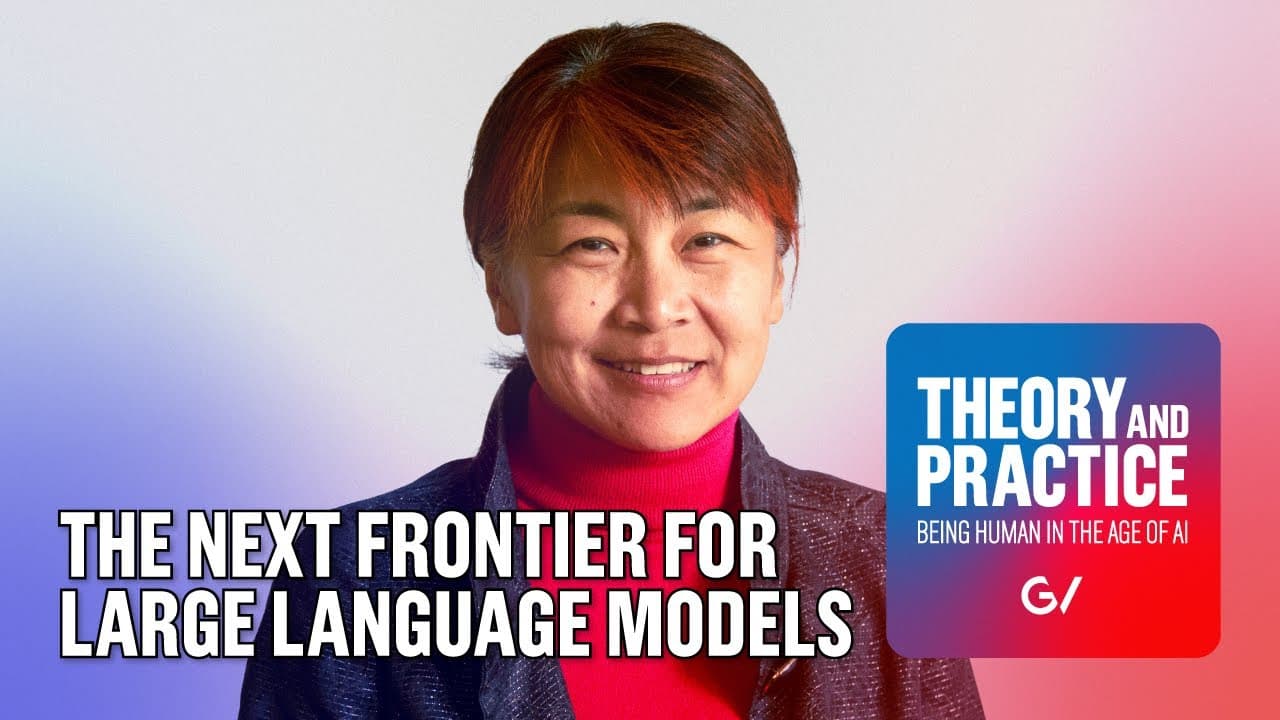
TL;DR
The development of large language models like Google's Bard and advancements in algorithms, data sets, and compute have led to chatbots becoming more human-like and empathic in their conversations.
Transcript
hello welcome to GV theory and practice this series is exploring what it means to be human in the age of human-like AI I'm Anthony filipakis and I'm Alex wilchko this is our second episode today and we'll be exploring Ai and communication yes I mean the AI driven chat Bots like Google bard Chachi BT and I others like it that everyone is talking abo... Read More
Key Insights
- 😫 Advancements in algorithms, data sets, and compute have made chatbots more human-like and empathic in their conversations.
- 🚂 Training large language models on vast amounts of internet data enables them to learn how to predict the next word and generate coherent and fluent responses.
- 👨🔬 Grounding chatbots in real-world knowledge and improving their introspection and confidence in responses are ongoing research areas.
- ❓ Enhancing efficiency, developing modular structures, and integrating multimodal learning can further advance chatbot capabilities.
- 💁 Implementing chatbots in clinical medicine can improve documentation, assist with information retrieval, and enhance patient-physician interactions.
- 🦺 Ethical considerations, data privacy, and safety measures are crucial in the development and implementation of chatbots.
Install to Summarize YouTube Videos and Get Transcripts
Explore YouTube Video Summarizer or Get YouTube Transcript Extractor
Questions & Answers
Q: How have developments in algorithms and data sets improved the human-like capabilities of chatbots?
Algorithms like self-supervised learning and the Transformer architecture have allowed large language models to learn from massive amounts of data, enabling them to generate more accurate and fluent responses.
Q: Can chatbots accurately handle complex tasks like deduction and reasoning?
While chatbots excel in pattern recognition and generation, they still struggle with accurate deduction and reasoning. Ongoing research aims to improve these capabilities and develop more intelligent approaches to utilize various tools for problem-solving.
Q: How can chatbots provide more grounded and factual responses?
Current chatbots often lack grounding in real-world knowledge. Methods like simulating physical environments and integrating fresh and updated data can help chatbots provide more accurate and factual responses.
Q: What are the challenges in implementing chatbots in clinical medicine?
Chatbots can play a significant role in improving clinical documentation, summarizing patient-physician encounters, and assisting with tasks like family history assessment. However, ensuring the safety, accuracy, and trustworthiness of chatbot-generated information remains a challenge.
Summary & Key Takeaways
-
Large language models like Bard and ChatGPT are trained on vast amounts of data from the internet, enabling them to learn how to predict the next word and generate human-like responses.
-
Self-supervised learning and the Transformer architecture have been key breakthroughs in improving the capabilities of these models.
-
The challenge now is to improve their grounding in real-world knowledge, enhance their introspection and confidence in responses, and develop more efficient and modular structures for different modalities.
Read in Other Languages (beta)
Share This Summary 📚
Summarize YouTube Videos and Get Video Transcripts with 1-Click
Try YouTube Summary with ChatGPT & Claude or YouTube Transcript Generator
Explore More Summaries from GV (Google Ventures) 📚






Summarize YouTube Videos and Get Video Transcripts with 1-Click
Try YouTube Summary with ChatGPT & Claude or YouTube Transcript Generator