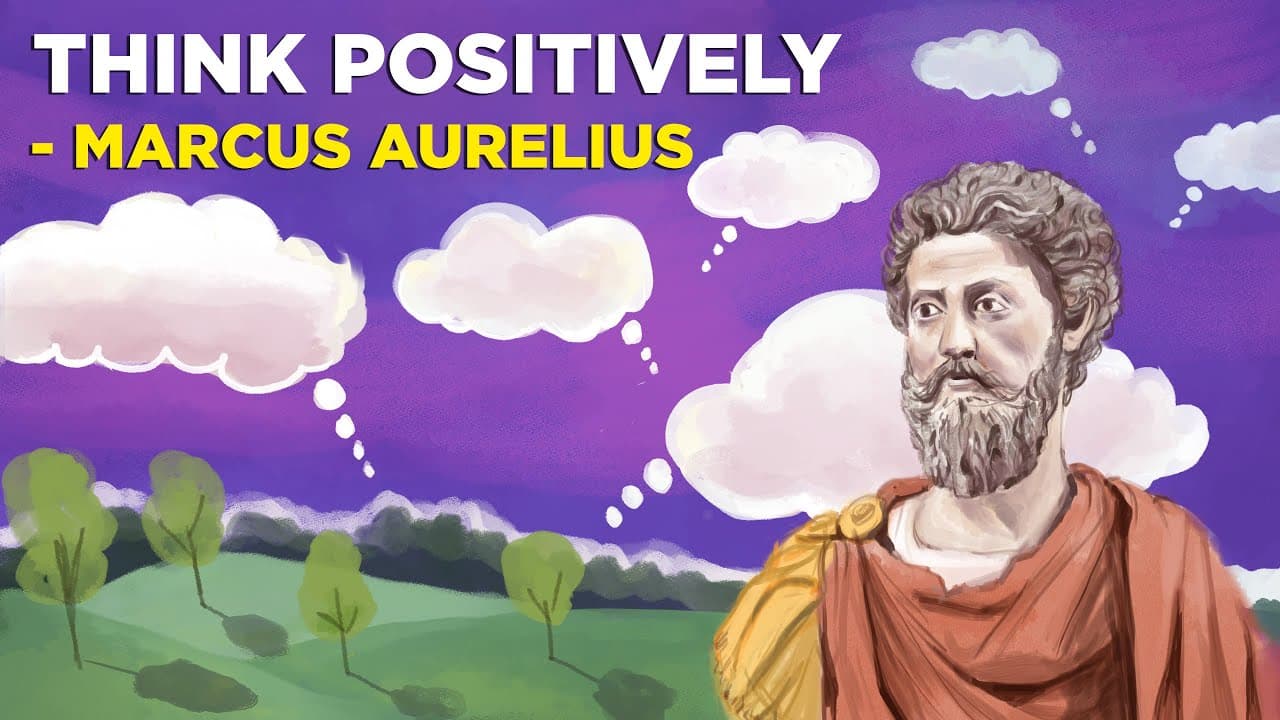
How To Think Positively - Marcus Aurelius (Stoicism)
TL;DR
Marcus Aurelius’ Stoicism teaches positive thinking by focusing on thoughts and actions within your control, accepting what you cannot control, and consciously reframing negative judgments. Practices such as Evening Reflection help identify thoughts that inspire action or hold you back. Read on to see how perception shapes behavior and how reflection can turn adversity into an opportunity for growth.
Transcript
Marcus Aurelius says “The happiness of your life depends on the quality of your thoughts.” Marcus Aurelius was a Roman Emperor from 161 to 180 AD and a very prominent figure within the philosophy of Stoicism. At its core, Stoicism teaches us to distinguish between what we can and cannot control and encourages us to focus on what we can control, whi... Read More
Key Insights
- 💭 Stoicism emphasizes focusing on thoughts and actions within one's control.
- 🤑 Transforming negative thoughts into positive ones empowers action and motivates growth.
- 🍵 Practicing Premeditatio Malorum prepares individuals to handle challenges with resilience.
- 🥹 Gratitude and living in the present moment contribute to a fulfilling and content life.
- 🤔 Marcus Aurelius' stoic wisdom emphasizes the power of positive thinking and acceptance of what cannot be changed.
- 🥺 Reflection on thoughts and conscious effort to transform them leads to personal growth and positive actions.
- 🥹 Actively seeking and recognizing gratitude promotes a positive mindset and strengthens relationships.
Install to Summarize YouTube Videos and Get Transcripts
Explore YouTube Video Summarizer or Get YouTube Transcript Extractor
Questions & Answers
Q: How does Marcus Aurelius teach you to think positively?
Focus on the thoughts and actions you can control, and accept what you cannot control. Examine negative judgments, question whether they reflect reality, and adopt perceptions that support constructive action.
Q: What does Stoicism say you can control?
Stoicism distinguishes between what you can and cannot control. Your thoughts and actions are mainly within your control, so directing attention toward them helps you shape your response to challenges.
Q: Why are thoughts important in Marcus Aurelius’ philosophy?
Marcus Aurelius says the quality of your thoughts determines the happiness of your life. Thoughts can either paralyze you with fear or inspire motivation, effort, and action.
Q: How can negative thoughts affect your actions?
Negative thoughts can reduce motivation, encourage complaining, and lead you to avoid people or situations. Fearful thoughts can also produce bodily effects such as increased adrenaline, shaking, and nervous breathing.
Q: How can you identify thoughts that are holding you back?
Pause and examine what you have been thinking through meditation, reflection, or journaling. Notice how each thought affected you and whether it helped you move forward or prevented constructive action.
Q: What is the Stoic Evening Reflection?
Evening Reflection means setting aside a fixed amount of time in the evening to review the day’s thoughts. You consider their effects and the worldviews they represent, revealing which thoughts help you and which hold you back.
Q: How do you transform negative thoughts according to Stoicism?
Recognize that spontaneous thoughts often contain quick value judgments shaped by emotion, bias, and incomplete facts. Changing your perception can change your thoughts, making positive action easier.
Q: How does Stoicism help you handle adversity?
Stoicism encourages you to look for solutions and opportunities for growth instead of becoming overwhelmed by what lies beyond your control. Difficulties can then become chances to learn, adapt, and emerge stronger.
Summary & Key Takeaways
-
Definition: Stoicism distinguishes between what you can and cannot control, directing attention toward your thoughts and actions.
-
Who: Marcus Aurelius was a Roman Emperor and a prominent figure within Stoicism.
-
When: Marcus Aurelius ruled from 161 to 180 AD.
-
Definition: Meditations is the name given to the autobiographical writings Marcus Aurelius composed during his rule.
-
Definition: Evening Reflection reviews the day’s thoughts, their effects, and the worldviews they represent.
-
Tool: Meditation, reflection, and journaling help Stoics examine what happens in their minds.
-
Compare: Fearful thoughts can discourage action, while motivating thoughts can inspire action and hard work.
-
Definition: Negative judgments often reflect perception shaped by emotions and bias, rather than complete facts.
-
Compare: Complaining consumes energy that could otherwise support positive action.
-
Definition: Constructive thinking treats adversity as an opportunity to learn, adapt, and emerge stronger.
Read in Other Languages (beta)
Share This Summary 📚
Summarize YouTube Videos and Get Video Transcripts with 1-Click
Try YouTube Summary with ChatGPT & Claude or YouTube Transcript Generator
Explore More Summaries from Philosophies for Life 📚

Summarize YouTube Videos and Get Video Transcripts with 1-Click
Try YouTube Summary with ChatGPT & Claude or YouTube Transcript Generator