How to Effectively Take Notes While Reading
TL;DR
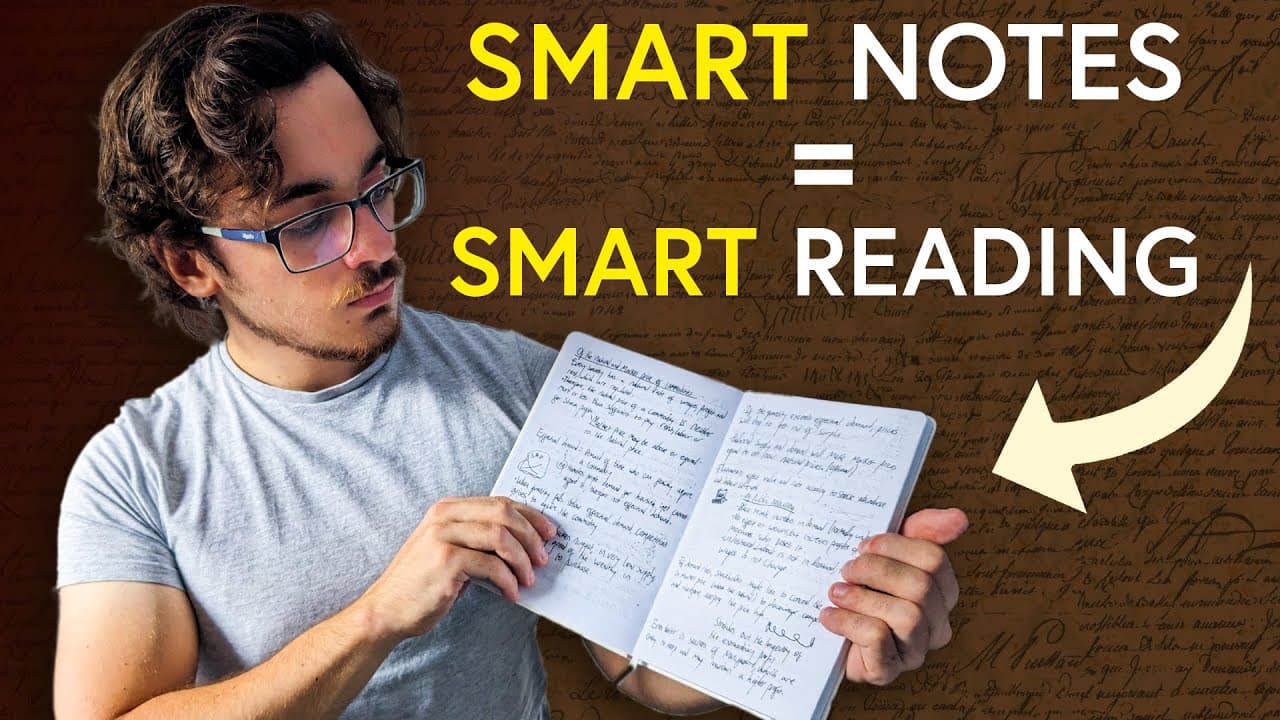
To effectively take notes while reading, use techniques such as underlining key sentences, writing in the margins, and marking important actionable advice with exclamation points. Return to your notes for processing and integration into your overall understanding to enhance engagement and memory retention. The most effective note-taking system is personalized, so explore different methods to find what works best for you.
Transcript
a book is not truly yours until you have written it because of course when we buy a book off the shelf it becomes our property but only once we put pen to paper and externalized our thinking process onto the book itself and our notes only then does it become intellectual property it becomes part of our mind part of our understanding our knowledge a... Read More
Key Insights
- 🤯 Note-taking helps with active reading, engagement, and focusing our minds on the material.
- 💁 Different techniques like underlining, writing icons, and forming connections enable effective note-taking.
- 🎵 Processing and integrating notes into our broader understanding is crucial for consolidating learning.
- 🛀 Being selective in underlining and highlighting important passages prevents excessive and meaningless note-taking.
- 🥳 Writing icons and exclamation points help identify the most significant parts and actionable advice, respectively.
- 🤩 Marking sequences of related points and circling key terms aid in organizing and understanding the content.
- 🤔 Referencing connections between ideas and asking questions help deepen comprehension and critical thinking.
Install to Summarize YouTube Videos and Get Transcripts
Explore YouTube Video Summarizer or Get YouTube Transcript Extractor
Questions & Answers
Q: How does note-taking contribute to active reading?
Note-taking engages our minds, forces us to translate information into our own words, and helps us focus on the material, ensuring active reading rather than passive passivity. It allows us to have a dialogue with the author.
Q: Why is it important to go back to the notes and process them?
Writing notes is just the first step. We need to revisit them, reflect on the content, and integrate it into our knowledge network. Only by doing so can we truly understand and apply what we have learned.
Q: What are some dangers of underlining?
Underlining can become excessive and lose its meaning if we underline everything. Selectivity is key, and we should only underline information that truly matters and will be useful later in our learning process.
Q: How can note-taking be more beneficial for practical books?
For practical books, such as those on personal finance or fitness, using exclamation points to mark actionable advice can help identify concrete steps to apply in real life. This technique ensures that we don't just gather theoretical knowledge, but also take action based on what we learn.
Summary & Key Takeaways
-
Note-taking allows for active reading, helps us engage with the author, and enhances our understanding by filling gaps and patching holes in our knowledge.
-
Writing notes is only useful if we go back to them, process them, and integrate them into our broader understanding.
-
Different note-taking techniques include underlining important sentences, writing vertical notes for longer passages, using icons for the most significant parts, and marking actionable advice with exclamation points.
Read in Other Languages (beta)
Share This Summary 📚
Summarize YouTube Videos and Get Video Transcripts with 1-Click
Try YouTube Summary with ChatGPT & Claude or YouTube Transcript Generator
Explore More Summaries from Odysseas 📚




Summarize YouTube Videos and Get Video Transcripts with 1-Click
Try YouTube Summary with ChatGPT & Claude or YouTube Transcript Generator