How Does Cosmic Thinking Clarify Our Reality?
TL;DR
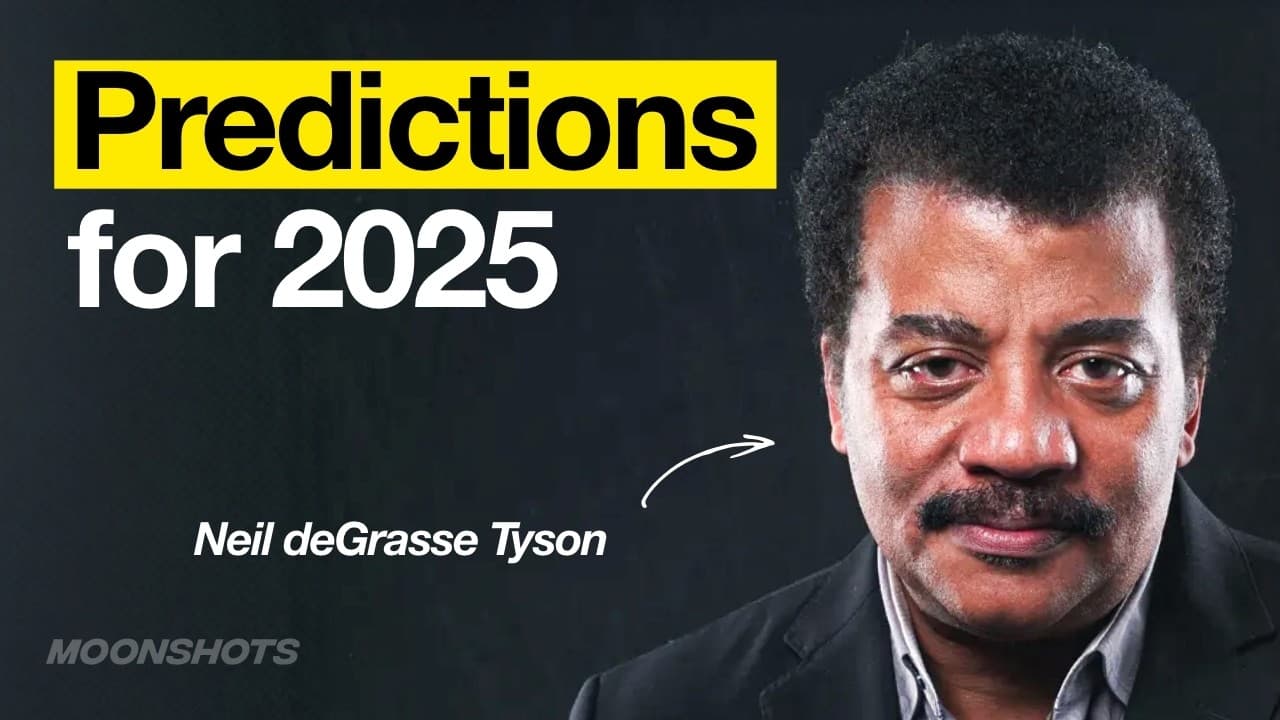
Scientific analysis and a cosmic perspective can expose assumptions, reveal alternatives, and reduce conflicts built around rigid opinions. Humanity also struggles because brains accustomed to linear thinking must navigate exponential change, making future developments difficult to anticipate and requiring curiosity, flexibility, and careful reasoning.
Transcript
our brains are wired for linear thinking in an exponential world and it's causing us a great deal of strife this linear thinking prevents you from realizing a possible future that awaits you this is a rich country we can do whatever we want if we all agree to it so it's really not a matter of a budget it's a matter of what is motivating us 1908 the... Read More
Key Insights
- Scientific analysis is a method for examining assumptions behind subjects that divide people. Applying evidence and a cosmic perspective can uncover positions above familiar disagreements, showing that both sides may be wrong or that another interpretation can reduce conflict.
- Galileo’s telescope observations are examples of evidence overturning established ideas. He reported phases of Venus, a cratered Moon, and spots on the Sun, challenging beliefs in perfect heavenly bodies and contributing to a changed understanding of Earth’s place.
- Inflexible authority is a source of conflict when evidence challenges accepted doctrine. Tyson describes Galileo’s house arrest as a cautionary example of what can happen when disruptive observations confront institutions unwilling to revise their understanding.
- Human thinking is adapted to linear patterns while technological change can be exponential. Diamandis argues that this mismatch causes considerable strain because people may fail to recognize plausible futures developing through accelerating discovery and innovation.
- Long-range predictions are inherently unreliable even when they sound reasonable. Forecasts involving genome-matched drugs, self-driving electric cars, and solar-system exploration illustrate possible directions, but Tyson emphasizes that the only certainty is that such predictions will be wrong.
- National priorities are shaped by collective motivation as well as budgets. The discussion argues that a rich country can pursue major goals when people agree on them, making shared commitment central to deciding which ambitious projects receive support.
- Unconventional ambition is often necessary for transformative projects. Tyson says that accomplishing something like a private spaceflight competition requires a degree of craziness, framing departures from normal expectations as part of pursuing difficult ideas.
- XPRIZE is an organization that uses public, incentivized competitions to encourage technological development. Its stated mission is to produce radical breakthroughs benefiting humanity, connecting competitive structures with innovation, exploration, and the pursuit of ambitious solutions.
Install to Summarize YouTube Videos and Get Transcripts
Explore YouTube Video Summarizer or Get YouTube Transcript Extractor
Questions & Answers
Q: How can a cosmic perspective reduce social conflict?
A cosmic perspective places familiar disagreements within a wider frame and encourages people to test their assumptions scientifically. Tyson argues that subjects such as truth, race, identity, law, exploration, and risk can look different from above entrenched positions. That broader view may show that both parties are mistaken or reveal another interpretation that diffuses conflict.
Q: Why does linear thinking struggle with exponential change?
Linear thinking makes people expect change to proceed in familiar, steady increments, while exponential developments can accelerate beyond those expectations. Diamandis says this mismatch causes considerable strife and can prevent people from recognizing a possible future awaiting them. The challenge is therefore not simply technological change, but the difficulty of imagining its pace and consequences.
Q: What did Galileo’s observations change about astronomy?
Galileo reported that Venus has phases, the Moon has a pitted and cratered surface, and the Sun has spots. These observations challenged the accepted image of perfect, smooth heavenly bodies. Tyson describes them as messages from the universe showing that prevailing explanations might be incorrect and helping undermine the belief that Earth occupies the center of the known universe.
Q: Why was Galileo’s story presented as a cautionary tale?
Galileo’s findings conflicted with authorities committed to an established interpretation of reality, and Tyson says he ultimately died while under house arrest for his views. The story warns disruptive thinkers that evidence challenging rigid institutions can provoke punishment or discrediting. Tyson also notes that modern responses represent progress because they do not involve torture in a dungeon.
Q: Why are predictions about the year 2050 likely to be wrong?
Predictions extend current knowledge into a future shaped by discoveries and conditions that cannot be fully anticipated. The discussion imagines genome-based drugs without individual side effects, self-driving electric cars, and a solar system functioning as humanity’s backyard. Tyson’s central caution is that these projections may sound plausible, but their one dependable feature is that they will be wrong.
Q: What does motivation have to do with national budgets?
The discussion argues that a rich country can accomplish what it collectively chooses to pursue. From that perspective, the main constraint is not merely whether money exists, but what motivates citizens and decision-makers to allocate it. Agreement and shared priorities determine whether resources support ambitious scientific, technological, or social goals that might otherwise appear financially unattainable.
Q: How does XPRIZE encourage technological breakthroughs?
XPRIZE designs and hosts public competitions intended to encourage technological development. Its mission is to use incentivized competition to generate radical breakthroughs for humanity’s benefit. The conversation connects that model with private spaceflight and with the willingness to pursue difficult ideas that may initially appear unrealistic, unconventional, or too ambitious for ordinary institutions.
Q: What is the central idea of Star Messenger?
Star Messenger applies rational analysis, scientific thinking, and a cosmic perspective to subjects that commonly generate conflict. Its chapters address paired themes including truth and beauty, exploration and discovery, Earth and Moon, color and race, gender and identity, law and order, and risk and reward. The aim is to reveal overlooked perspectives above established opinions.
Summary & Key Takeaways
-
Neil deGrasse Tyson presents the universe as a source of evidence that can overturn accepted beliefs. Galileo’s observations challenged ideas about perfect heavenly bodies and Earth’s position, illustrating how new discoveries can conflict with inflexible authorities while expanding humanity’s understanding of reality.
-
Tyson argues that scientific analysis and a cosmic perspective can illuminate divisive subjects such as truth, identity, exploration, law, and risk. Looking from above established positions may reveal that both sides are mistaken or that another perspective can reduce conflict.
-
Peter Diamandis connects exponential technological progress with humanity’s tendency toward linear thinking. Predictions about distant futures remain unreliable, but curiosity, unconventional ambition, and incentivized competition can help people pursue discoveries that once appeared impossible and create breakthroughs intended to benefit humanity.
Read in Other Languages (beta)
Share This Summary 📚
Summarize YouTube Videos and Get Video Transcripts with 1-Click
Try YouTube Summary with ChatGPT & Claude or YouTube Transcript Generator
Explore More Summaries from Peter H. Diamandis 📚






Summarize YouTube Videos and Get Video Transcripts with 1-Click
Try YouTube Summary with ChatGPT & Claude or YouTube Transcript Generator