What Is Fool's Gold and How Can You Identify It?
TL;DR
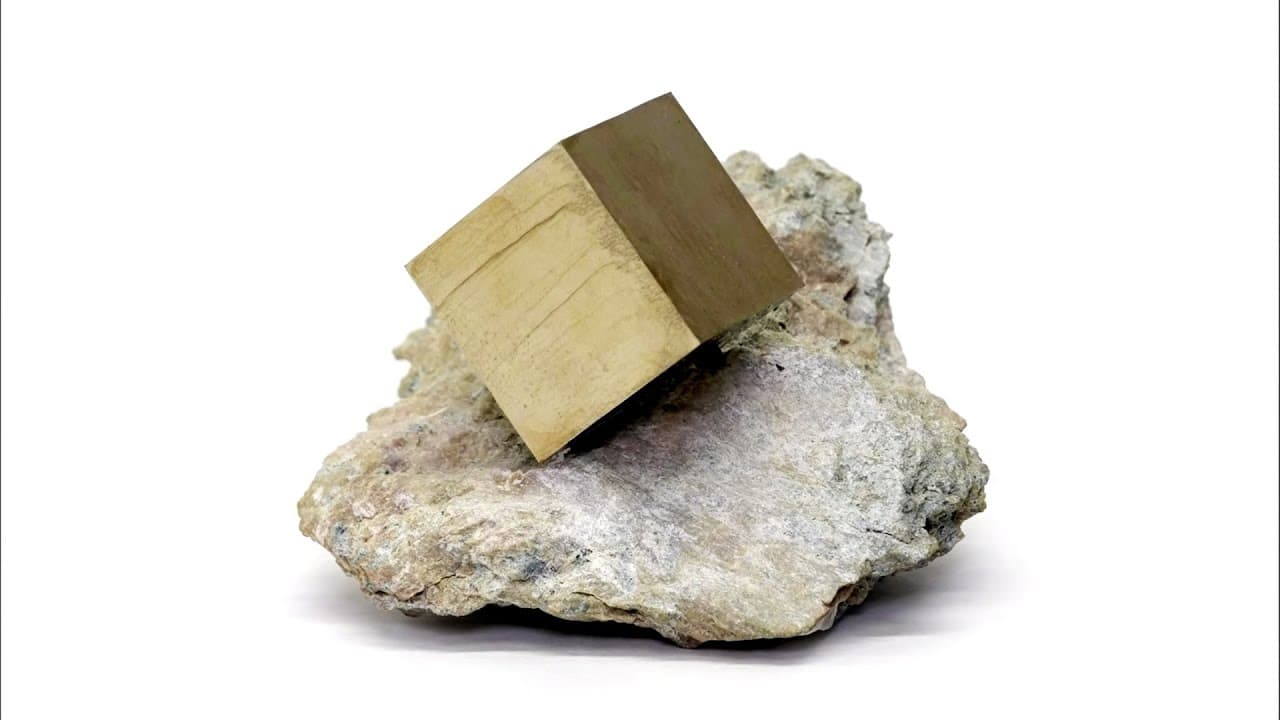
Fool's gold, or pyrite, is an iron disulfide mineral that resembles gold but is harder, more brittle, and less dense. It can be identified by its metallic luster and distinct crystalline structures, which differ based on environmental factors. While less valuable than gold, pyrite is a semiconductor with applications in electronics and batteries.
Transcript
This video has been sponsored by Nord VPN. Right now they're offering 75% off 3 year plans, as well as one month free, which you can get by going to nordvpn.com/nilered. As a kid I can sometimes remember looking through dirt, and finding little bits that looked almost like gold. And almost every time, I would get really excited thinking t... Read More
Key Insights
- 🏅 Pyrite, or fool's gold, is a fascinating compound with different crystalline structures depending on environmental conditions.
- 🏅 It closely resembles gold in appearance but differs in hardness, brittleness, and density.
- 🔋 Pyrite has semiconductor properties and finds applications in non-rechargeable batteries.
- 🫢 Heating pyrite accelerates its reaction with hydrochloric acid, producing Fe(ii)Cl and hydrogen sulfide gas.
- 🫢 Pyrite can crack or explode due to the release of sulfur gas during decomposition.
- 😒 The use of pyrite in industries such as electronics and sulfur production showcases its unique properties and potential.
- 😒 Pyrite is relatively affordable, allowing for easy access and use in experiments or collections.
Install to Summarize YouTube Videos and Get Transcripts
Explore YouTube Video Summarizer or Get YouTube Transcript Extractor
Questions & Answers
Q: What is fool's gold and how does it differ from real gold?
Fool's gold, or pyrite, is an iron disulfide compound that resembles gold in appearance. However, pyrite is harder, more brittle, and less dense than gold. It also forms sharp and highly ordered structures not found in gold.
Q: What are the environmental factors that affect the crystallization of pyrite?
Factors such as purity, time, pressure, and temperature influence the crystallization of pyrite. Different regions can produce varying crystal shapes and sizes.
Q: What are the applications of pyrite in the electronics industry?
Pyrite is classified as a semiconductor material and is used in non-rechargeable lithium batteries. Its properties make it suitable for certain electronic components.
Q: How does the reaction between pyrite and hydrochloric acid work?
Pyrite reacts with hydrochloric acid to produce Fe(ii)Cl and hydrogen sulfide gas. The reaction can be slow, but heating pyrite to its decomposition temperature accelerates the reaction. The sulfur gas evolved can cause the pyrite to crack or explode.
Summary & Key Takeaways
-
Pyrite, also known as fool's gold, is an iron disulfide compound that can crystallize in different ways depending on environmental factors.
-
It closely resembles gold in appearance and is often found in the same areas, but it is harder, more brittle, and less dense than gold.
-
Unlike gold, pyrite displays sharp and highly ordered structures. It is a semiconductor material and has applications in the electronic and battery industries.
Read in Other Languages (beta)
Share This Summary 📚
Summarize YouTube Videos and Get Video Transcripts with 1-Click
Try YouTube Summary with ChatGPT & Claude or YouTube Transcript Generator
Explore More Summaries from NileRed 📚
Summarize YouTube Videos and Get Video Transcripts with 1-Click
Try YouTube Summary with ChatGPT & Claude or YouTube Transcript Generator