How to start a postcard ad business for under $100
TL;DR
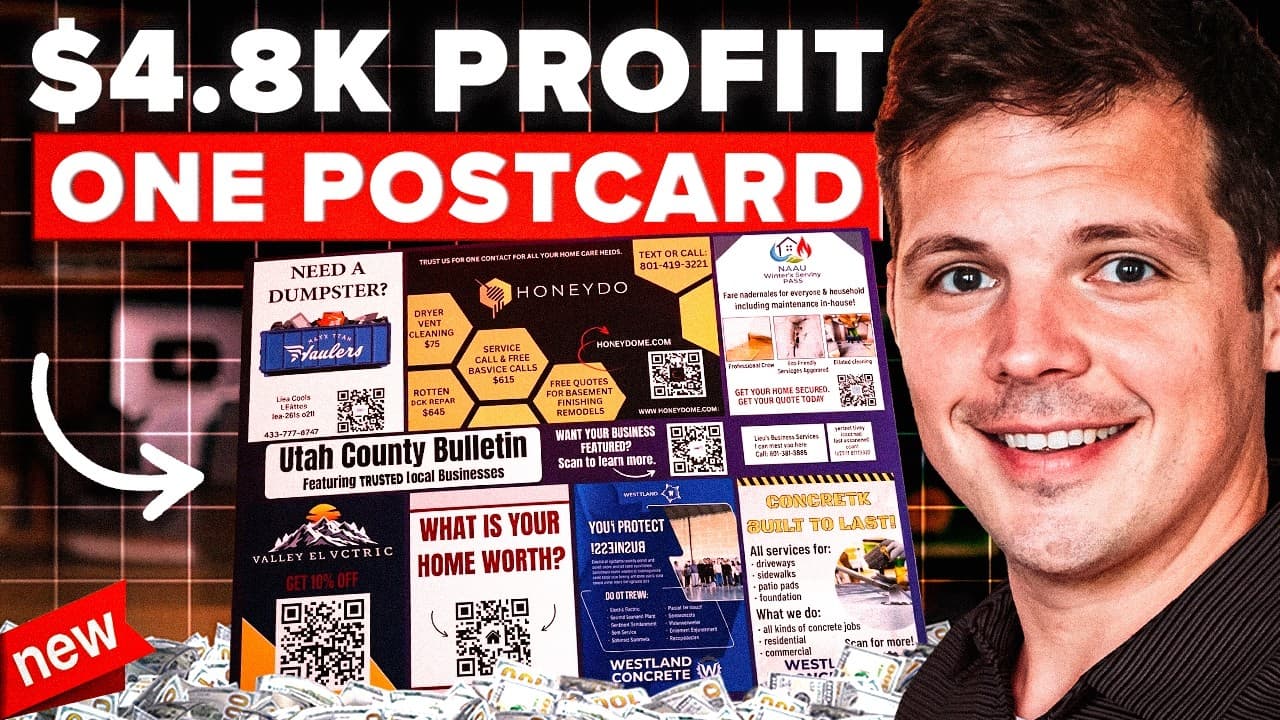
Profit comes from selling shared postcard ad space to local businesses, with break even around the cost of printing and postage for 10,000 mail pieces and most revenue beyond that as profit. Deals close mainly via messenger or text, with no cold calls, no ads, and minimal staffing at first.
Transcript
You turned a $90 investment into $50,000 in a year on the side. >> Yeah. Yep. >> Jeez. >> You could start this for free if you really wanted to. I probably close 95% of my deals over messenger or text. >> Wow. Without having to hop on the call. >> No, I didn't have an LLC for the first two cards that I sent out. >> That's fine. >> I always just wou... Read More
Key Insights
- The business model is built on selling ad space on shared postcards mailed to thousands of local homeowners.
- Break-even depends on covering printing and postage costs, approximately five thousand dollars for a ten thousand piece run.
- Advertisers are acquired primarily through Facebook groups and DMs rather than cold outreach or ads.
- You do not need an LLC initially; early deals can be made without extensive business setup or fancy branding.
- USPS Every Door Direct Mail requires targeting specific zip codes and income ranges to maximize relevance and ROI.
- Two card types exist, a larger 9x12 for five to ten thousand homes and a smaller 6x11 for around 2,500 homes.
- Recurring revenue can come from repeat advertisers or multi-month runs, with different pricing for premium and community cards.
- Operations emphasize outsourcing printing and mailing while the core role is prospecting and coordinating with vendors and advertisers.
- More videos from this channel:
- More from this channel: Chris Koerner on The Koerner Office Podcast
Install to Summarize YouTube Videos and Get Transcripts
Explore YouTube Video Summarizer or Get YouTube Transcript Extractor
Questions & Answers
Q: How can I start a postcard ad business with less than $100 in startup costs?
The approach is to partner with printers who produce the postcards and use USPS Every Door Direct Mail to reach a defined local area. You avoid upfront branding costs, set up a simple front and back design, and begin by filling the card with sponsors who fit the target category. Purchasing print quantities and postage will be the main outlay, but you can begin with minimal inventory and scale as deals close. Focus on validating the concept by getting a few advertisers successfully on a card and then reinvest profits to expand the run. This keeps your initial risk low while proving the model works in a real market.
Q: What are the typical costs to run a 10,000 postcard mailing?
The costs break down into roughly 2,300 dollars for printing 10,000 cards and about 2,500 dollars for postage to mail all pieces, totaling around 4,800 dollars. This is the initial outlay to ensure the front of the card is fully filled with sponsors, which makes the campaign viable. These figures provide the break even point, assuming successful sales of the available ad slots on the card.
Q: How do deals usually get closed without calls or meetings?
Deals are closed primarily via text and messenger conversations. The seller uses groups on Facebook to post the opportunity and then moves the discussion into direct messages where sponsors ask questions and commit. The process emphasizes rapid, asynchronous communication, allowing you to manage multiple prospects without scheduling calls. This method reduces friction and accelerates conversions, contributing to high close rates in this model.
Q: What kind of customers are targeted for the postcard ads?
Targeting focuses on local homeowners in specific zip codes with higher income levels and single family homes. The strategy excludes multi-family dwellings like condos and apartments to avoid wasted impressions. The idea is to offer services from local businesses that service those homeowners, such as landscapers, roofers, and other home service providers. Matching the area with relevant advertisers increases the likelihood of conversion and advertiser satisfaction.
Q: What are the two card formats and when should each be used?
There are two card formats: a 9 by 12 inch card for larger radius campaigns targeting 5,000 to 10,000 homeowners with premium advertising, and a 6 by 11 inch community card for about 2,500 homes aimed at smaller, local businesses like bakeries or restaurants. The larger card accommodates more sponsors and higher value placements, while the smaller card is more affordable and can be used for shorter, more aggressive campaigns.
Q: How often can a business repeat a postcard campaign, and how is repeat business handled?
Campaigns can run on a monthly cadence or be a one-off, depending on the client’s goals. Some advertisers sign up for multi-month runs (for example, three months), while others run single campaigns. To encourage repeats, you typically reach back out to previous advertisers for the next card, offering them priority placement before you approach new sponsors. This approach builds continuity and stabilizes revenue.
Q: What is the profitability model after the break-even point?
Profit beyond the break-even point comes from selling multiple sponsor slots and maintaining efficient fulfillment. If the front is fully filled with sponsor ads, revenue per run can be around ten thousand dollars, with profits estimated between four and five thousand dollars after printing and postage costs. The key is sustaining advertiser demand and ensuring the production quality meets expectations so repeat business remains strong.
Q: What role does distribution play in the business and how is it managed?
Distribution is handled by outsourcing printing and mailing; you coordinate with a vendor for the design, printing, and sending of the mail pieces to USPS. You do not need to physically ship or manage envelopes; your job is to assemble sponsors, provide clear front and back designs, and direct the print shop where to ship. This setup minimizes labor and emphasizes a lean, scalable process that can expand with additional runs and more advertisers.
Summary & Key Takeaways
-
A low-cost postcard advertising model is built by selecting a target area, using USPS Every Door Direct Mail to reach homeowners, and selling ad space to businesses on a single card per category. Start-up costs are largely printing and postage, with revenue from multiple advertisers per run.
-
The seller emphasizes simplicity and speed: close deals via social groups and DMs, avoid complicated branding or websites, and scale by stacking multiple runs and repeat advertisers while maintaining a clear front and back card design.
-
Repeatability and scalability hinge on choosing card sizes, frequency of mailouts, and keeping a lean operation. Profit per run typically ranges from about four to five thousand dollars when the front is fully filled with sponsors and back offers, assuming consistent advertiser acquisition and proper fulfillment.
Read in Other Languages (beta)
Share This Summary 📚
Summarize YouTube Videos and Get Video Transcripts with 1-Click
Try YouTube Summary with ChatGPT & Claude or YouTube Transcript Generator
Explore More Summaries from Chris Koerner on The Koerner Office Podcast 📚






Summarize YouTube Videos and Get Video Transcripts with 1-Click
Try YouTube Summary with ChatGPT & Claude or YouTube Transcript Generator