What Changed in AI and Robotics in April 2025?
TL;DR
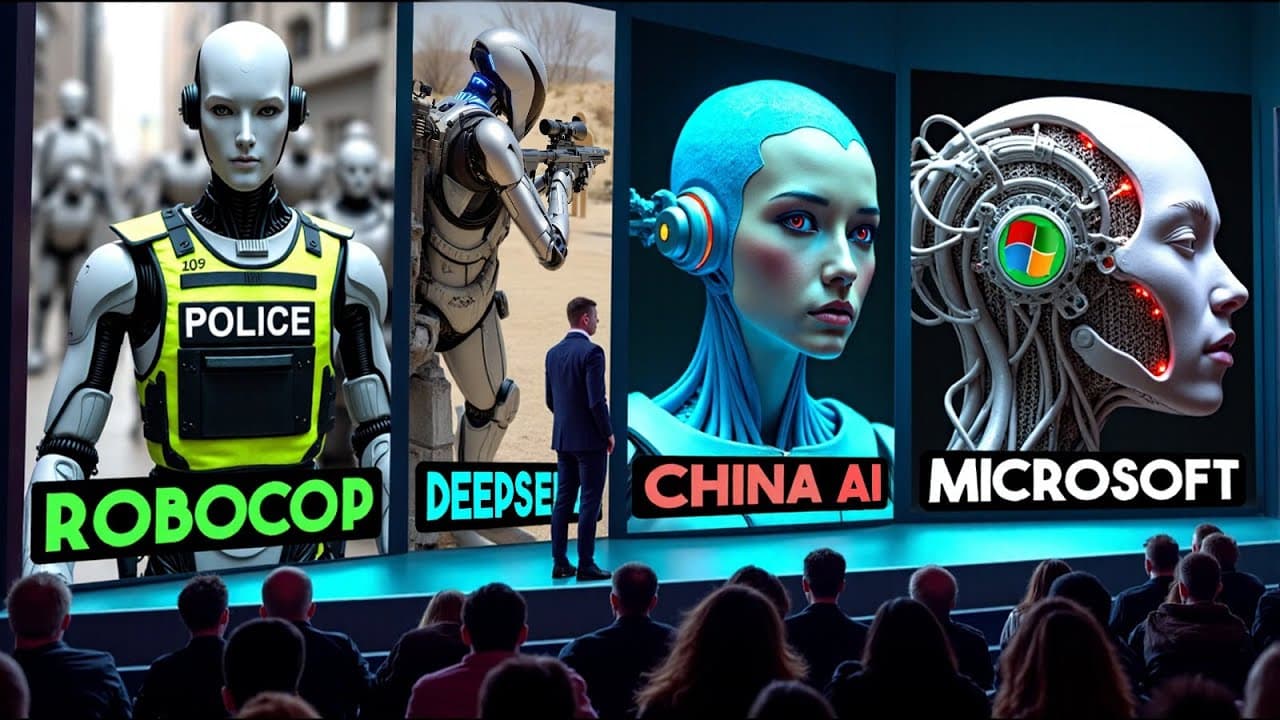
Humanoid robots are progressing toward practical work through faster movement, onboard computing, improved balance, and autonomous manipulation. April's developments also included an AI-assisted police cyborg in Thailand, expressive Disney research robots, a robot-versus-human half marathon, automated grocery packing, highly efficient language models, self-learning agents, and increasingly realistic AI video generation.
Transcript
It's time for your monthly dose of AI news. And this one's wild. We've got humanoid robots that can run and think faster than us. AI cops already on the streets in China. And self-eing agents outsmarting even open AI. Deep Mind managed to break its own AI with a single sentence. Microsoft accidentally built its most efficient model yet. And Meta's ... Read More
Key Insights
- Themis V2 is a life-sized humanoid robot with 40 degrees of freedom, including six degrees in each arm and seven additional degrees in its hands or end effectors, enabling more articulated movement and finer object handling.
- Back-drivable electromechanical actuators are designed to move joints smoothly in both directions, reduce the jerky motion associated with older robots, sense resistance, and support safer interactions with people or delicate objects.
- Themis V2 processes about 200 trillion operations per second onboard, allowing advanced machine-learning algorithms to run locally and helping the robot respond quickly when its surroundings or physical conditions change.
- The 3DM-CV7 orientation sensor tracks Themis V2's tilting and turning up to 1,000 times per second, providing continuous motion data that supports balance on uneven surfaces, stairs, and unexpected obstacles.
- Neo is presented as an autonomous household robot that can collect leaves, load a dishwasher, and reposition cushions by making real-time decisions from visual information, body position, and the locations of nearby objects.
- Household robotics is difficult because homes contain unpredictable objects, rugs, pets, children, movable furniture, and constantly changing tasks, requiring robots to adapt rather than follow routines developed for tightly controlled environments.
- AI Police Cyborg 1.0 is a stationary robotic police system unveiled by the Royal Thai Police on April 17, 2025, equipped with 360-degree cameras, real-time facial recognition, video analytics, and links to CCTV and drone footage.
- Real-world automation is expanding beyond demonstrations, with bipedal robots entering a Beijing half marathon, plans for a fully AI-operated Las Vegas hotel, and Ocado robotic arms packing more than 30 million groceries annually.
Install to Summarize YouTube Videos and Get Transcripts
Explore YouTube Video Summarizer or Get YouTube Transcript Extractor
Questions & Answers
Q: How fast can the Themis V2 humanoid robot run?
Themis V2 has reportedly been clocked running at up to 10 kilometers per hour, or roughly 6.2 miles per hour. Westwood Robotics also says it can walk at about a typical human pace. Demonstrations emphasize running, rapid pivots, rough terrain, and possible low-obstacle movements as evidence that the machine is being developed for physical conditions beyond controlled laboratory floors.
Q: How does Themis V2 maintain balance on rough terrain?
Themis V2 uses a 3DM-CV7 attitude and heading reference sensor that monitors how the robot tilts and turns up to 1,000 times per second. This continuous orientation stream acts like an artificial inner ear, helping the control system make balance corrections on uneven ground, stairs, and unexpected obstacles. Its onboard computing also supports rapid responses to environmental changes.
Q: What makes Themis V2 safer around people?
Themis V2 uses back-drivable electromechanical actuators, which allow its joints to move smoothly in both directions and respond when they encounter resistance. This design reduces the rigid, jerky behavior associated with some older robots. If the robot contacts a person or delicate object, it can make a more controlled adjustment instead of continuing with an unyielding mechanical movement.
Q: What household tasks can the 1X Neo robot perform?
Neo has been demonstrated collecting leaves and placing them into a bag, loading a cup into an already open dishwasher, and moving a cushion neatly onto a couch. These tasks involve visual perception, two-handed object transfer, object orientation, careful placement, and balance. According to 1X, the demonstrations are autonomous rather than controlled remotely by a hidden operator.
Q: Why does 1X train Neo in home environments?
1X describes the home as the final boss of robotics because it is unstructured and constantly changing. Rugs, pets, children, furniture, laundry, soft objects, and stuck lids create diverse situations that a robot must handle. The company's argument is that this variety generates valuable training data and exposes the system to more unusual cases than a predictable warehouse environment would.
Q: How does Neo coordinate full-body household movements?
Neo's demonstrations are described as being driven by data and a comprehensive network that coordinates the lower body, arms, and spinal joints. Reinforcement learning is used for the lower body and merged with the rest of the control system. This coordination helps the robot remain balanced while bending, leaning, transferring objects between hands, and placing awkward items such as cushions.
Q: What is Thailand's AI Police Cyborg 1.0?
AI Police Cyborg 1.0 is a stationary robotic police system unveiled by the Royal Thai Police during the Songkran Festival on April 17, 2025. It uses smart 360-degree cameras and real-time facial recognition. Its AI system combines live inputs from nearby CCTV and drone surveillance, analyzes the footage, and sends real-time alerts to human officers through a command center.
Q: What other real-world robotics developments were reported?
The report describes a Disney Research humanoid that mirrors a person's shyness or excitement, 21 bipedal robots competing with 10,000 humans in a Beijing half marathon, and plans for a fully AI-operated hotel in Las Vegas. It also states that Ocado robotic arms pack more than 30 million groceries annually using computer vision, reinforcement learning, and diffusion-based generative AI.
Summary & Key Takeaways
-
Westwood Robotics presented Themis V2, a humanoid with 40 degrees of freedom, improved arm articulation, back-drivable actuators, substantial onboard AI computing, and high-frequency orientation sensing. It is designed to move fluidly, react to environmental changes, traverse uneven surfaces, and reach running speeds of 10 kilometers per hour.
-
1X demonstrated Neo autonomously collecting leaves, loading a dishwasher, and arranging a couch cushion. These ordinary chores require object recognition, dexterous manipulation, balance, and adaptation to changing surroundings. The company treats homes as a difficult training environment whose variety could produce valuable data for increasingly capable general-purpose robotic systems.
-
Other reported developments included Thailand's stationary AI Police Cyborg 1.0, Disney's responsive humanoid research, a Beijing half marathon involving bipedal robots, plans for a fully AI-operated hotel in Las Vegas, and Ocado's automated grocery packing. The broader report also covered new language models, self-learning agents, system vulnerabilities, and realistic video generators.
Read in Other Languages (beta)
Share This Summary 📚
Summarize YouTube Videos and Get Video Transcripts with 1-Click
Try YouTube Summary with ChatGPT & Claude or YouTube Transcript Generator
Explore More Summaries from AI Revolution 📚






Summarize YouTube Videos and Get Video Transcripts with 1-Click
Try YouTube Summary with ChatGPT & Claude or YouTube Transcript Generator