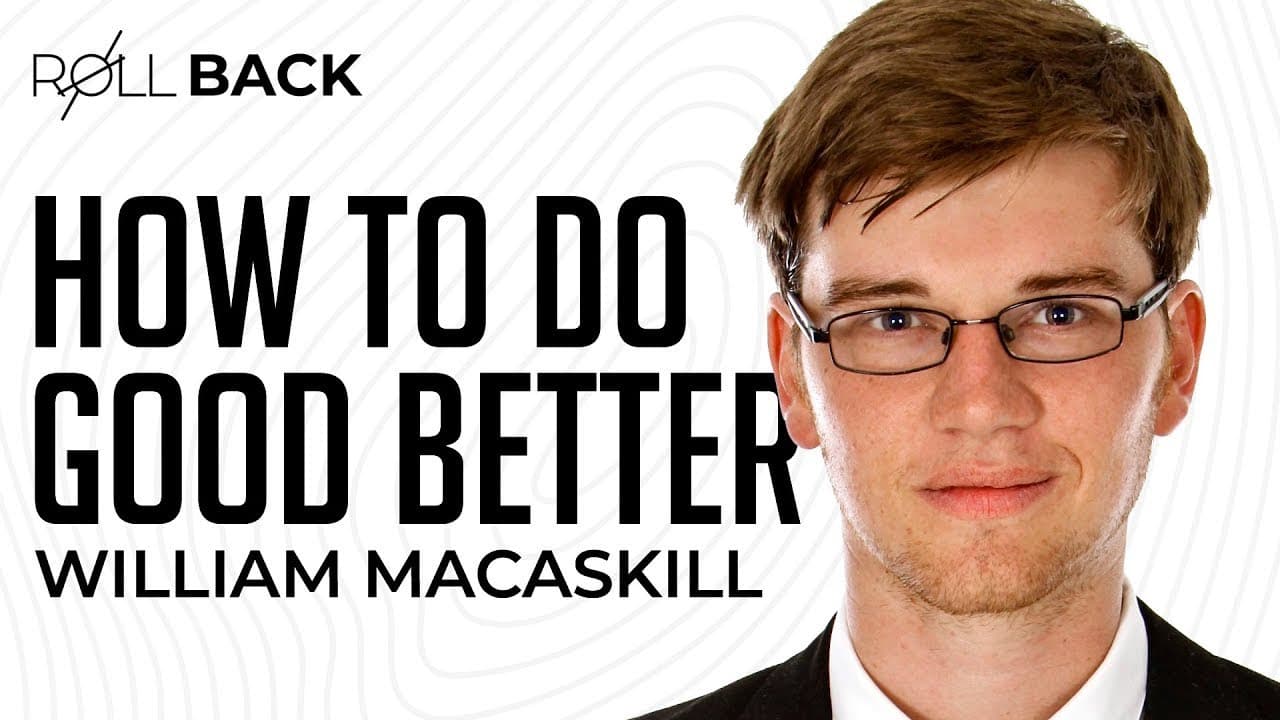
How Can You Maximize Your Positive Global Impact? William MacAskill | ROLLBACK #178 | Rich Roll Podcast
TL;DR
Effective altruism means using your time, money, charitable giving, and career as effectively as possible to improve other people’s lives. William MacAskill describes it as a scientific, evidence-based, data-driven approach measured by how many people are helped and how significantly their lives improve. He also explains why helping yourself in the process can be a bonus, making the discussion worth reading for practical guidance on doing the most good.
Transcript
for me altruism is just about making other people better off and more precisely i just want to measure that as just how many people are you affecting and how significantly are you improving their lives and if in the course of that you improve your own life as well as i think is actually quite often the case that's a bonus hey everybody welcome to a... Read More
Key Insights
- Effective altruism is about using your time and money as effectively as possible to make the world a better place, asking not just how to make a difference with charity or a career, but how to make the most difference possible.
- The method of effective altruism is a scientific, evidence-based, data-driven approach to the question of how to do the most good, which MacAskill says has become both a philosophy and a worldwide social movement.
- Altruism as MacAskill defines it is not self-sacrifice, which is the biologists' usage. It is making other people better off, measured by how many people you affect and how significantly their lives improve.
- Improving your own life while helping others counts as a bonus and a reason in favor of an action, not a reason against it, so effective altruism is not asceticism or self-flagellation in MacAskill's framing.
- Human nature contains a strong altruistic component, though MacAskill estimates people are roughly ninety percent out for themselves and ten percent altruistic, with the balance varying by subculture.
- Responses to natural disasters are hard to explain on purely self-interested evolutionary grounds, because people feel compelled to help strangers whose suffering they see even when they have no connection to them.
- Peter Singer's drowning child argument holds that you would not walk past a child drowning in a shallow pond just to avoid muddying your suit, and there is no morally relevant difference between that child and one dying of an easily preventable disease abroad.
- Giving What We Can, co-founded by MacAskill and Toby Ord, encourages people to give at least ten percent of their income to whatever causes do the most good, and grew out of Ord's own pledge to give away everything he earned above 20,000 pounds.
Install to Summarize YouTube Videos and Get Transcripts
Explore YouTube Video Summarizer or Get YouTube Transcript Extractor
Questions & Answers
Q: What is effective altruism?
Effective altruism is the effort to use your time and money as effectively as possible to make the world better. It asks how charitable giving or career choices can make the most difference, using a scientific, evidence-based, data-driven approach.
Q: How does William MacAskill define altruism?
MacAskill defines altruism as making other people better off, rather than necessarily sacrificing your own welfare. He measures it by how many people you affect and how significantly you improve their lives.
Q: Does effective altruism require self-sacrifice?
No. MacAskill says that improving your own life while helping others is a bonus and a reason in favor of the action, not an argument against it.
Q: Does MacAskill believe humans are naturally altruistic?
MacAskill estimates that people may be roughly ninety percent self-interested and ten percent altruistic, although the balance varies among subcultures. He argues that people’s urge to help unknown victims of natural disasters demonstrates a strong altruistic component in human nature.
Q: What is Peter Singer’s drowning child argument?
The argument asks whether you would walk past a child drowning in a shallow pond merely to avoid muddying your suit and losing a few thousand dollars. MacAskill says there is no morally relevant difference between rescuing that child and helping a child abroad who is dying from an easily preventable disease.
Q: Why did William MacAskill reconsider his career plans?
After Cambridge, MacAskill worked as a street fundraiser for CARE International and encountered apathy while asking people to donate ten dollars a month. He then recognized that he was also failing to live by his values because he planned to study esoteric philosophy at Oxford instead of applied philosophy.
Q: How did MacAskill begin donating his own money?
At Oxford, MacAskill began by giving a couple of percent or a few percent of his graduate stipend. After meeting Toby Ord in early 2009, he took a pledge to give away everything he earned above 20,000 pounds a year, adjusted for inflation and living costs.
Q: What is Giving What We Can?
Giving What We Can is a nonprofit co-founded by William MacAskill and Toby Ord. It encourages people to donate at least ten percent of their income to the causes that do the most good, and it grew from Ord’s pledge to give away earnings above 20,000 pounds.
Summary & Key Takeaways
-
Effective altruism asks how to use time and money as effectively as possible to improve the world, whether through charitable giving or career choice. MacAskill describes the approach as scientific, evidence-based and data-driven, and says it has grown into both a philosophy and a social movement with an effective altruism community now spread around the world.
-
MacAskill separates his definition of altruism from the biologists' definition of self-sacrifice. He measures altruism by how many people you affect and how significantly you improve their lives. If your own life improves in the process, which he thinks happens quite often, that is a bonus and a reason in favor of the action rather than an argument against it.
-
The turning point came when MacAskill worked as a street fundraiser for CARE International after Cambridge, faced daily apathy, and realized he was not living up to his own values either. At Oxford he began giving a few percent of his graduate stipend, then met Toby Ord in early 2009 and co-founded Giving What We Can.
Read in Other Languages (beta)
Share This Summary 📚
Summarize YouTube Videos and Get Video Transcripts with 1-Click
Try YouTube Summary with ChatGPT & Claude or YouTube Transcript Generator
Explore More Summaries from Rich Roll 📚


Summarize YouTube Videos and Get Video Transcripts with 1-Click
Try YouTube Summary with ChatGPT & Claude or YouTube Transcript Generator