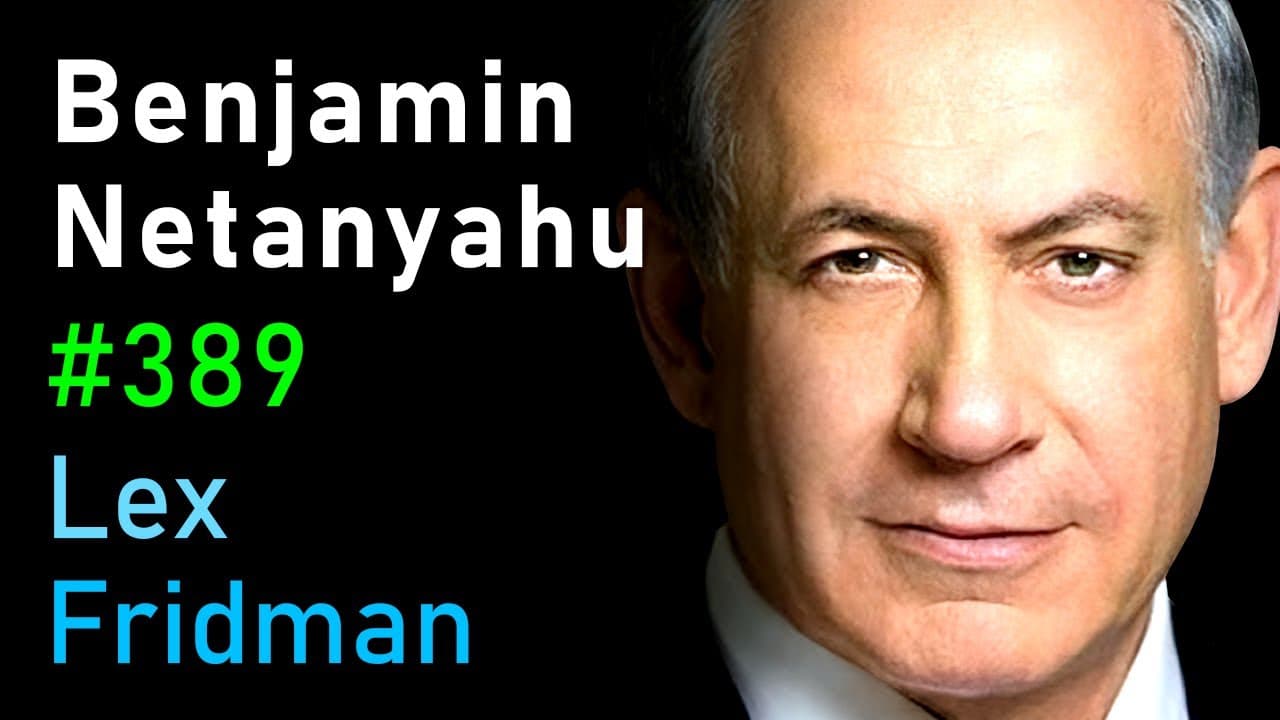
Benjamin Netanyahu: Israel, Palestine, Power, Corruption, Hate, and Peace | Lex Fridman Podcast #389
TL;DR
Benjamin Netanyahu argues that the primary obstacle to peace is the Palestinian refusal to acknowledge a Jewish state. He stresses the importance of addressing threats seriously and advocates for dialogue as a means to foster understanding and potential resolution in both Israeli-Palestinian relations and broader regional conflicts.
Transcript
- We should never, and I never sit aside and say, oh, they're just threatening to destroy us. They won't do it. If somebody threatens to eliminate you as Iran is doing today, and as Hitler did then and people discounted it, well, if somebody threatens to annihilate us, take them seriously and act to prevent it early on. Don't let them have the mean... Read More
Key Insights
- 🪡 Netanyahu emphasizes the need to identify and address threats in a timely manner to prevent potential harm.
- ❓ He believes that the persistent refusal of Palestinians to recognize a Jewish state is the main obstacle to peaceful coexistence.
- ✌️ Netanyahu highlights the power of conversation and dialogue in achieving peace, both between Israelis and Palestinians and with other Arab nations.
- 🤙 He calls for a broad and deep education to be an effective leader and emphasizes the importance of lifelong learning.
- 🎙️ More videos with Benjamin Netanyahu:
Install to Summarize YouTube Videos and Get Transcripts
Explore YouTube Video Summarizer or Get YouTube Transcript Extractor
Questions & Answers
Q: How does Benjamin Netanyahu view the power of conversation in achieving peace?
Netanyahu recognizes the importance of conversation and dialogue in finding solutions to conflicts. He believes that direct talks between leaders can lead to understanding and the resolution of long-standing issues.
Q: What are the main obstacles to peaceful coexistence with Palestinians?
Netanyahu identifies the persistent refusal of Palestinians to recognize a Jewish state as the main obstacle to peaceful coexistence. He emphasizes the need for Palestinians to acknowledge Israel's right to exist in order to move towards a peaceful settlement.
Q: How does Netanyahu view the expansion of settlements in the West Bank?
Netanyahu argues that settlements are not an obstacle to peace as most Israelis living in the West Bank reside in urban blocks that are expected to be part of Israel in any future arrangement. He also mentions the need for compromise on both sides to achieve peace.
Q: How does Netanyahu approach the issue of corruption in Israel?
Netanyahu defends himself against corruption charges, stating that they are collapsing and that the real issue is the corruption of the legal process against him. He also mentions the importance of combating systemic corruption in Israeli politics and society.
Key Insights:
- Netanyahu emphasizes the need to identify and address threats in a timely manner to prevent potential harm.
- He believes that the persistent refusal of Palestinians to recognize a Jewish state is the main obstacle to peaceful coexistence.
- Netanyahu highlights the power of conversation and dialogue in achieving peace, both between Israelis and Palestinians and with other Arab nations.
- He calls for a broad and deep education to be an effective leader and emphasizes the importance of lifelong learning.
- Netanyahu recognizes human mortality and contemplates the legacy he will leave behind in his efforts to secure the future of the Jewish state.
Summary
This is a conversation with Benjamin Netanyahu, Prime Minister of Israel, about various topics including hate, Israel's democratic values, the rise of Third Reich, anti-Zionism and anti-Semitism, proposed judicial reforms in Israel, the future of tech companies in Israel, artificial intelligence, corruption cases, the obstacle to peaceful coexistence between Israelis and Palestinians, and the expansion of settlements in the West Bank.
Questions & Answers
Q: You're loved by many people here in Israel and in the world, but you're also hated by many. In fact, I think you may be one of the most hated men in the world. So if there's a young man or a young woman listening to this right now who have such hate in their heart, what can you say to them to one day turn that hate into love?
Benjamin Netanyahu disagrees with the premise of the question, stating that he has enjoyed broad support around the world. He cites his interviews with Iranian television channels that had millions of viewers, as well as the respect he receives from Arab countries due to the peace agreements he has made. He believes that those who hate Israel are guided by ignorance, as they do not understand the contributions Israel makes to the world in various fields like medicine, agriculture, and technology. He emphasizes Israel's role in helping humanity and providing aid during times of crisis.
Q: What can you say to people who have negative views about Israel and hold hate in their hearts towards the country?
Netanyahu believes that those who hold negative views about Israel are uninformed and ignorant. He emphasizes Israel's status as a stellar democracy and an advanced society that has made significant contributions to various fields. He argues that opposing Zionism, which is the belief in a Jewish state, is equivalent to opposing the Jewish people's right to have a state of their own. He equates anti-Zionism with anti-Semitism, stating that those who oppose the Jewish people also oppose the Jewish state.
Q: If we look at history, what can we learn from the rise of the Third Reich and the hate that permeated that period?
Netanyahu emphasizes the importance of nipping bad things in the bud and taking threats seriously. He draws parallels between the Iranian regime, which threatens to destroy Israel, and Hitler's regime in the past. He warns against discounting threats and suggests acting early to prevent annihilation. He believes that the deliberate incitement of hatred against a community is a dangerous and destructive path, as seen during the Holocaust when the hatred towards Jews spread to all of humanity. He urges the need to be vigilant and proactive in preventing such destructive ideologies from taking hold.
Q: How much of the hatred towards Israel is rooted in anti-Zionism and anti-Semitism?
Netanyahu does not distinguish between anti-Zionism and anti-Semitism. He argues that opposing the Jewish state essentially denies the Jewish people's right to have a state of their own. He equates both forms of opposition, stating that those who oppose the Jewish people also oppose the Jewish state. He believes it is not possible to say one is not anti-Semitic but is against the existence of Israel as a Jewish state, just as it would be absurd to say one is not anti-American but is against the existence of America.
Q: Critics argue that the proposed judicial reform in Israel gives too much power to the government and could lead to a potential dictatorship. How would you respond to those concerns?
Netanyahu dismisses the criticism as ridiculous, pointing out the vibrant democracy in Israel and the robust protests that demonstrate the opposite of a dictatorship. He explains that the proposed reforms aim to restore the balance between the legislative, executive, and judicial branches of government, which has become imbalanced over the years. He outlines the need for an independent judiciary without it being all-powerful. He clarifies that the reform does not include an override clause that would nullify Supreme Court decisions and that the concerns raised about the structure of appointing Supreme Court judges have been misrepresented. He asserts that the reforms aim to bring Israeli democracy back to its early years and maintain a vibrant and balanced democracy.
Q: Large and small tech companies are nervous about the proposed judicial reform in Israel. How can Israel ensure a future for tech companies in the country?
Netanyahu highlights Israel's free-market economy, which has been strengthened through numerous free-market reforms. He explains that Israel has a vibrant startup ecosystem and has attracted major tech companies due to its investment in knowledge workers and its status as an innovation nation. He believes that Israel's talent pool and entrepreneurial spirit will continue to attract tech companies, despite global economic trends. He emphasizes Israel's ability to adapt and innovate in various fields, making it a compelling destination for tech companies.
Q: What is your vision for artificial intelligence (AI) and its impact on the world?
Netanyahu acknowledges the rapid development of AI and its potential impact on society. He emphasizes the need for regulation and recognizes that there may not be global consensus on how to regulate AI. He mentions conversations with Sam Altman and Elon Musk about the future of AI and the challenges it presents. He acknowledges the need for caution and the difficulty of projecting its long-term effects, but expresses optimism about Israel's potential to become a leading AI power due to its investment in knowledge workers and its tradition of innovation.
Q: How do you fight corruption in your own party and in Israel as a whole?
Netanyahu addresses corruption cases against him, stating that many charges are collapsing and being proven baseless in the trial. He highlights the use of spyware, blackmail, and mistreatment of witnesses in the investigations against him. He believes that the cases against him are falling apart and that the trial has uncovered corruption on the part of those investigating him. He expresses confidence in the legal process and expects the truth to prevail.
Q: What is the top obstacle to peaceful coexistence between Israelis and Palestinians?
Netanyahu identifies the persistent Palestinian refusal to recognize a Jewish state, regardless of its boundaries, as the top obstacle to peace. He believes that Palestinian leadership has been commanded by a century-long refusal to compromise with Zionism, which seeks a state for the Jewish people. He argues that the Palestinian refusal to accept Israel's existence in any form hampers progress towards reconciliation and a two-state solution. He cites examples of Israel leaving territories, such as Gaza, only for them to be overtaken by terrorist organizations committed to the destruction of Israel.
Q: Critics argue that the expansion of settlements in the West Bank escalates tensions and is detrimental to a two-state solution. How do you respond to these concerns?
Netanyahu understands the perspective that settlement expansion is seen as an obstacle to a two-state solution. However, he argues that most Israelis who live in Judea and Samaria (the West Bank) reside in urban blocks that account for around 90% of the population. He reiterates the Palestinian refusal to recognize a Jewish state as the main obstacle to peace. He believes that Israel must have overall security responsibility due to the immediate threat of terrorist organizations taking control if Israel were to withdraw completely. He suggests a model where the Palestinians have the power to govern themselves but not to threaten Israel's security.
Summary & Key Takeaways
-
Benjamin Netanyahu emphasizes the need to take threats seriously and act to prevent them, citing the examples of Iran and Hitler's regime.
-
He highlights the persistent Palestinian refusal to recognize a Jewish state as the main obstacle to peaceful coexistence and emphasizes the need for compromise.
-
Netanyahu discusses the Abraham Accords and his efforts to establish peace with Arab nations, which he believes can lead to broader peace in the region.
-
He expresses his concern for the war in Ukraine and the importance of resolving conflicts through dialogue and understanding.
Read in Other Languages (beta)
Share This Summary 📚
Summarize YouTube Videos and Get Video Transcripts with 1-Click
Try YouTube Summary with ChatGPT & Claude or YouTube Transcript Generator
Explore More Summaries from Lex Fridman Podcast 📚



Summarize YouTube Videos and Get Video Transcripts with 1-Click
Try YouTube Summary with ChatGPT & Claude or YouTube Transcript Generator