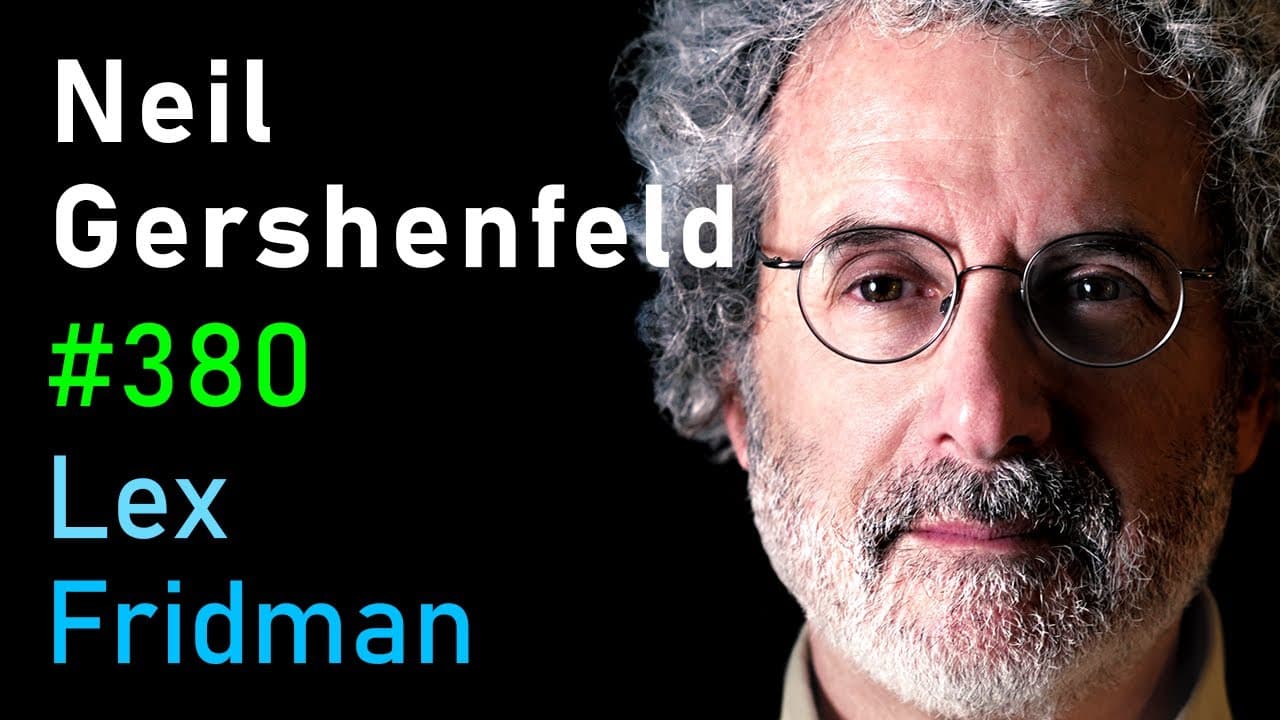
Neil Gershenfeld: Self-Replicating Robots and the Future of Fabrication | Lex Fridman Podcast #380
TL;DR
Neil Gershenfeld argues that fabrication can scale dramatically when robots make the parts needed to build more robots. He compares this process with ribosomes, which run at about one molecule per second but exist by the trillions because ribosomes make ribosomes. He also explains why separating computation from physical hardware creates scaling problems, giving readers a reason to explore how bits and atoms can be reunited.
Transcript
- The ribosome, who I mentioned a little while back, can make an elephant one molecule at a time. Ribosomes are slow. They run at about one molecule a second, but ribosomes make ribosomes, so you have trillions of them and that makes an elephant. In the same way these little assembly robots I'm describing can make giant structures, at heart because... Read More
Key Insights
- "ribosomes are slow they run at about one molecule a second but ribosomes make ribosomes so you have trillions of them and that makes an elephant" (0:03)
- "in the turing machine there's a head that programmatically moves and reads and writes a tape" (3:12)
- "the computer somebody's using to watch this is spending much of its effort moving information from Storage Transit transistors to processing transistors even though they have the same computational complexity" (3:48)
- "van Neumann studied self-reproducing automata how a machine communicates its own construction" (5:51)
- "a touring studied morphogenesis how genes give rise to form" (5:55)
Install to Summarize YouTube Videos and Get Transcripts
Explore YouTube Video Summarizer or Get YouTube Transcript Extractor
Questions & Answers
Q: How can self-replicating robots build giant structures?
Small assembly robots can build giant structures because a robot can make the parts for another robot. As more robots are produced, the capacity for robotic assembly grows.
Q: Why does Neil Gershenfeld compare assembly robots with ribosomes?
Ribosomes work slowly, at about one molecule per second, but they make other ribosomes. With trillions operating together, they can make something as large as an elephant, which illustrates how self-replication can enable assembly at enormous scales.
Q: Can robots be made from the same parts they manufacture?
Yes. Gershenfeld says his students Amira and Miana published a Nature Communication paper showing that a robot can be made from the parts it is making.
Q: What mistake does Neil Gershenfeld identify in Turing's machine?
He says the head is distinct from the tape in Turing's machine. This separates the persistence of information from interaction with that information, a distinction Gershenfeld calls a simple physics mistake.
Q: How does the separation of storage and processing affect modern computers?
Gershenfeld says a modern computer spends much of its effort moving information from storage transistors to processing transistors. He notes that these transistors have the same computational complexity.
Q: What does Neil Gershenfeld consider the only physical model of computation?
He describes a patch of space that occupies space, stores state, takes time to transit, and can be interacted with. He argues that this is the only physical model of computation and that the other models are fictions.
Q: What did Turing and Von Neumann study near the end of their lives?
Von Neumann studied self-reproducing automata and how a machine communicates its own construction. Turing studied morphogenesis, specifically how genes give rise to form, so both examined how software becomes hardware.
Q: What did Neil Gershenfeld learn from working between bits and atoms?
He came to see computer science and physical science as inseparable because software is physical rather than independent of hardware. He says many computing scaling problems, as well as opportunities, arise at the boundary between bits and atoms.
Summary
Neil Gershenfeld, the director of MIT's Center for Bits and Atoms, discusses the intersection of digital and physical worlds and the concept of digital fabrication. He explores the ideas of self-reproducing automata and the potential for personal fabrication through FabLabs. Gershenfeld also dives into the connection between biology and digital materials, highlighting the power of code in construction and the ability to scale capacity through assemblers.
Questions & Answers
Q: What has Gershenfeld learned by working at the boundary between bits and atoms?
Gershenfeld has learned why fundamental mistakes were made in computing, the secret of life, and how to solve important problems. He has discovered that there is not much difference between computer science and physical science when it comes to the fundamental models of computation.
Q: Why were Turing and von Neumann wrong?
Gershenfeld explains that Turing's machine had a simple physics mistake with the distinction between the head and the tape. Von Neumann, on the other hand, wrote about computing in a memo that led to a machine architecture that requires moving information between storage transistors and processing transistors, causing scaling issues in computing.
Q: Is there a distinction between the head and the tape in computing?
Gershenfeld states that there is no distinction between the head and the tape in the physical model of computation. This model, which exists in physics, allows for space occupation, state storage, time transit, and interaction. All other models of computation are fictions.
Q: How does Gershenfeld relate this to the digital and physical divide?
Gershenfeld explains that the divide between digital and physical is based on the fiction that bits are not constrained by atoms. However, he believes that embracing this boundary can lead to both challenges and opportunities in computing. He mentions the importance of understanding how digital becomes physical and physical becomes digital.
Q: How does Gershenfeld's work connect with biology and the study of life?
Gershenfeld's work overlaps with biology through the concept of digital materials. By creating a discreet set of parts that can be reversibly joined with global geometry determined by local constraints, Gershenfeld aims to digitize materials. This approach mimics the way biology uses a limited inventory of amino acids to create all forms of life.
Q: How does Gershenfeld's work extend to the creation of large structures?
Gershenfeld discusses the potential of using self-reproducing automata, inspired by the work of von Neumann, to build large-scale structures. By allowing robots to make copies of themselves from the parts they are already creating, Gershenfeld believes it is possible to scale the capacity of robotic assembly.
Q: Can Gershenfeld provide an example of robots that can self-replicate and perform error correction?
Gershenfeld explains that the robots can vary in size depending on the length scale being considered. Micro-robots made from nano-bricks can be used as building blocks for larger robots, which, in turn, can be used to build larger-scale structures. The key is to have a hierarchy of parts that can self-replicate and perform error correction.
Q: How does Gershenfeld see this technology evolving in the future?
Gershenfeld believes that as the technology progresses, it will be possible to move from small-scale self-replication to larger-scale structures. He envisions using swarms of table-scale robots to efficiently place parts for 3D printing houses, among other applications.
Q: What is the significance of personal fabrication?
Gershenfeld suggests that personal fabrication is the killer app of digital fabrication. It allows individuals to express themselves through these new means of expression. By giving people the tools to create rather than just assemble or program, personal fabrication taps into human creativity and the desire for self-expression.
Q: How does Gershenfeld's work connect with FabLabs?
FabLabs, which are digital fabrication community labs, emerged as an accidental network of labs that grew rapidly. Gershenfeld started the labs to address the need for training in using digital fabrication tools. However, he discovered that the real power of FabLabs lies in personal fabrication and giving people the ability to create. It has become a platform for personal expression and creativity.
Takeaways
Neil Gershenfeld's work at the intersection of bits and atoms has led to insights into the nature of computing, the connection between digital and physical spaces, and the potential for personal fabrication. By studying the concept of self-reproducing automata and digital materials, Gershenfeld aims to unlock the ability to scale capacity and bring about a third revolution in digital fabrication. His development of FabLabs has provided a platform for personal expression and unleashed human creativity worldwide. As the field continues to evolve, Gershenfeld envisions a future where the boundary between digital and physical becomes increasingly blurred, allowing for the creation of complex and innovative structures.
Summary & Key Takeaways
-
Digital fabrication is the process of using computer-controlled machines to create physical objects, allowing for precise and complex designs.
-
The concept of self-replication, inspired by organisms like the ribosome, is a key area of research in digital fabrication. It involves creating machines that can build copies of themselves, leading to exponential growth and scalability.
-
FabLabs, community workshops equipped with digital fabrication tools, are empowering individuals worldwide to create and innovate. These labs serve as hubs for learning, collaboration, and the exchange of ideas.
-
The future of digital fabrication lies in the seamless integration of communication, computation, and fabrication. It holds the potential to revolutionize various industries, from manufacturing to biotechnology.
Read in Other Languages (beta)
Share This Summary 📚
Summarize YouTube Videos and Get Video Transcripts with 1-Click
Try YouTube Summary with ChatGPT & Claude or YouTube Transcript Generator
Explore More Summaries from Lex Fridman Podcast 📚
Summarize YouTube Videos and Get Video Transcripts with 1-Click
Try YouTube Summary with ChatGPT & Claude or YouTube Transcript Generator