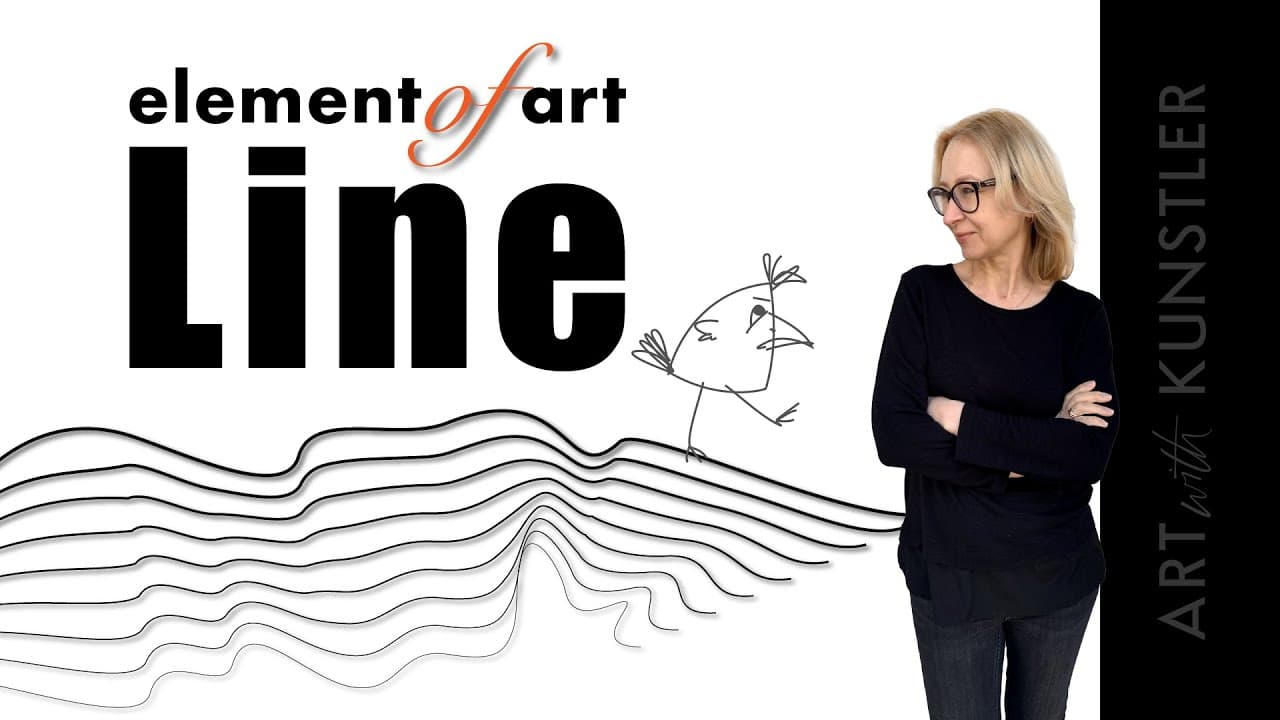
How does line shape art: types, styles, uses?
TL;DR
Lines are the backbone of art, existing as straight and curved forms and expanding into solid, interrupted, implied, and psychological categories. They define space, guide the eye, and convey mood through thickness, direction, and texture. Mastery comes from using lines to outline, shade, decorate, and create perspective, rhythm, and emotion in a composition.
Transcript
line is the path of a moving point it is a starting place for most art creations it is the most basic and fundamental visual element so what do we know about lines there is an endless number of lines that you see and use in art but technically speaking there are only two types straight lines and curved lines the rest of them are combinations or var... Read More
Key Insights
- Line is the starting point for most art creations and underpins the entire visual language of an artwork.
- There are two technical line shapes, straight and curved, and all others are variations of these two types.
- Four line styles are solid or continuous, interrupted or broken, implied, and psychological, each serving different design needs.
- Implied lines are not drawn but perceived, such as a horizon line that guides attention without a visible edge.
- Psychological lines are not physically present but are created by perception to steer viewers’ gaze.
- Shading and form can be built entirely with lines through techniques like parallel marks, cross hatching, and contouring.
- Line choice affects mood; horizontal lines feel calm, vertical lines convey height and strength, and curved lines suggest softness and elegance.
- Lines support perspective by using receding lines and grid structures, which are essential for realistic drawing and accurate spatial relationships.
Install to Summarize YouTube Videos and Get Transcripts
Explore YouTube Video Summarizer or Get YouTube Transcript Extractor
Questions & Answers
Q: What is the fundamental purpose of a line in art?
A line is the path of a moving point and serves as the starting place for most art creations. It defines objects, outlines shapes, and builds shading, texture, and depth. By varying line weight and direction, an artist organizes space, guides the viewer’s eye, and communicates movement or stillness within a composition.
Q: What are the two technical types of lines artists use?
Technically, art uses two basic line shapes: straight lines and curved lines. All other line varieties are variations or combinations of these two. The choice between straight and curved lines helps determine form, mood, and energy in a drawing or painting.
Q: What are the four line style categories and their roles?
The four line style categories are solid or continuous lines, interrupted or broken lines, implied lines, and psychological lines. Solid lines define clear boundaries and form, broken lines suggest breaks or motion, implied lines guide the eye without a literal edge, and psychological lines influence perception and attention through suggestion rather than depiction.
Q: What is an implied line and how is it used?
An implied line is not physically drawn but is perceived through borders, changes in characteristics, or alignment of elements. A common example is a horizon line that exists in effect rather than as a drawn edge. Implied lines help organize composition and direct viewers without explicit marks.
Q: What are psychological lines and how do they work?
Psychological lines are not visible in the artwork but are generated by the viewer’s mind. These lines arise from the arrangement of elements and cues within the composition and can guide attention, suggesting pathways for visual exploration even without actual lines drawn.
Q: How do lines contribute to shading and texture?
Lines contribute to shading and texture through techniques like parallel strokes and cross hatching. Varying the thickness, length, and direction of lines creates tonal values, depth, and surface quality, enabling artists to depict form, volume, and material with just line work.
Q: What role do lines play in perspective and space?
Lines are essential to perspective and space, using grid methods, temporary construction lines, and receding lines to build accurate forms and spatial relationships. Proper use of line helps convey distance, foreshortening, and the illusion of three dimensions on a two dimensional surface.
Q: How can line choice affect mood and energy in a piece?
Line choice affects mood through direction, curvature, and rhythm. Horizontal lines often convey calmness and space, vertical lines suggest height and strength, and curved lines feel elegant and soothing. Energetic lines like zigzags and slanted diagonals can create tension, motion, or excitement within a composition.
Summary & Key Takeaways
-
Line is the fundamental visual element in art, used to define shapes, space, and form with various styles. It can be drawn as continuous, broken, or implied, and even generated by the viewer’s mind to guide attention. Mastery of line supports perspective, shading, and expression across media.
-
Line usage spans sketching, contour drawing, shading, grids, and perspective. Artists employ lines to create depth, measure space, and structure compositions. The emotional impact of lines comes from their direction, curvature, and weight, influencing mood from calm to energetic.
-
Understanding line types and styles enables artists to plan, decorate, and convey information visually. From simple patterns to abstract optical art, lines organize, emphasize, and lead the viewer through a piece, making the line a powerful tool in both design and illustration.
Read in Other Languages (beta)
Share This Summary 📚
Summarize YouTube Videos and Get Video Transcripts with 1-Click
Try YouTube Summary with ChatGPT & Claude or YouTube Transcript Generator
Explore More Summaries from Art with Kunstler 📚
Summarize YouTube Videos and Get Video Transcripts with 1-Click
Try YouTube Summary with ChatGPT & Claude or YouTube Transcript Generator