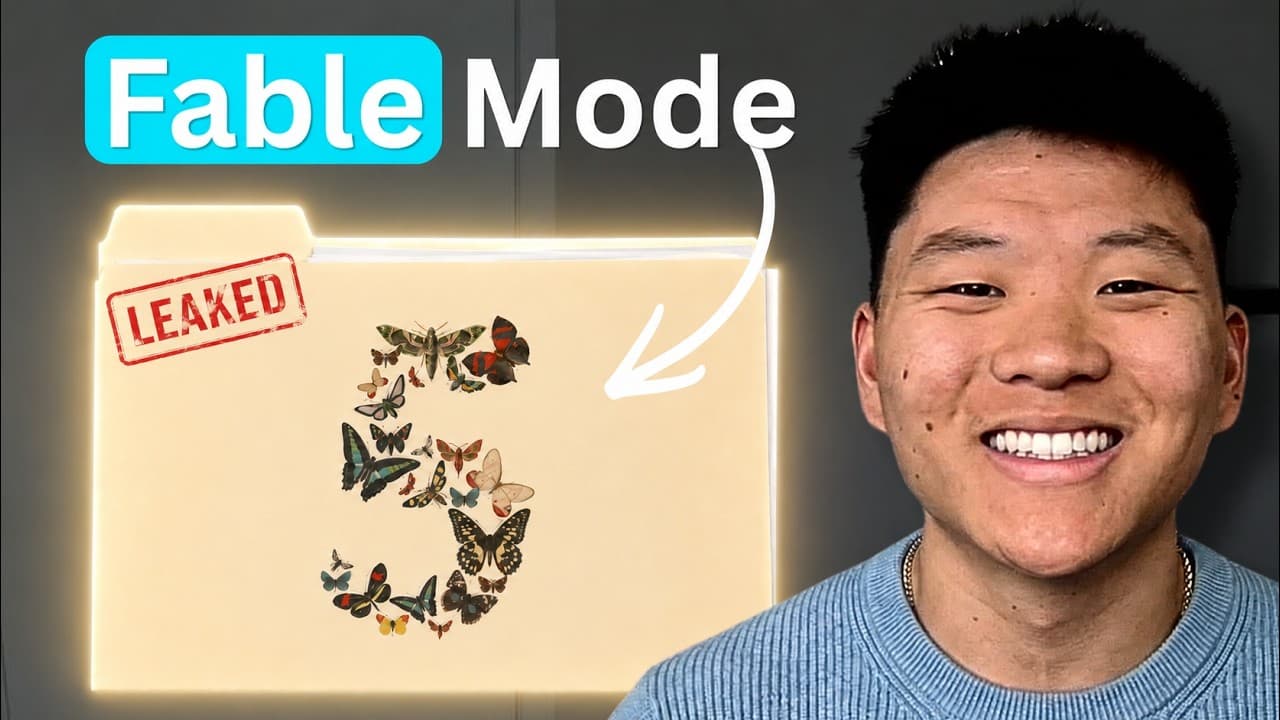
How to Make Opus Reason More Like Fable 5
TL;DR
Capture Fable 5’s process in a reusable skill, then let Opus or Sonnet execute that process at a lower cost. Structure the skill around five gates: scoping, evidence, adversarial reasoning, verification, and reporting, while routing each task to the least expensive model and effort level capable of delivering the required quality.
Transcript
Since we all got access to Fable 5, I've spent a few thousand dollars in usage credits, just playing around with it, understanding how it works, and understanding more importantly how we as people can get the most out of a model this powerful. And I think one of the most important takeaways I've had is that yes, Fable 5 is an incredible model, don'... Read More
Key Insights
- The model is not the primary moat because operator skill, instructions, systems, and feedback loops can matter more than raw model intelligence. A knowledgeable user can produce better work with an older model than a beginner can produce with a substantially stronger model.
- Fable 5’s process can be preserved even when access to its intelligence changes. Its planning, judgment, verification, and reasoning habits can be extracted from successful sessions and converted into reusable instructions that guide Opus, Sonnet, GPT 5.5, or open source models.
- Fable 5 is most valuable as a teacher or senior decision-maker rather than a workhorse. It can inspect existing setups, improve skills, document its working discipline, and transfer its methods to less expensive models that perform the execution.
- Verification is a central part of Fable-style work because remembered information may not represent current knowledge, and a prompt mentioning a file does not prove that the file exists. The workflow should check evidence and confirm completed work before accepting conclusions.
- Effort level is separate from model selection and should be matched to task difficulty. Higher settings can make a run longer and more expensive, while excessive reasoning may cause overthinking, second-guessing, and a worse result than a well-calibrated high-effort run.
- The Fable mode skill is organized around five gates: scoping, evidence, attacking, verifying, and reporting. These gates require the model to define the work, gather support before reasoning, challenge assumptions, validate the result, and communicate conclusions with calibrated confidence.
- Adversarial planning explores unknowns and potential failure points instead of merely listing implementation steps. Fable can design a dynamic workflow around these risks, receive reports from executing agents, and create additional steps when evidence reveals that the plan must change.
- Model routing reduces costs by assigning each task to the least expensive model capable of meeting the required quality. A stronger model can orchestrate and review the workflow while Sonnet or another smaller model handles execution, producing results described as similar to all-Fable workflows.
Install to Summarize YouTube Videos and Get Transcripts
Explore YouTube Video Summarizer or Get YouTube Transcript Extractor
Questions & Answers
Q: How can Opus be made to reason more like Fable 5?
Create an installable skill that captures Fable 5’s judgment, planning, verification, and reasoning habits, then activate it as a dedicated mode when Opus faces a difficult problem. The proposed structure uses five gates: scoping, evidence, attacking assumptions, verifying the work, and reporting the result. It also includes standing habits that require evidence before reasoning and validation before declaring completion.
Q: What are the five gates in the Fable mode skill?
The five gates are scoping, evidence, attacking, verifying, and reporting. Scoping defines the task before work begins. Evidence requires support before conclusions are formed. Attacking applies adversarial reasoning to assumptions, unknowns, and possible failures. Verifying confirms that the output actually works. Reporting communicates the outcome and calibrates claims according to the available evidence.
Q: Why does process matter more than access to the strongest AI model?
Process determines how effectively a model’s intelligence is applied. Clear instructions, reusable systems, dynamic workflows, verification loops, and skilled judgment can allow an experienced operator with an older model to outperform a beginner with a stronger model. Model intelligence cannot be retained independently, but its working process can be documented and reused across Opus, Sonnet, GPT 5.5, or open source models.
Q: How can a successful Fable 5 session become a reusable skill?
Start with a Fable 5 deliverable that produced an unusually strong result, especially one whose quality is difficult to explain. Analyze the deliverable and, when available, the full session. Identify what the model considered, how it reached the result, and what it did to prove the work was correct. Convert those recurring planning, reasoning, and verification behaviors into explicit skill instructions.
Q: Why should Fable 5 be used as a teacher instead of a workhorse?
Fable 5 can contribute the most valuable judgment at the planning and supervisory levels, then transfer that process to cheaper models. The suggested analogy is a senior engineer preparing junior engineers to take over: it reviews setups, improves skills, packages its knowledge, anticipates problems, and directs execution. This preserves its reasoning approach without paying for it to perform every routine step.
Q: How should effort levels be selected for AI tasks?
Choose the effort level according to the difficulty and uncertainty of the task rather than automatically selecting the maximum. The transcript reports that Fable 5 on low can be similar to Opus 4.8 on high in the referenced comparison. It also warns that extra-high or maximum effort can produce longer, more expensive runs that overthink and second-guess decisions, sometimes yielding worse results.
Q: What is model routing, and how does it reduce AI costs?
Model routing assigns work according to the intelligence, cost, and taste required for each task. A stronger model handles planning, supervision, or difficult judgment, while a smaller and cheaper model performs work within its capabilities. A routing table can list the available models, their relative cost, perceived intelligence, and taste, helping a workflow obtain more useful work from a limited monthly AI budget.
Q: Why can Fable-orchestrated Sonnet agents match all-Fable workflows?
The reported tests found roughly similar results when Fable 5 orchestrated Sonnet subagents and when it orchestrated Fable subagents, although the all-Fable runs cost substantially more. The proposed explanation is that Fable contributes the important planning, risk analysis, and continuing supervision. Sonnet can then execute defined steps, report its findings, and receive newly designed steps from Fable as the workflow develops.
Summary & Key Takeaways
-
Model intelligence alone does not determine output quality. A skilled operator using an older or smaller model can outperform a beginner using a stronger model because instructions, systems, workflows, and feedback loops shape performance. The durable advantage is therefore the process surrounding the model, rather than exclusive access to one model.
-
Fable 5 should be treated as a teacher, senior engineer, or company officer whose judgment can be documented for other models. Strong past sessions and deliverables can be analyzed to identify planning, reasoning, and verification habits. Those habits can then be packaged into an installable skill that works with Opus, Sonnet, or other models.
-
The proposed Fable mode uses five gates: scoping, evidence, attacking assumptions, verification, and reporting. It pairs naturally with model routing, where a stronger model plans and supervises while cheaper models execute suitable tasks. Effort levels must also be calibrated because maximum effort can increase cost, length, overthinking, and second-guessing without improving results.
Read in Other Languages (beta)
Share This Summary 📚
Summarize YouTube Videos and Get Video Transcripts with 1-Click
Try YouTube Summary with ChatGPT & Claude or YouTube Transcript Generator
Explore More Summaries from Nate Herk | AI Automation 📚


Summarize YouTube Videos and Get Video Transcripts with 1-Click
Try YouTube Summary with ChatGPT & Claude or YouTube Transcript Generator