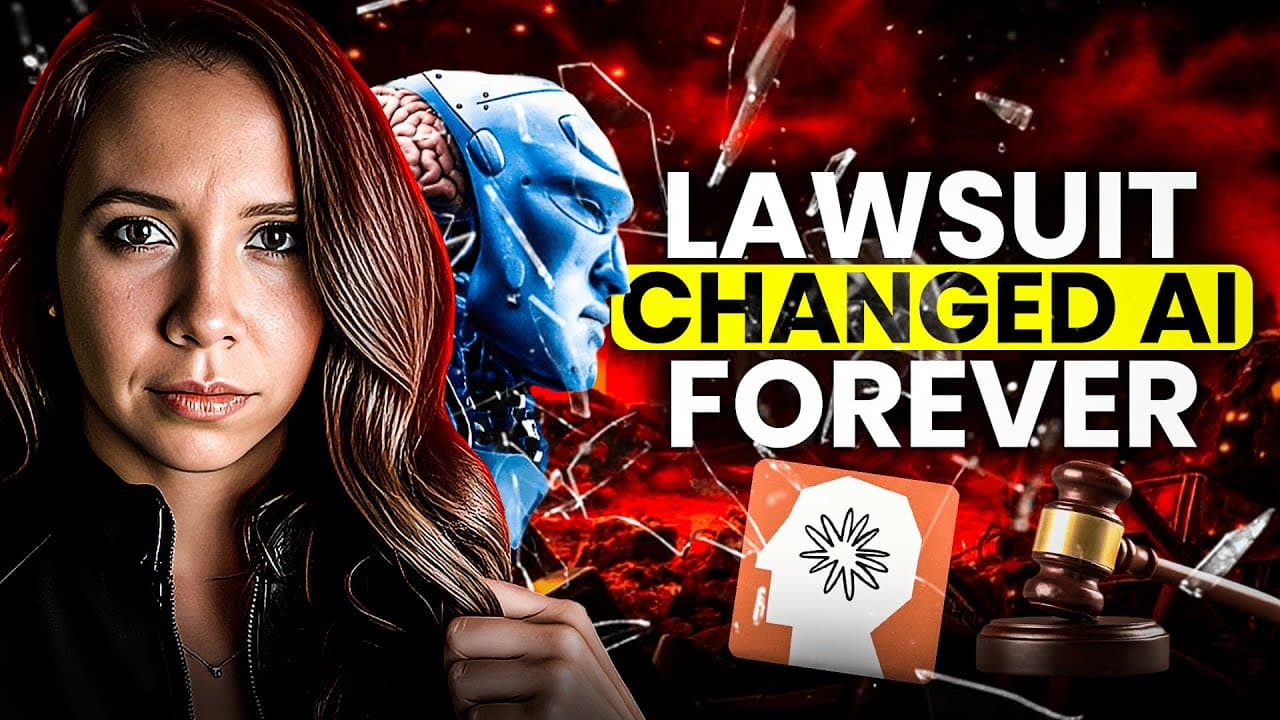
Anthropic's $1.5 Billion Copyright Settlement: What It Means for AI
TL;DR
Training AI on copyrighted books can count as fair use, but obtaining them from pirate sites does not. Anthropic settled the authors' class action for $1.5 billion, roughly $3,000 per book across about 500,000 works, covering past conduct only. The case sets two precedents that push AI companies toward licensing training data.
Transcript
7 million books stolen, not from a library, from pirate websites. And the company that did it, they literally have AI safety in their mission statement. I'm talking about Anthropic, the company behind Claude, one of the most advanced AI systems on the planet. And they just agreed to pay $1.5 billion to settle the biggest copyright lawsuit in Americ... Read More
Key Insights
- The Anthropic case was filed in August 2024 by authors Andrea Barts, Charles Greyber, and Kirk Wallace Johnson, who alleged the company downloaded over seven million books from pirate sites, including Library Genesis and Pirate Library Mirror.
- Judge William Alsup ruled in June 2025 that training AI on books is fair use, calling it exceedingly transformative, because the training resembles human learning rather than copying for resale.
- Downloading books from pirate websites is not fair use, according to the same judge, who said a company cannot excuse taking any textbook it wants by claiming a research purpose.
- Statutory damages can reach $150,000 per willfully infringed work, so seven million books created potentially existential exposure in the hundreds of billions, which pushed Anthropic to settle in September 2025.
- The $1.5 billion settlement works out to roughly $3,000 per book, is split between authors and publishers, covers about 500,000 unique works, and is paid over three years.
- The settlement covers only past conduct and gives Anthropic no rights to use the pirated data going forward, so it is payment for past infringement rather than a license.
- The US Copyright Office's May 2025 report states that AI learning differs from human learning in ways that matter for copyright, since AI training makes perfect copies and can sometimes reproduce works verbatim.
- Licensing is predicted to become mandatory, with OpenAI deals such as $70 million with Reddit, and a licensing market of $2.5 billion already existing, which may widen the gap between big tech and small AI startups.
Install to Summarize YouTube Videos and Get Transcripts
Explore YouTube Video Summarizer or Get YouTube Transcript Extractor
Questions & Answers
Q: Why did Anthropic agree to pay $1.5 billion in the authors' lawsuit?
Anthropic faced a trial with potential statutory damages of up to $150,000 per willfully infringed work across more than seven million allegedly pirated books, a figure that could reach into the hundreds of billions of dollars. Weighing that existential risk, the company settled in September 2025 for $1.5 billion instead.
Q: Is training AI on copyrighted books legal under fair use?
In June 2025, Judge William Alsup ruled that using books to train AI was fair use, describing the training as exceedingly and quintessentially transformative and comparing it to human learning. However, the ruling was nuanced: it covered the training itself, not how the books were obtained, so it does not protect piracy.
Q: Why was downloading books from pirate sites not protected as fair use?
The judge held that acquiring books from pirate websites was absolutely not fair use. He stated that a company cannot bless itself by claiming a research purpose and then take any textbook it wants. The lawsuit named Library Genesis and Pirate Library Mirror as the sources, with about 5 million and 2 million books respectively.
Q: How is the $1.5 billion Anthropic settlement structured?
The settlement comes to roughly $3,000 per book, split between authors and publishers, and covers about 500,000 unique works. Payments are spread over three years. It only resolves past conduct and does not give Anthropic any rights to use the data going forward, so it is not a license.
Q: Is AI learning the same as human learning under copyright law?
No, according to the US Copyright Office's May 2025 report, which said AI learning differs from human learning in ways material to copyright analysis. Humans keep imperfect impressions filtered through personality and worldview, while AI training creates perfect copies of millions of works, processes them billions of times, and can sometimes reproduce them verbatim.
Q: Which other AI companies are facing copyright lawsuits?
Every major AI company faces suits. OpenAI was sued by the New York Times, George RR Martin, and the Authors Guild, and a judge found substantial similarity between ChatGPT summaries and Game of Thrones. Meta won summary judgment in Kadrey versus Meta, though the judge said the ruling does not make its use lawful. Music publishers sued Anthropic in 2023 over lyrics, and over 40 lawsuits are pending.
Q: How will the Anthropic ruling change AI training data in the future?
The speaker predicts four shifts: licensing becomes mandatory, with deals like OpenAI's $70 million Reddit agreement and a $2.5 billion licensing market already existing; small companies fall behind because they cannot afford licensing; training data becomes regulated, as in the EU AI Act; and AI may temporarily get worse as quality public data could run out between 2026 and 2032.
Q: Why might the settlement hurt small AI companies more than big tech?
Million-dollar licensing deals are affordable for large companies but not for startups. The Electronic Frontier Foundation warned that the cost of licensing training data could entrench big tech's dominance and shut out small developers, since only well-funded firms can pay creators for the content that AI models need to improve.
Summary & Key Takeaways
-
Three authors sued Anthropic in August 2024, alleging it downloaded over seven million books from pirate sites such as Library Genesis and Pirate Library Mirror. The complaint also said Anthropic bought physical books, scanned them, and destroyed the originals, and accused the company of cloaking itself in AI safety rhetoric.
-
Judge William Alsup issued two rulings in opposite directions. Training on the books was fair use and exceedingly transformative, but downloading them from pirate sites was not. Facing statutory damages up to $150,000 per work, Anthropic settled in September 2025 for $1.5 billion, about $3,000 per book across roughly 500,000 works.
-
Other AI companies face over 40 pending lawsuits, including OpenAI versus the New York Times and Kadrey versus Meta. The speaker predicts mandatory licensing, a widening gap with small AI firms, regulated training data, and possible short-term capability drops as quality public data may run out between 2026 and 2032.
Read in Other Languages (beta)
Share This Summary 📚
Summarize YouTube Videos and Get Video Transcripts with 1-Click
Try YouTube Summary with ChatGPT & Claude or YouTube Transcript Generator
Explore More Summaries from Julia McCoy 📚




Summarize YouTube Videos and Get Video Transcripts with 1-Click
Try YouTube Summary with ChatGPT & Claude or YouTube Transcript Generator