Jeremy Howard: Deep Learning Frameworks - TensorFlow, PyTorch, fast.ai | AI Podcast Clips
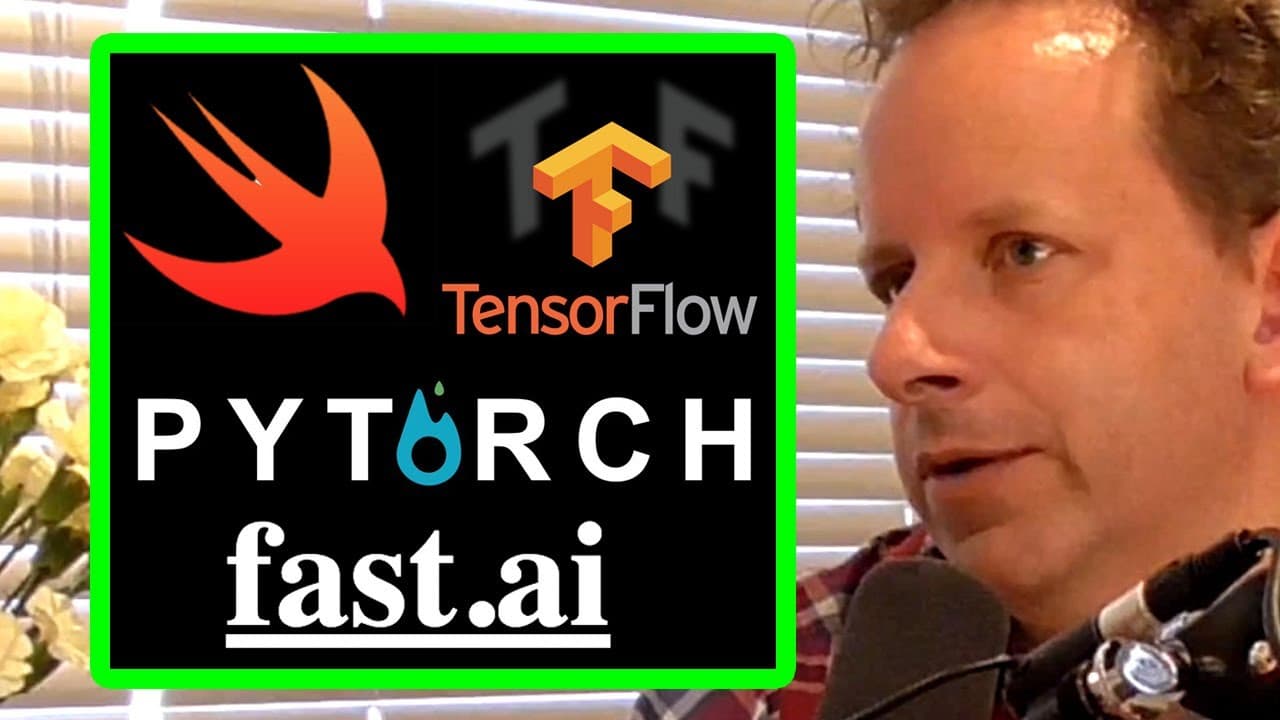
TL;DR
PyTorch and FastAI offer superior flexibility and usability over Theano and TensorFlow by allowing developers to use standard Python programming. This approach simplifies debugging and accelerates experimentation, making it easier for newcomers to learn deep learning concepts effectively.
Transcript
the from the perspective of deep learning frameworks you work with fast AI tickler this framework and pi torch intensive flow what are the strengths of each platform your perspective so in terms of what we've done our research on and taught in our course we started with Theano and care us and then we switch to tensor flow and care us and then we sw... Read More
Key Insights
- 👨💻 TensorFlow, despite its popularity, has code organization issues and technical debt that hinder its performance and programmability.
- 😄 PyTorch's flexibility and ease of use make it a preferred choice for researchers and practitioners, offering an API that allows training state-of-the-art neural networks in just a few lines of code.
- 🖤 Swift for TensorFlow has potential but is currently lacking in data science community libraries and prioritization from Apple.
- 😒 The ability of Swift for TensorFlow to directly use Python code and libraries provides an intermediate solution for adoption.
- 🎙️ More videos with Jeremy Howard:
Install to Summarize YouTube Videos and Get Transcripts
Explore YouTube Video Summarizer or Get YouTube Transcript Extractor
Questions & Answers
Q: What were the strengths and limitations of Theano and TensorFlow?
Theano and TensorFlow were great deep learning frameworks but had limitations in terms of programmability and debugging due to their upfront definition of a computational graph. They were harder to teach and do research and development on.
Q: Why is PyTorch considered a strong entrant in the field of deep learning frameworks?
PyTorch provides a significant leap in research and teaching capabilities by allowing normal Python usage and offering more control and flexibility. It eliminates the need for boilerplate code and overhead, allowing researchers to focus on their algorithms.
Q: What are the limitations of PyTorch for newcomers and researchers?
PyTorch requires users to write their own training loop and manage gradients, making it less accessible for newcomers. Additionally, it can be time-consuming for researchers to deal with the boilerplate code instead of focusing on their algorithms.
Q: How does Swift compare to Python as a language for deep learning frameworks?
Swift is not yet as practical as Python for deep learning frameworks, but it shows promise. The lack of data science community libraries and a limited understanding of numeric computing in the Swift community hinder its adoption. However, Swift for TensorFlow may change the landscape in the future.
Key Insights:
- TensorFlow, despite its popularity, has code organization issues and technical debt that hinder its performance and programmability.
- PyTorch's flexibility and ease of use make it a preferred choice for researchers and practitioners, offering an API that allows training state-of-the-art neural networks in just a few lines of code.
- Swift for TensorFlow has potential but is currently lacking in data science community libraries and prioritization from Apple.
- The ability of Swift for TensorFlow to directly use Python code and libraries provides an intermediate solution for adoption.
Overall, the analysis highlights the strengths and weaknesses of various deep learning frameworks, emphasizing the importance of flexibility, programmability, and ease of use in research and teaching. PyTorch and Swift for TensorFlow show promise in addressing these concerns and shaping the future of deep learning frameworks.
Summary
In this video, the speaker discusses the strengths and weaknesses of various deep learning frameworks, including FastAI, TensorFlow, and PyTorch. He explains how these frameworks have evolved over time and shares his perspective on their usability, accessibility, and performance. The speaker also mentions the potential of using Swift for deep learning in the future, highlighting its advantages and current limitations.
Questions & Answers
Q: What are the strengths and weaknesses of FastAI and PyTorch?
FastAI and PyTorch are both powerful frameworks for deep learning. FastAI, built on top of PyTorch, provides a high-level API that allows users to train state-of-the-art neural networks with just a few lines of code. It offers progressively more control, allowing deep dives into the underlying layers of the framework. PyTorch, on the other hand, allows users to use normal Python programming, making it accessible and familiar. However, its drawback is that it requires users to write their own training loops and manage gradients, which can be challenging for newcomers and researchers.
Q: What is the main limitation of PyTorch?
One of the main limitations of PyTorch is its lack of accessibility for newcomers. The framework requires users to write their own training loops and manage gradients, which can be daunting for beginners. Additionally, the boilerplate code and overhead involved can detract from the focus on algorithm development. However, efforts have been made to address these limitations, resulting in a multi-layered API that allows users to train neural networks with just a few lines of code.
Q: How does TensorFlow compare to PyTorch?
TensorFlow originally aimed to replicate the interactive computation features of PyTorch but failed to make significant changes to its foundational runtime components. While TensorFlow Eager, a more recent addition, provides a syntax similar to PyTorch and improves programmability, it is still about 10 times slower than PyTorch in terms of actual computation speed. The codebase of TensorFlow is disorganized and reflects a lack of thorough consideration in its design, making it challenging to retool its foundations. As a result, the speaker holds a negative view of TensorFlow's potential future.
Q: Is there a potential for Swift to be used in deep learning?
Yes, there is a potential for Swift to be used in deep learning, but it may take a few years for it to become practical. Swift for TensorFlow, built on top of the MLIR compiler infrastructure, can leverage the powerful LLVM compiler to take advantage of great compiler-related features. However, currently, Swift lacks a strong data science community and understanding of numeric computing, leading to suboptimal decisions and performance-related issues. The involvement of Chris Lattner, the developer of Swift, in Swift for TensorFlow at Google shows promise, but it remains to be seen if Apple, the creator of Swift, will prioritize numeric programming in their low-level libraries.
Q: What deep learning framework and library does the speaker recommend for new students?
The speaker strongly recommends using FastAI and PyTorch for new students. These frameworks are practical for teaching and provide an opportunity to quickly grasp the concepts of deep learning. Moreover, using FastAI and PyTorch allows students to utilize state-of-the-art techniques and achieve world-class results. It is worth noting that the choice of deep learning library may not matter significantly, as switching between libraries can be done within a couple of days for someone with a solid understanding of the foundations.
Takeaways
In summary, FastAI and PyTorch offer practicality, usability, and the ability to achieve state-of-the-art results in deep learning. While PyTorch excels in its accessibility to beginners and familiarity to Python programmers, FastAI provides a high-level API that simplifies building and training neural networks. On the other hand, TensorFlow's shortcomings, such as slower computation speed and disorganized codebase, hinder its potential for growth and improvement. Swift for TensorFlow shows promise, but its lack of a strong data science community and incomplete support from Apple present significant challenges. Ultimately, the choice of the deep learning framework depends on the specific needs and goals of the user.
Summary & Key Takeaways
-
The growth and development of deep learning libraries have led to advancements in research and teaching, with Theano and TensorFlow being early players in the field.
-
However, Theano and TensorFlow require defining a computational graph upfront, making it harder to debug and program interactively.
-
PyTorch, on the other hand, allows normal Python usage and offers more control and flexibility without sacrificing performance.
Read in Other Languages (beta)
Share This Summary 📚
Summarize YouTube Videos and Get Video Transcripts with 1-Click
Try YouTube Summary with ChatGPT & Claude or YouTube Transcript Generator
Explore More Summaries from Lex Fridman 📚


Summarize YouTube Videos and Get Video Transcripts with 1-Click
Try YouTube Summary with ChatGPT & Claude or YouTube Transcript Generator