How Big Is the Andromeda Galaxy Really?
TL;DR
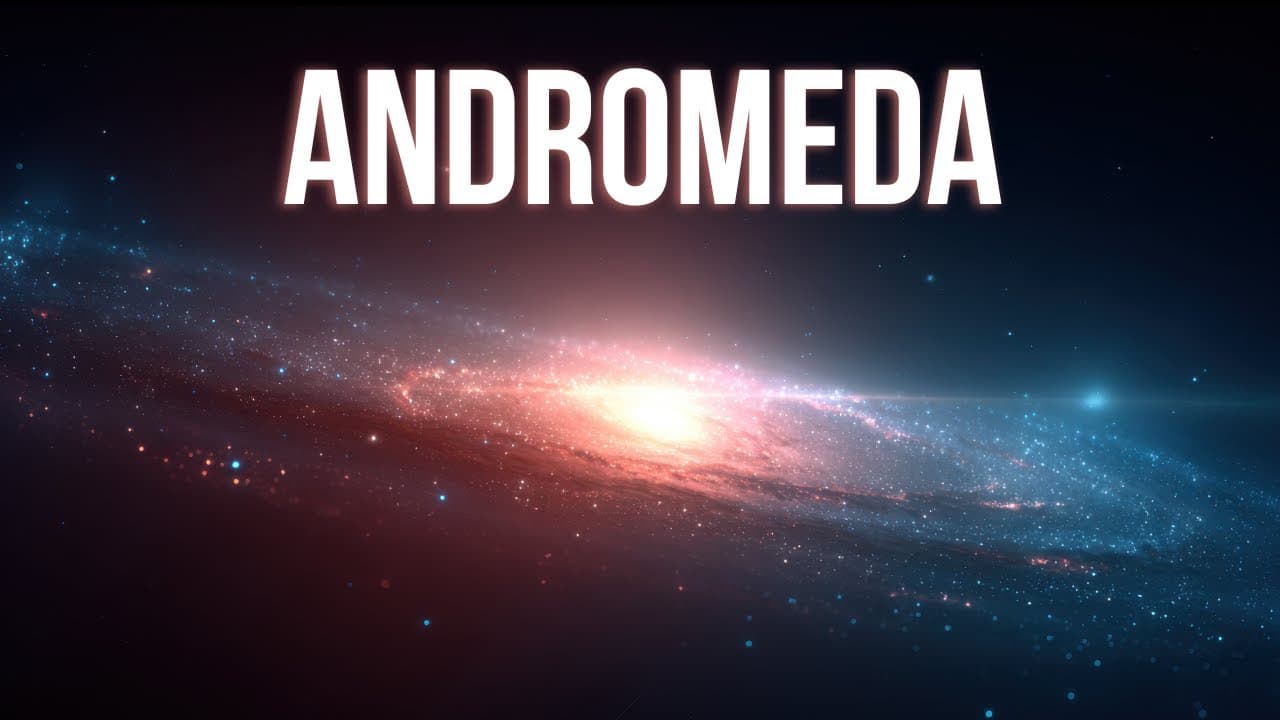
Andromeda spans roughly 220,000 light years and holds about 1 trillion stars, making it around 1.5 times the Milky Way's diameter with 2 to 3 times its star count. It sits 2.54 million light years away, about 24 quintillion kilometers, so its light left when Homo habilis walked Africa. A single black hole of roughly 140 million solar masses anchors its center.
Transcript
Tonight, we're going to explore something that will completely change how you understand our place in the universe. We're going to discover the true scale of the Andromeda galaxy. Not just the numbers you might have heard before, but what those numbers actually mean. By the end of this journey, you're going to understand a structure so vast that it... Read More
Key Insights
- Andromeda is the largest deep sky object visible without a telescope. The naked eye sees an elongated patch about 1.5 to 2 degrees long, the size of two or three full moons end to end, while long exposure imaging stretches the full disc to 5 to 6 degrees.
- The often quoted claim that Andromeda covers 30 full moons of sky came from older misunderstandings. The real photographic extent, roughly 10 to 12 full moons side by side, is still far larger than anything the unaided eye can detect on a dark night.
- Edwin Hubble proved Andromeda was a separate galaxy in the 1920s using the 100 inch telescope at Mount Wilson. By resolving individual stars and measuring variable stars called Cepheids, he calculated a distance placing it far beyond the boundaries of the Milky Way.
- Andromeda's distance of 2.54 million light years means its light left before modern humans existed. Homo habilis walked the African savannas when those photons departed, and all of recorded human history represents less than one quarter of one percent of that travel time.
- The supermassive black hole at Andromeda's center holds roughly 140 million solar masses, about 35 times more than Sagittarius A star at the Milky Way's center, which measures only about 4 million solar masses.
- The long standing theory that Andromeda hosts two supermassive black holes has largely been ruled out. Observations from 2020 onward point to a single black hole surrounded by an eccentric, off-center elongated disc of stars that creates the double nuclear appearance.
- Spiral arms are density waves rather than rigid structures, working like traffic jams on a circular highway. Stars pass through them during their orbits, and the compression triggers gas clouds to collapse into new stars, which is why the arms shine bright.
- Andromeda's lopsided spiral structure likely came from a major merger with another large galaxy about 800 million years ago. The collision disrupted the orderly spiral pattern, creating asymmetries between the two sides that persist to this day.
Install to Summarize YouTube Videos and Get Transcripts
Explore YouTube Video Summarizer or Get YouTube Transcript Extractor
Questions & Answers
Q: How to find the Andromeda galaxy with the naked eye?
On a dark night far from city lights, first locate Cassiopeia, the W-shaped constellation. From the center of the W, trace a line toward the constellation Pegasus. About halfway along that path you will find a fuzzy oval patch, which is Andromeda. It sits in the constellation Andromeda, named after an Ethiopian princess from Greek mythology. To the naked eye it appears as an elongated fuzzy patch roughly 1.5 to 2 degrees long, about the size of two or three full moons placed end to end. No equipment is needed.
Q: How far away is the Andromeda galaxy in kilometers?
Andromeda sits 2.54 million light years from Earth. Since light travels about 300,000 kilometers per second, or 186,000 miles per second, and covers roughly 9.5 trillion kilometers in a single year, the total distance works out to approximately 24 quintillion kilometers. That is 24 followed by 18 zeros, or about 15 quintillion miles. For comparison, sunlight reaches Earth in 8 minutes and 20 seconds, and light from Proxima Centauri, the nearest star beyond the Sun, takes 4.24 years.
Q: How long would it take to travel to Andromeda with current spacecraft?
The Parker Solar Probe, the fastest spacecraft humans have built, reaches about 700,000 kilometers per hour or 430,000 miles per hour at its closest approach to the Sun. At that speed, reaching Andromeda would take roughly 3.9 billion years, nearly as long as Earth has existed. Voyager 1, launched in 1977 and now humanity's most distant object, travels at about 61,000 kilometers per hour or 38,000 miles per hour, which would stretch the journey to over 44 billion years, more than three times the current age of the universe.
Q: How does Andromeda compare in size to the Milky Way?
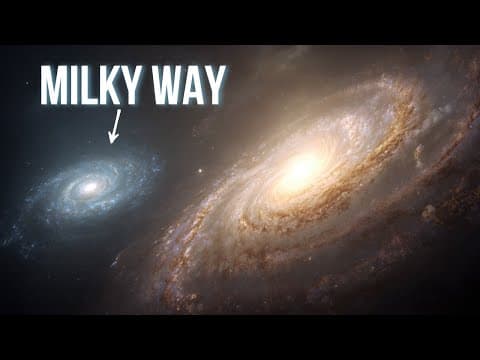
Andromeda measures approximately 220,000 light years in diameter, while the Milky Way spans about 100,000 light years, making Andromeda roughly 1.5 times larger on the latest estimates. Andromeda contains roughly 1 trillion stars compared to the Milky Way's 100 billion to 400 billion, so it holds about 2 to 3 times as many stars. Its total mass, including stars, gas, dust, and dark matter, comes to approximately 1.5 to 2 trillion solar masses. Both galaxies share the same basic barred spiral structure.
Q: Does Andromeda have two supermassive black holes?
No. For years astronomers debated whether Andromeda hosted two supermassive black holes based on a double nuclear structure visible in images, a popular theory in the early 2000s. However, more recent observations and analysis, particularly from 2020 onward, have largely ruled this out. The current scientific consensus points to a single black hole surrounded by an eccentric disc of stars. The double structure results from the way stars orbit the central black hole in an off-center, elongated disc, a fascinating optical effect rather than evidence of a binary system.
Q: What would the night sky look like from a planet near Andromeda's core?
The night sky would be completely transformed. The central bulge spans roughly 30,000 light years and contains several hundred billion old stars packed into a relatively small volume, with stellar density thousands of times higher than in our solar neighborhood. Thousands of stars would shine brightly enough to cast shadows, and the combined starlight would create a perpetual twilight, making true darkness impossible. Surviving there would also require withstanding the intense radiation environment near the galactic core.
Q: Why do spiral arms look brighter than the rest of a galaxy?
Spiral arms appear bright because that is where most star formation occurs. The arms are density waves, regions where stars and gas temporarily bunch up, similar to traffic jams forming and dissolving on a circular highway. When the density wave passes through a region, it compresses gas clouds enough to trigger gravitational collapse and fragment them into new stars. The most massive of these, O and B type stars, outshine the Sun by factors of thousands or even millions, but live only a few million years before exploding as supernovae, so they stay concentrated near their birthplaces.
Q: What is a tidal disruption event near a black hole?
A tidal disruption event happens when a star ventures too close to a supermassive black hole. The black hole's immense tidal forces stretch the star into a long stream of gas. That gas spirals inward, heating to millions of degrees and emitting intense X-rays before disappearing forever beyond the event horizon. In Andromeda's dense core, stars pass close enough to each other that gravitational interactions are common: binary systems can be disrupted, with one star captured by a new partner while the other is flung away at high speed.
Q: What would happen if Andromeda's central black hole became active?
Andromeda's black hole is currently quiescent, meaning it is not consuming large amounts of matter. If a large gas cloud or an entire star wandered too close, the black hole would devour it violently. The infalling material would form an accretion disc, a swirling maelstrom of superheated gas that would emit more light than the rest of the galaxy combined. Jets of particles might shoot outward perpendicular to the disc at nearly the speed of light, creating a quasar or active galactic nucleus and transforming Andromeda from a peaceful spiral into one of the most energetic objects in the local universe.
Summary & Key Takeaways
-
Andromeda is visible to the naked eye on a dark night as a fuzzy oval patch found by tracing a line from the center of Cassiopeia's W toward Pegasus. To the eye it covers about 1.5 to 2 degrees, but long exposure photographs including ultraviolet and hydrogen alpha light reveal a disc 5 to 6 degrees across.
-
The galaxy lies 2.54 million light years away, roughly 24 quintillion kilometers. Light needs 2.5 million years to cross that gap, the Parker Solar Probe at 700,000 km/h would need about 3.9 billion years, and Voyager 1 at 61,000 km/h would need over 44 billion years, more than three times the age of the universe.
-
Andromeda is a barred spiral about 220,000 light years wide containing roughly 1 trillion stars and 1.5 to 2 trillion solar masses of total material. Its central bulge spans 30,000 light years, its core stars are old metal-poor population two stars, and its spiral arms are density waves that trigger new star formation.
Read in Other Languages (beta)
Share This Summary 📚
Summarize YouTube Videos and Get Video Transcripts with 1-Click
Try YouTube Summary with ChatGPT & Claude or YouTube Transcript Generator
Explore More Summaries from Boring Space 📚



Summarize YouTube Videos and Get Video Transcripts with 1-Click
Try YouTube Summary with ChatGPT & Claude or YouTube Transcript Generator