Codex vs Claude Code: Which Is Better for Strategic Planning?
TL;DR
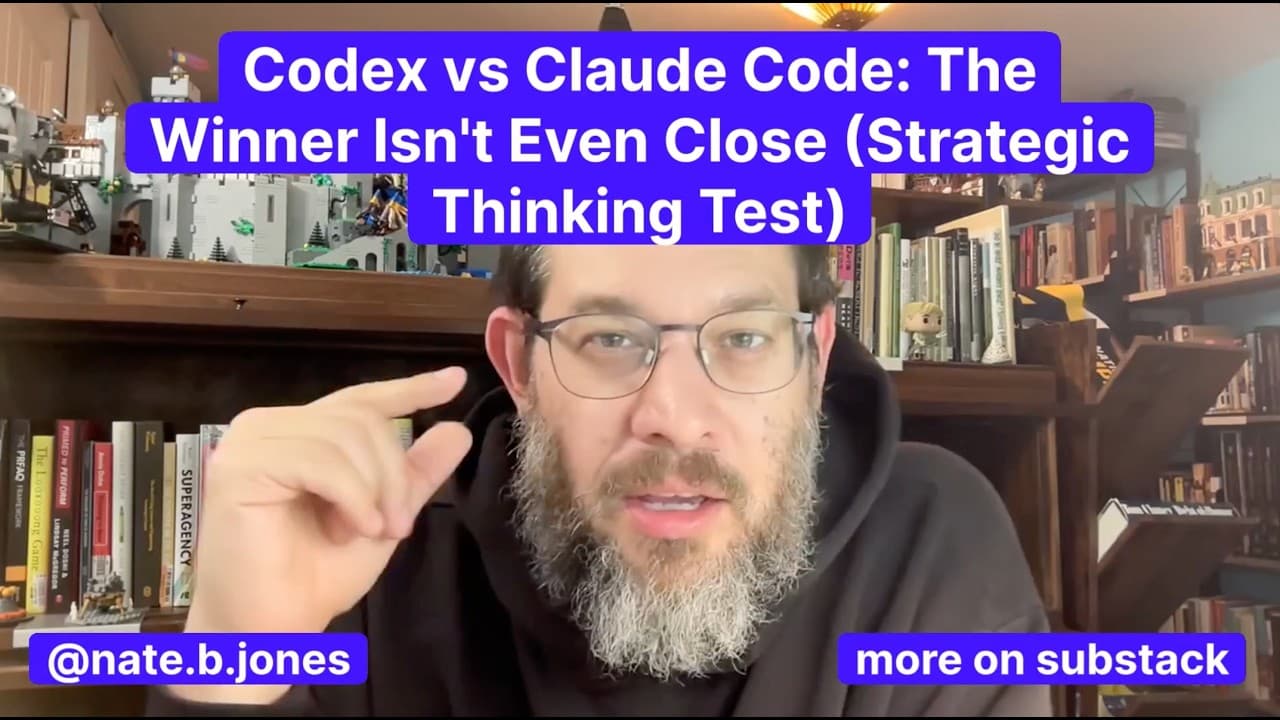
Codex is the better strategic planning partner in this side-by-side strategic thinking test because it keeps the discussion focused on architecture, trade-offs, risks, and key decisions before implementation. Given the same Jira multi-agent system prompt, Codex presented three scannable approaches, while Claude Code moved quickly into confidence thresholds, failure tables, and a sequential pipeline. Read on to compare their planning styles and the questions Codex surfaced.
Transcript
Codex is hands down the best strategic thinking partner that I have found for technically adjacent problems. What I mean by that is that if I am facing a problem and it's not code, I want to emphasize that people hear codeex and they hear clawed code and they think that means I'm just going to talk about coding stuff. I'm not. This is not for codin... Read More
Key Insights
- Codex is presented as a strategic thinking tool for technically adjacent problems, not merely as a coding assistant. It can help users reason about software systems, architecture options, governance, risks, and investment decisions without requiring them to implement the resulting plan in Codex.
- The comparison is based on an identical prompt about a multi-agent deployment that would triage Jira tickets, determine whether reported issues are bugs, trigger initial code review, and begin drafting pull requests while accounting for failure and degradation paths.
- Codex organizes the problem into three scannable options: a tool-augmented approach, an event-driven workflow, and an agentic pipeline. This framing keeps the discussion at the architectural level before committing to detailed implementation choices or individual failure scenarios.
- Claude Code is portrayed as having a strong bias toward action and specificity. It quickly introduces confidence thresholds, failure tables, and a sequential pipeline, which may be useful later but can distract from the high-level decisions that should guide early system planning.
- Planning is described as the highest-leverage stage of AI-assisted engineering because early decisions shape later implementation. A tool that clarifies options, risks, and governance can prevent premature commitments and provide more value than simply generating code after major choices have already been made.
- Codex identifies strategic questions concerning automation boundaries, quality and risk metrics, governance, operational resilience, and investment. These categories help decision-makers determine where humans should intervene, how success should be evaluated, and how the system should behave when components fail or become uncertain.
- Codex can translate technical architecture into accessible language for non-technical readers. It describes an agentic approach as a central coordinator assigning tickets to specialist bots and an event-driven approach as bots reacting when ticket statuses change, preserving the core distinctions without excessive jargon.
- The main distinction is between structured and iterative working styles. Codex is characterized as favoring clear structure, concise option framing, and difficult goal-oriented analysis, while Claude Code is described as useful for conversational iteration and repeated cycles that generate additional possibilities over time.
Install to Summarize YouTube Videos and Get Transcripts
Explore YouTube Video Summarizer or Get YouTube Transcript Extractor
Questions & Answers
Q: Why was Codex better than Claude Code for strategic planning in this test?
Codex stayed at the strategic level requested, presenting clear approaches, component considerations, degradation paths, and decision questions. Claude Code offered relevant ideas but moved quickly into confidence thresholds, a failure table, and a sequential pipeline before the broader choices had been settled.
Q: What task was used to compare Codex and Claude Code?
Both tools received the same prompt about designing a multi-agent AI deployment. The proposed system would triage Jira tickets filed by customer success, assess whether an issue was a bug, trigger an initial code review for confirmed bugs, begin drafting a pull request, and account for failure and degradation paths.
Q: What architectural approaches did Codex propose?
Codex presented three approaches: a tool-augmented approach, an event-driven workflow, and an agentic pipeline. The options were organized so they could be scanned and compared before choosing specific implementation details.
Q: What strategic questions did Codex identify for the multi-agent system?
Codex raised questions about data, human involvement, tooling, scalability, governance, resilience, quality, risk, and investment. It also asked what labeled ticket history existed to train or assess triage accuracy, helping define what good performance would look like.
Q: What failure and degradation risks did Codex highlight?
Codex identified classification uncertainty and model hallucination as degradation concerns. It presented these risks concisely while keeping the discussion focused on how the system should be designed rather than prematurely detailing every possible failure mode.
Q: Why can moving into technical details too quickly hurt strategic planning?
Early specificity can pull attention away from the major choices that need to guide the system. In this comparison, Claude Code's confidence thresholds, failure table, and sequential pipeline arrived before the user was ready to decide on specific failure modes or implementation details.
Q: Can Codex help non-engineers think about software systems?
Yes. The comparison presents Codex as useful for anyone who wants to think intentionally about software systems or products, not only people writing code. Its structured options and plain-English questions made the technical planning easier to follow, and using it for planning did not commit the user to building the system in Codex.
Q: When might Claude Code still be useful for planning?
Claude Code may suit a more iterative, conversational working style that develops additional possibilities over repeated exchanges. Its bias toward action and specificity can produce useful details, although the comparison found that style less suitable for framing high-level decisions at the beginning of planning.
Summary & Key Takeaways
-
Codex and Claude Code received the same prompt about designing a multi-agent system for Jira ticket triage, bug assessment, initial code review, and pull request drafting. The comparison evaluated whether each tool could identify strategic questions, technical trade-offs, automation boundaries, failure paths, governance needs, and human oversight requirements before implementation decisions were made.
-
Codex presented three scannable architectural options: a tool-augmented approach, an event-driven workflow, and an agentic pipeline. It then organized considerations around components, uncertainty, hallucination, data, tooling, scalability, human involvement, governance, resilience, quality, risk, and investment. Its concise structure made the technical problem accessible to both engineering and non-technical audiences.
-
Claude Code offered useful material, including confidence thresholds, failure tables, and a sequential pipeline, but moved into detailed design choices earlier than requested. The comparison concludes that Claude Code may suit iterative conversation, while Codex is stronger for structured planning, high-level decision framing, and producing clear analysis that teams can understand and share.
Read in Other Languages (beta)
Share This Summary 📚
Summarize YouTube Videos and Get Video Transcripts with 1-Click
Try YouTube Summary with ChatGPT & Claude or YouTube Transcript Generator
Explore More Summaries from AI News & Strategy Daily | Nate B Jones 📚






Summarize YouTube Videos and Get Video Transcripts with 1-Click
Try YouTube Summary with ChatGPT & Claude or YouTube Transcript Generator