How to Invest Your Money During a Major War
TL;DR
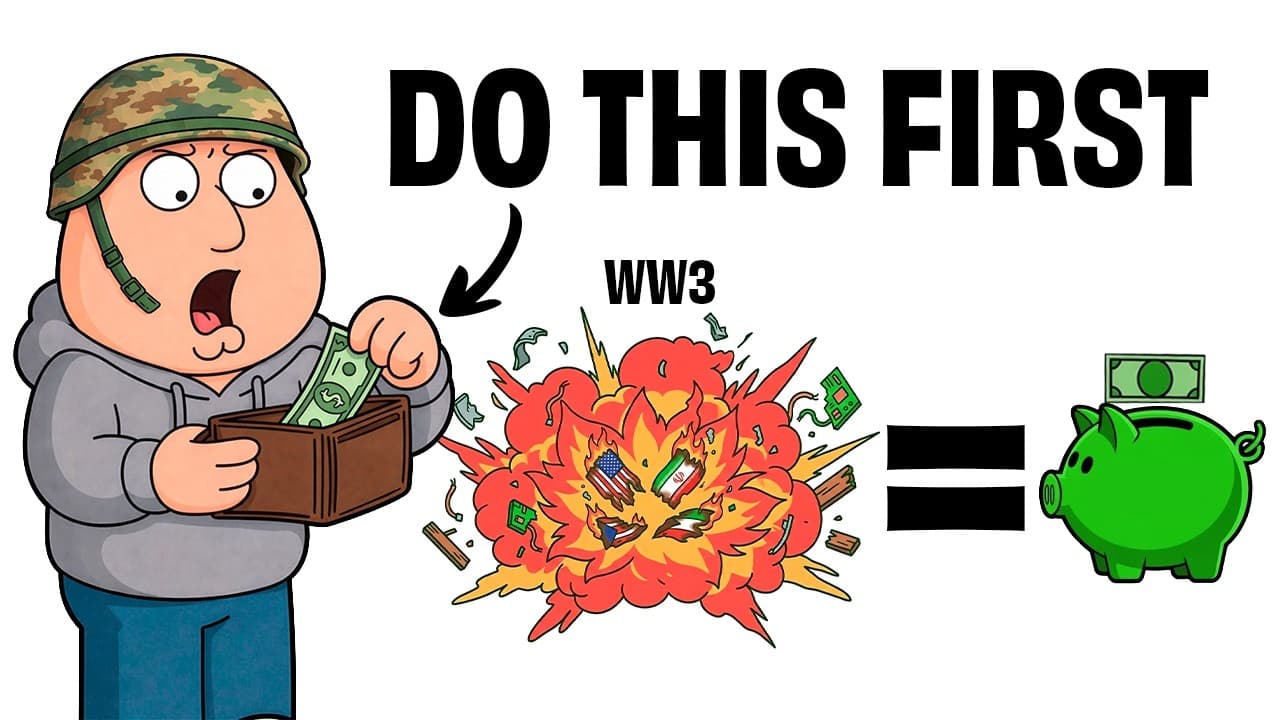
Keep six to twelve months of expenses accessible, maintain broad market exposure, and avoid panic selling during conflict-driven volatility. The suggested sequence is to establish an emergency reserve first, then allocate 10–15% of investable assets to gold, while recognizing that fear-driven gold spikes and excess wartime cash can both damage long-term purchasing power.
Transcript
The first thing most people would do if World War II started tomorrow is open their brokerage app, not call their mom, not check on their neighbors, their brokerage app, because that's what financial anxiety does to you. It hijacks every primal instinct and redirects it toward a portfolio that in the grand scheme of global conflict probably doesn't... Read More
Key Insights
- Financial media has a commercial incentive to amplify geopolitical anxiety because fear increases viewership, engagement, and advertising revenue. The transcript argues that dramatic labels can make a 2% market decline sound exceptional, even though such movement may be consistent with ordinary volatility around conflict headlines.
- Broad stock markets have historically survived major wars and crises rather than permanently collapsing. The transcript states that the Dow gained 50% during World War II, 60% during the Korean War, and 27% during Vietnam, while 73% of armed conflicts since 1945 were followed by positive one-year S&P 500 returns.
- War spending can support corporate earnings because governments purchase weapons, fuel, food, logistics, medical supplies, communications infrastructure, and intelligence systems. The government can effectively become an enormous customer, directing wartime expenditure toward publicly traded companies even while conflict creates fear and market volatility.
- Panic selling feels rational because taking action provides immediate psychological relief during uncertainty. The longer-term problem is that investors may remain in cash while waiting for clarity, then miss the recovery because the point at which conditions feel safe can arrive only after prices have already rebounded.
- Market timing can fail after missing only a small number of strong sessions. According to the cited JPMorgan analysis, $10,000 held in the S&P 500 from 2005 through 2024 grew to $71,000, while missing the ten best trading days reduced the ending value to $32,000.
- Emergency reserves are the first layer of the proposed wartime investment framework. The recommendation is six to twelve months of expenses in accessible cash equivalents, with $2,000–$5,000 physically available at home as protection against a temporary banking, ATM, cyber, or payment infrastructure disruption.
- Excess cash can lose purchasing power because wars tend to be inflationary. The transcript gives average wartime inflation of 4.5%, compared with 3% during peacetime, and therefore advises stopping cash accumulation once the emergency reserve is adequately funded rather than treating cash as the entire defensive strategy.
- Gold is presented as a limited portfolio hedge rather than an emergency purchase made after frightening headlines. The suggested allocation is 10–15% of investable assets, while historical examples warn that buying at fear-driven peaks can produce long waits or substantial losses after the crisis premium fades.
Install to Summarize YouTube Videos and Get Transcripts
Explore YouTube Video Summarizer or Get YouTube Transcript Extractor
Questions & Answers
Q: How should you invest if a major war begins?
The proposed order begins with financial resilience rather than an immediate speculative trade. First, hold six to twelve months of expenses in accessible reserves and keep $2,000–$5,000 in physical cash for a temporary payment disruption. Next, preserve broad market exposure instead of panic selling. Gold may then represent 10–15% of investable assets, subject to the warning that crisis headlines can already reflect a large fear premium.
Q: Why should investors avoid panic selling during war?
Panic selling can lock in a decline and leave an investor outside the market when prices rebound. The transcript says seven of the ten best trading days in a typical stretch occur within two weeks of the ten worst, making the crash and recovery closely connected. Selling also creates the challenge of deciding when to return, and waiting for clarity can mean missing the strongest recovery period.
Q: How have stock markets performed during past wars?
The historical figures presented suggest that major conflicts have not permanently destroyed broad stock markets. The Dow reportedly gained 50% during World War II, 60% during the Korean War, and 27% during Vietnam. The transcript also states that the S&P 500 produced positive one-year returns after 73% of armed conflicts since 1945, although short-term panic and declines still occurred.
Q: Why can wars support stock market earnings?
Wars create extensive government demand for weapons, fuel, food, logistics, medical supplies, communications infrastructure, and intelligence systems. According to the transcript, this spending can flow directly to publicly traded companies and support their earnings. That economic mechanism helps explain why frightening geopolitical conditions and positive market performance can coexist, even though the human consequences of conflict remain separate from investment outcomes.
Q: How much emergency cash should investors keep during a crisis?
The framework recommends keeping six to twelve months of living expenses accessible, but it cautions against accumulating unlimited cash. It also suggests holding $2,000–$5,000 in physical currency at home for several days or weeks of essential expenses if ATMs or digital payment systems stop functioning. Once this foundation is established, additional investable money should not automatically remain in cash.
Q: Why keep physical cash during a modern conflict?
Physical cash provides a limited hedge against a temporary breakdown in digital banking or payment infrastructure. The transcript cites the February 2022 removal of Russia from SWIFT, when citizens encountered nonfunctional ATMs even though their money had not necessarily disappeared. Because cyber warfare can target payment systems, enough physical currency for short-term expenses may help bridge a three-day banking disruption.
Q: How much gold should a wartime portfolio contain?
The suggested gold allocation is 10–15% of investable assets, after the emergency reserve has been established. Gold is not presented as a reason to abandon diversified market exposure or as an asset to buy recklessly during frightening headlines. The transcript mentions IAU and SG as vehicles holding physical gold at near-zero cost, while stressing that allocation size and purchase timing matter.
Q: When is the wrong time to buy gold during a crisis?
The transcript warns against buying gold after fear has already pushed it to prominent highs. Buyers at the January 1980 peak during the Soviet invasion of Afghanistan reportedly waited 26 years to break even after inflation, while buyers at the 2011 debt-ceiling peak lost 30% over the next two years. The stated principle is to establish gold exposure before crisis headlines add a large fear premium.
Summary & Key Takeaways
-
Financial media benefits when geopolitical fear increases attention, engagement, and trading activity. The transcript argues that alarming coverage can make an ordinary market decline appear catastrophic, encouraging investors to sell at precisely the wrong moment. A calmer response begins with recognizing this incentive and separating urgent headlines from long-term investment decisions.
-
Historical examples in the transcript suggest that markets typically dip around conflicts and subsequently recover. Investors who sell can miss the rebound, incur taxes, and remain in depreciating cash while waiting for certainty. Because strong trading days often occur near the worst ones, staying invested is presented as more reliable than market timing.
-
The proposed investment order starts with six to twelve months of expenses in accessible reserves, including $2,000–$5,000 in physical cash for potential payment disruptions. After establishing that floor, the framework assigns 10–15% of investable assets to gold, preferably before crisis-driven prices incorporate a substantial fear premium.
Read in Other Languages (beta)
Share This Summary 📚
Summarize YouTube Videos and Get Video Transcripts with 1-Click
Try YouTube Summary with ChatGPT & Claude or YouTube Transcript Generator
Explore More Summaries from Nick Invests 📚




Summarize YouTube Videos and Get Video Transcripts with 1-Click
Try YouTube Summary with ChatGPT & Claude or YouTube Transcript Generator