How to Rank Your Brand in AI Search Answers
TL;DR
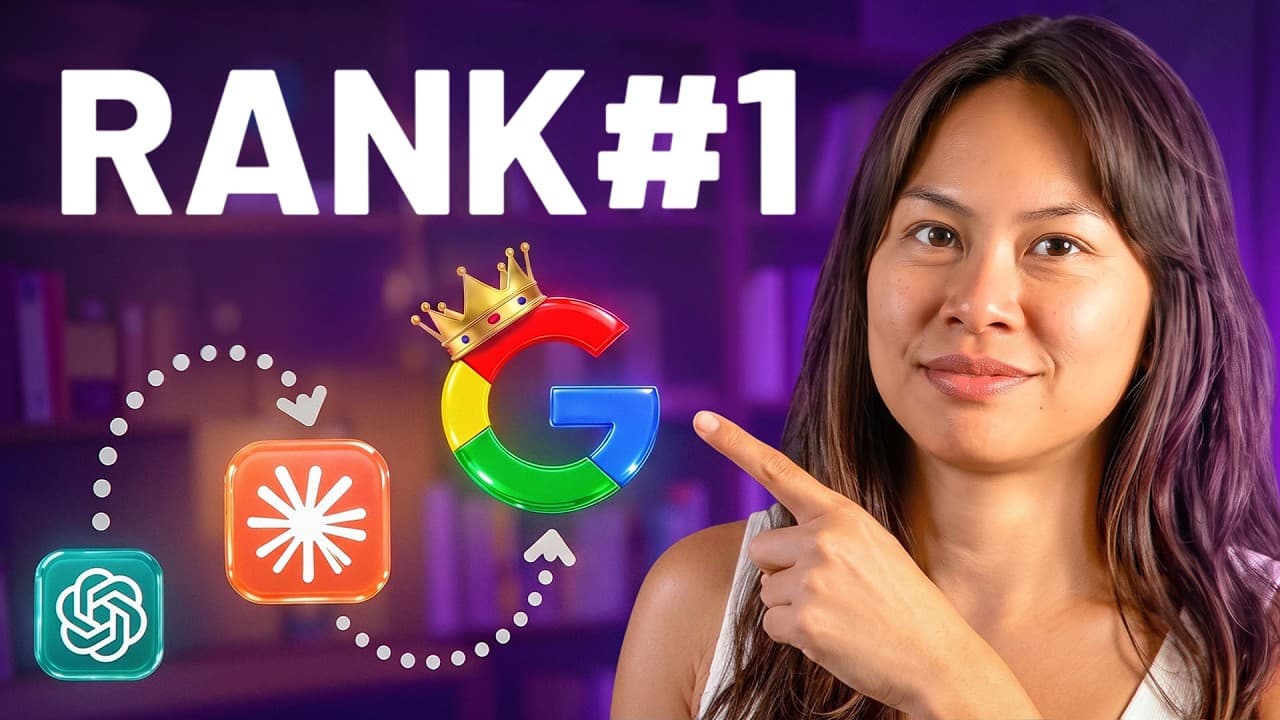
Choose one specific claim you want your brand to be known for, support it with credible proof, and repeat the same positioning across LinkedIn, social profiles, websites, podcasts, and directories. To appear in AI-generated answers, also publish pages that directly address customer questions, especially best-of lists, competitor comparisons, and alternatives pages with clear, structured information.
Transcript
My website got 1.4 million views in 2026. If you ask Claude how to post to Instagram from Claude, my website shows up first. In this video, I'm going to teach you everything I know about AI SEO, what has actually worked for me as a multi-million dollar business owner. Starting with what is SEO? So, in the olden days of doing things before ChatGpt, ... Read More
Key Insights
- Traditional SEO is built around ranking web pages in Google results so users see and click a link, ideally among the top three results or at least on the first page. That model assumes searchers will visit a website before evaluating a company, product, or offer.
- Answer engine optimization is the practice of getting a brand, company, product, or offer included inside an AI-generated response. It is also described as ask engine optimization or AI SEO, and its goal differs from merely ranking one link among many traditional search results.
- AI answers typically mention fewer brands than conventional search pages display as links. The transcript says an answer often names fewer than three brands, making clear positioning important when ChatGPT, Claude, or Google researches sources and selects which businesses to include in a summarized response.
- AI-referred visitors can be more valuable than their traffic volume suggests. The cited Ahrefs example says AI search supplied only 0.5% of website traffic at the time of its study but produced 12% of signups, indicating that a small stream of better-matched visitors may produce meaningful results.
- A specific positioning claim is more informative than a generic title or personal detail. The recommended LinkedIn structure places the one thing a person wants to be known for first, then follows it with credentials, achievements, audience size, leadership experience, or other evidence supporting that claim.
- Consistent positioning helps AI systems form a clearer picture of a person or business. The same concise claim should appear across LinkedIn, other social profiles, the company website, podcast appearances, directory listings, software review sites, and other accessible online pages.
- Best-of lists are a recommended AEO content format because they directly address category-level searches. Suggested examples include invoicing software for freelancers and AI video tools in 2026, presented as ranked options with a clean, structured table that makes comparison information easy to interpret.
- Comparison and alternatives pages target users who are actively evaluating solutions. An X-versus-Y page compares two competitors directly, while an alternatives page addresses customers who already use a tool but are unhappy with it and are searching for another option.
Install to Summarize YouTube Videos and Get Transcripts
Explore YouTube Video Summarizer or Get YouTube Transcript Extractor
Questions & Answers
Q: What is answer engine optimization?
Answer engine optimization, also called ask engine optimization or AI SEO, is the practice of helping a company, brand, product, or offer appear inside an AI-generated answer. Instead of competing only for a link on a Google results page, the goal is to be named or used as a source when ChatGPT, Claude, or Google summarizes an answer to a user's question.
Q: How is AEO different from traditional SEO?
Traditional SEO aims to place a webpage near the top of Google results so a searcher will click through to the website. AEO aims to place a brand or solution directly within an answer generated by an AI system. The distinction matters because AI responses summarize information and may mention only two or three brands instead of presenting ten visible links.
Q: Why can AI search traffic convert better than Google traffic?
AI systems can receive detailed context about a user's business, goals, team, positioning, customers, marketing, and writing. They can combine that context with information researched on the web to recommend a more suitable company or tool. The transcript cites an Ahrefs analysis in which 0.5% of traffic from AI search produced 12% of signups, suggesting stronger visitor intent and fit.
Q: How should I write a LinkedIn headline for AI SEO?
Start the LinkedIn headline with the single specific claim you want people and AI systems to associate with you. Do not lead with a generic job title or an unrelated personal detail. Follow the claim with proof, such as audience figures, a founder or executive role, recognition, or an acquired company, provided those credentials genuinely support the positioning you selected.
Q: How do I decide what I want to be known for online?
Choose a short, specific claim about the value you provide rather than simply naming your job. Ask what few words you would want ChatGPT to use when describing you or your business. You can also ask an AI system that already knows your background to propose options, identify which credentials support each option, and show which claim has the strongest evidence.
Q: Why should brand positioning be repeated across multiple websites?
Repeated positioning gives AI systems a consistent description of who you are and what you do. If LinkedIn, Instagram, a website, directory listings, and podcast profiles all describe you differently, the resulting picture may be unclear. The recommended approach is to reuse one positioning statement across social profiles, company pages, podcasts, software review sites, and other online locations accessible to AI systems.
Q: What content formats should beginners create for AEO?
Beginners should start with three focused page formats: best-of lists, X-versus-Y comparisons, and alternatives pages. A best-of list ranks options in a category and can include a structured table. A comparison page evaluates two competing solutions directly. An alternatives page helps people who already have a tool but are dissatisfied and want a replacement.
Q: How can a small business compete in AI search?
A small business can focus on speed, consistent positioning, and direct answers to the questions customers are asking. It does not necessarily need a million website visitors because even a smaller number of well-matched AI referrals may produce meaningful leads or signups. The suggested playbook is to establish one supported claim, repeat it widely, and publish structured comparison-oriented content.
Summary & Key Takeaways
-
Answer engine optimization focuses on getting a person, company, product, or offer included directly in responses from ChatGPT, Claude, and Google AI summaries. Unlike traditional SEO, which aims for a prominent link in search results, AEO seeks inclusion within a synthesized answer where only a small number of brands may be named.
-
The recommended positioning process begins by selecting one specific value claim rather than a generic job title. That claim should appear first in a LinkedIn headline, followed by credentials and achievements that support it. The same wording should then be repeated across social profiles, websites, podcasts, directories, and review sites.
-
Content should answer the questions prospective customers actually ask AI systems. Three suggested starting formats are ranked best-of lists with structured tables, direct comparisons between two competing products, and alternatives pages for people dissatisfied with an existing solution. These formats present focused information that answer engines can use when composing recommendations.
Read in Other Languages (beta)
Share This Summary 📚
Summarize YouTube Videos and Get Video Transcripts with 1-Click
Try YouTube Summary with ChatGPT & Claude or YouTube Transcript Generator
Explore More Summaries from Sabrina Ramonov 🍄 📚



Summarize YouTube Videos and Get Video Transcripts with 1-Click
Try YouTube Summary with ChatGPT & Claude or YouTube Transcript Generator