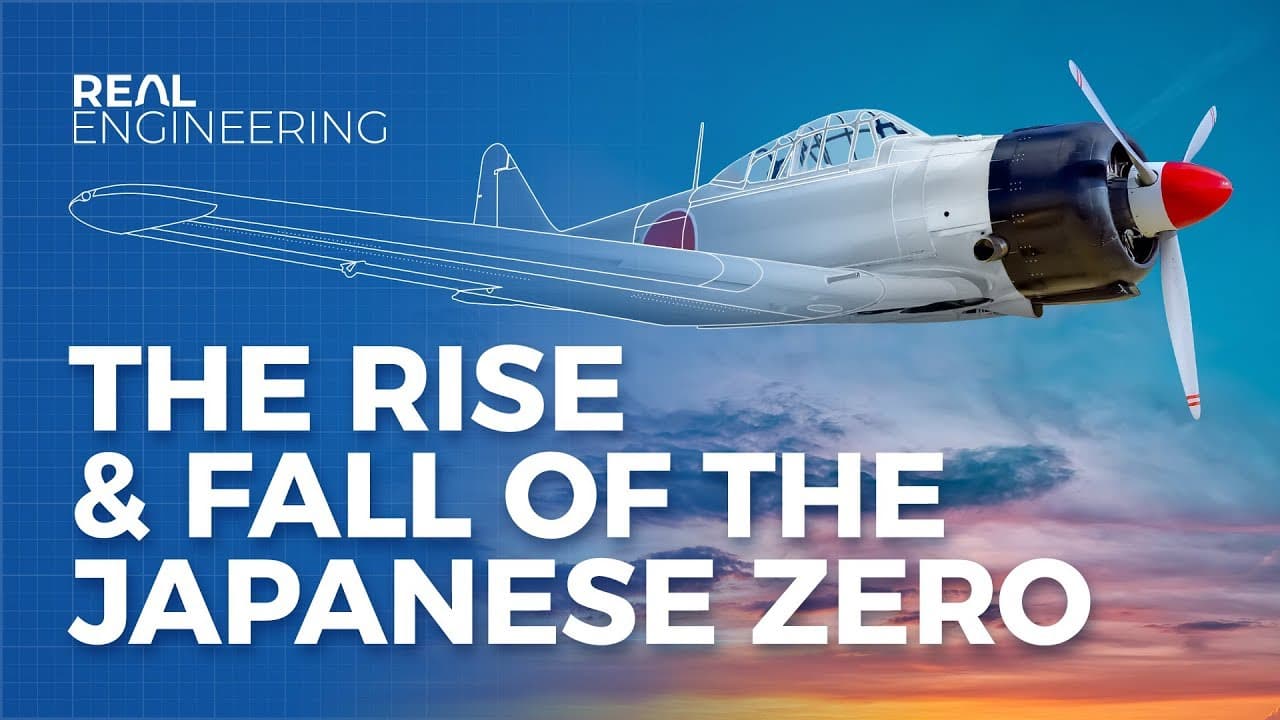
The Rise and Fall of the Japanese Zero
TL;DR
The Mitsubishi A6M Zero's dominance faded due to design flaws.
Transcript
This episode of Real Engineering is brought to you by Brilliant, a problem solving website that teaches you to think like an engineer. In the late 19th and early 20th century the Japanese Empire was under rapid expansion, fueled by a feudal born military economy and European technology.First invading the chain of islands north and south of it’s hom... Read More
Key Insights
- The Mitsubishi A6M Zero was a formidable fighter plane at the start of World War II, designed for speed, maneuverability, and range, but lacked armor and self-sealing fuel tanks.
- Japan's rapid industrial expansion in the early 20th century made it a dominant Pacific power, leading to inevitable conflict with Western nations.
- The Zero's design focused on lightweight construction, sacrificing protective armor, which made it vulnerable to enemy fire despite its initial tactical advantages.
- The Zero's tactical edge diminished when the U.S. captured a plane and discovered its weaknesses, including issues with its float carburetor and sluggishness at high speeds.
- Japan's pilot training shifted from quality to quantity as skilled pilots were lost faster than they could be replaced, weakening their air combat effectiveness.
- The Zero was eventually used in kamikaze missions due to Japan's dwindling resources and trained personnel, reflecting a desperate strategy rather than pure devotion to the emperor.
- Kamikaze pilots were often inadequately trained and driven by a sense of duty to protect their country and loved ones rather than blind allegiance to the emperor.
- The Zero's decline paralleled Japan's military struggles, ultimately leading to its use in suicide missions as a last resort against the advancing Allies.
Install to Summarize YouTube Videos and Get Transcripts
Explore YouTube Video Summarizer or Get YouTube Transcript Extractor
Questions & Answers
Q: What were the initial strengths of the Mitsubishi A6M Zero?
The Mitsubishi A6M Zero was initially celebrated for its exceptional speed, maneuverability, and range. These characteristics made it a formidable opponent in the early stages of World War II, especially in the Pacific theater. Its lightweight design allowed for superior agility in dogfights, giving it an edge over many of its contemporaries.
Q: Why did the Zero eventually lose its tactical advantage?
The Zero lost its tactical advantage due to several design flaws, including its lack of armor and self-sealing fuel tanks, which made it vulnerable to enemy fire. Additionally, the plane suffered from performance issues at high speeds, such as sluggishness and engine problems during zero-g maneuvers. These weaknesses were exploited by the Allies, who adapted their tactics accordingly.
Q: How did Japan's pilot training strategy change during the war?
Initially, Japan focused on training highly skilled pilots, which contributed to their early successes in air combat. However, as the war progressed and experienced pilots were lost faster than they could be replaced, Japan shifted to a strategy of quantity over quality. This resulted in sending less experienced and inadequately trained pilots into battle, diminishing the effectiveness of their air force.
Q: What role did the Zero play in kamikaze missions?
As Japan's resources and trained personnel dwindled, the Zero was repurposed for kamikaze missions. This shift reflected Japan's desperate attempt to inflict damage on the Allies despite their declining military capabilities. Kamikaze pilots, often inadequately trained, were tasked with suicide missions as a last resort to protect their homeland, driven by cultural values of self-sacrifice for the greater good.
Q: What were the cultural factors influencing kamikaze pilots?
Cultural factors played a significant role in the mindset of kamikaze pilots. In Japanese society, the group often took precedence over the individual, and suicide was seen as an honorable choice in the face of defeat. Many pilots were motivated not by blind devotion to the emperor but by a sense of duty to protect their families, friends, and country.
Q: How did the Allies exploit the Zero's weaknesses?
The Allies exploited the Zero's weaknesses by capturing an intact plane and analyzing its vulnerabilities. They discovered issues such as its tendency to catch fire, lack of protective armor, and sluggishness at high speeds. Armed with this knowledge, Allied pilots were trained to maintain high speeds and avoid low-speed maneuvers, effectively countering the Zero's initial advantages.
Q: What impact did the Zero have on Japan's wartime strategy?
The Zero's initial success bolstered Japan's early wartime strategy, contributing to their dominance in the Pacific. However, as its vulnerabilities were exposed and resources became scarce, the Zero's role shifted to kamikaze missions. This change symbolized Japan's increasingly desperate strategy as they faced mounting pressure from the advancing Allies.
Q: How did the Zero's design reflect Japan's military priorities?
The Zero's design prioritized speed, range, and maneuverability, reflecting Japan's military doctrine of using nimble, lightweight planes piloted by skilled aviators. However, this focus came at the expense of protective features like armor and self-sealing fuel tanks. These priorities were initially effective but ultimately left the Zero vulnerable as the war progressed and Allied tactics evolved.
Summary & Key Takeaways
-
The Mitsubishi A6M Zero was initially a highly effective fighter plane due to its speed, maneuverability, and range. However, its lack of armor and self-sealing fuel tanks made it vulnerable, which became evident as the war progressed.
-
Japan's industrial and military expansion in the early 20th century set the stage for conflict with Western powers. The Zero played a key role in Japan's early successes but was eventually outmatched by evolving Allied tactics and technology.
-
As Japan's skilled pilots dwindled, the Zero's effectiveness decreased. The plane's design flaws were exploited by the U.S., leading to its relegation to kamikaze missions, symbolizing Japan's desperate wartime strategy.
Read in Other Languages (beta)
Share This Summary 📚
Summarize YouTube Videos and Get Video Transcripts with 1-Click
Try YouTube Summary with ChatGPT & Claude or YouTube Transcript Generator
Explore More Summaries from Real Engineering 📚





Summarize YouTube Videos and Get Video Transcripts with 1-Click
Try YouTube Summary with ChatGPT & Claude or YouTube Transcript Generator