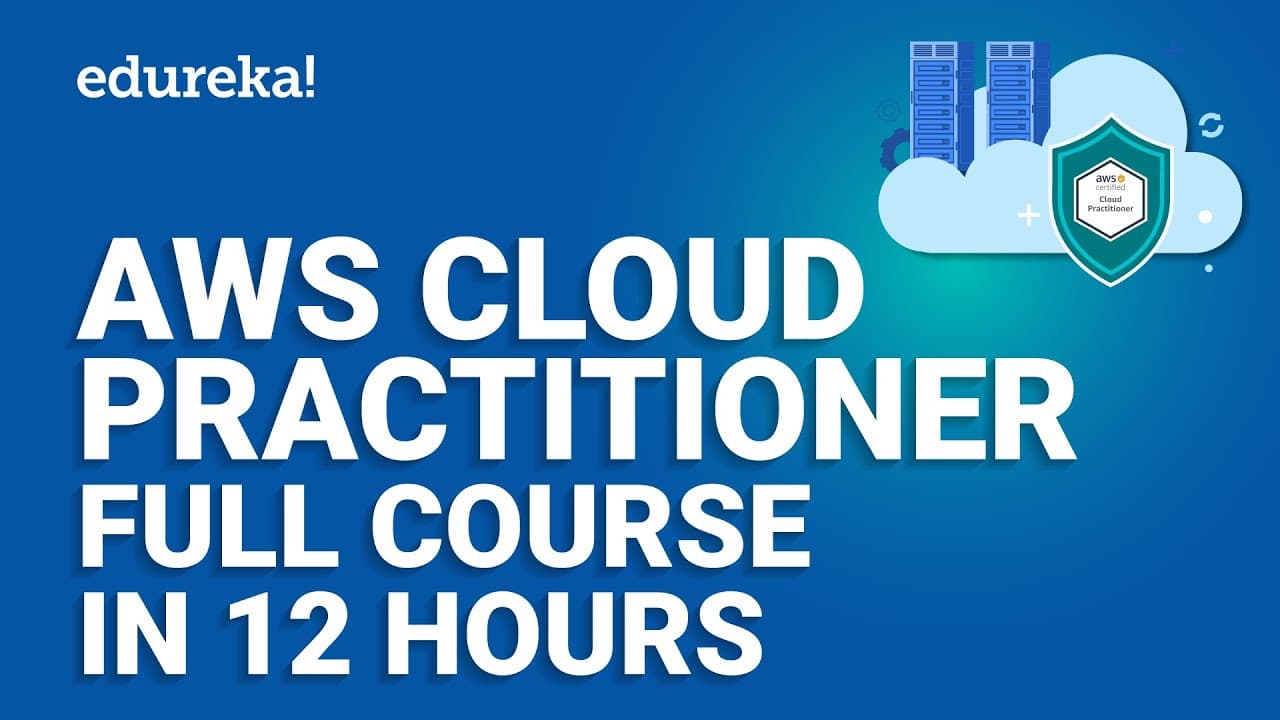
How Do You Prepare for the AWS Certified Cloud Practitioner (CLF-C01) Exam? | Edureka 12-Hour Full Course
TL;DR
Prepare for the AWS Certified Cloud Practitioner exam by studying cloud fundamentals, the AWS console, core AWS services, billing, business concepts, security, and practical applications. Edureka estimates about 8 hours of structured practice for working developers, 15 hours for boot camp graduates, and 20 hours for sales or management professionals. Read on for exam details, curriculum topics, recommended skills, and the next certification step.
Transcript
Cloud initiatives are flourishing and businesses are ramping up hiring to support them as more businesses are adopting cloud services there is a significant increase in demand for cloud skills which has been identified as one of the top trends in the current Tech skill market and the wonderful way to get started on this path is an AWS Cloud practit... Read More
Key Insights
- The AWS Certified Cloud Practitioner credential validates foundational knowledge of cloud computing, the AWS console, general AWS offerings, billing, and business-centered concepts. The course characterizes it as a lighter introduction than the Solutions Architect Associate certification.
- The certification is especially relevant to sales and management professionals because it emphasizes billing and business concepts. That knowledge can help them explain AWS adoption considerations to stakeholders and business leaders without requiring the same technical depth as an advanced certification.
- Preparation time depends on prior experience. The course estimates about 8 hours of structured practice for working developers, approximately 15 hours for boot camp graduates, and around 20 hours for people from sales or management backgrounds.
- The exam can be taken at a test center or online with proctoring. According to the course, it costs 100 US dollars, lasts 90 minutes, contains 65 questions, requires a 70 percent passing score, and produces a certification valid for three years.
- A cloud practitioner helps supervise application architecture and deployment on AWS while supporting cloud adoption, management, and monitoring plans. The described responsibilities may also include application development, containerization, automation, infrastructure support, and project management.
- The technical learning path begins with cloud computing concepts, AWS fundamentals, and instances. It then expands into compute, storage, networking, content delivery, monitoring, infrastructure automation, scaling, load balancing, security, analytics, messaging, IoT, and Kubernetes.
- The supporting skills identified across job descriptions include AWS infrastructure, Linux, Docker, Python, Java, networking, storage, MySQL or PL/SQL, Selenium, Git, Jenkins, Gradle, Ansible, Chef, and Jira. Individual positions may demand different combinations of these abilities.
- The certification can serve as preparation for more advanced AWS exams because it introduces the testing environment through a comparatively approachable examination. The course suggests moving toward Solutions Architect Associate or another advanced certification after completing Cloud Practitioner.
Install to Summarize YouTube Videos and Get Transcripts
Explore YouTube Video Summarizer or Get YouTube Transcript Extractor
Questions & Answers
Q: How should I prepare for the AWS Cloud Practitioner exam?
Study foundational cloud computing, AWS basics, the AWS console, general AWS offerings, billing, and business-centered concepts. The course then builds practical familiarity through compute, storage, networking, monitoring, automation, scaling, security, analytics, IoT, DevOps, and Kubernetes topics.
Q: How long should I study for the AWS Cloud Practitioner exam?
The course estimates about 8 hours of structured practice for a working developer, who may be able to prepare in less than a week. It recommends approximately 15 hours for a boot camp graduate and around 20 hours for someone from a sales or management background.
Q: What does the AWS Certified Cloud Practitioner certification cover?
The credential validates foundational knowledge of cloud computing, the AWS console, general AWS offerings, billing, and business-centered concepts. The course describes it as a lighter introduction than the Solutions Architect Associate certification, with a particularly strong focus on billing and business topics.
Q: What are the AWS Cloud Practitioner exam details?
According to the course, the exam costs 100 US dollars, lasts 90 minutes, and contains 65 questions. It requires a 70 percent passing score, can be taken at a test center or online with proctoring, and produces a certification valid for three years.
Q: Who should pursue the AWS Cloud Practitioner certification?
The certification is presented as suitable for beginners, developers, boot camp graduates, managers, and sales professionals seeking foundational AWS knowledge. Its billing and business focus is especially relevant to people who need to explain AWS adoption considerations to stakeholders and business leaders.
Q: Which AWS services and technologies does the full course cover?
The curriculum includes AWS instances, Lambda, Elastic Beanstalk, S3, CloudFront, CloudWatch, CloudFormation, autoscaling, load balancing, and cloud security. It also covers Redshift, Kinesis, API Gateway, SES, IoT, CodePipeline, and running Kubernetes on AWS.
Q: What skills support a career as an AWS cloud practitioner?
The course identifies AWS infrastructure, Linux, Docker, Python, Java, networking, storage, and databases such as MySQL or PL/SQL as useful supporting skills. It also mentions Selenium, Git, Jenkins, Gradle, Ansible, Chef, Jira, automation, strategic planning, and other DevOps capabilities.
Q: What should I do after earning AWS Cloud Practitioner?
The course suggests using Cloud Practitioner as preparation for a more advanced AWS certification. After becoming familiar with foundational concepts and the testing environment, candidates can prepare for Solutions Architect Associate or another advanced certification.
Summary & Key Takeaways
-
The course introduces the AWS Certified Cloud Practitioner credential as a foundation-level way to demonstrate familiarity with cloud computing, the AWS console, general AWS offerings, billing, and business concepts. It presents the certification as particularly relevant to beginners, managers, sales professionals, and candidates planning to pursue more advanced AWS certifications.
-
The technical curriculum moves from cloud computing and AWS basics into instances, Lambda, Elastic Beanstalk, storage, S3, networking, CloudFront, CloudWatch, and CloudFormation. It also covers autoscaling, load balancing, cloud security, Redshift, Kinesis, API Gateway, SES, IoT, and Kubernetes deployments on AWS.
-
The career guidance describes cloud practitioners as professionals who help design, plan, manage, maintain, monitor, and support cloud infrastructure. It identifies useful supporting skills in Linux, Docker, Python, Java, databases, networking, automation, strategic planning, and DevOps tools, then concludes with career guidance and AWS interview questions.
Read in Other Languages (beta)
Share This Summary 📚
Summarize YouTube Videos and Get Video Transcripts with 1-Click
Try YouTube Summary with ChatGPT & Claude or YouTube Transcript Generator
Explore More Summaries from edureka! 📚


Summarize YouTube Videos and Get Video Transcripts with 1-Click
Try YouTube Summary with ChatGPT & Claude or YouTube Transcript Generator