How Do Habits Form and How Can You Break Them?
TL;DR
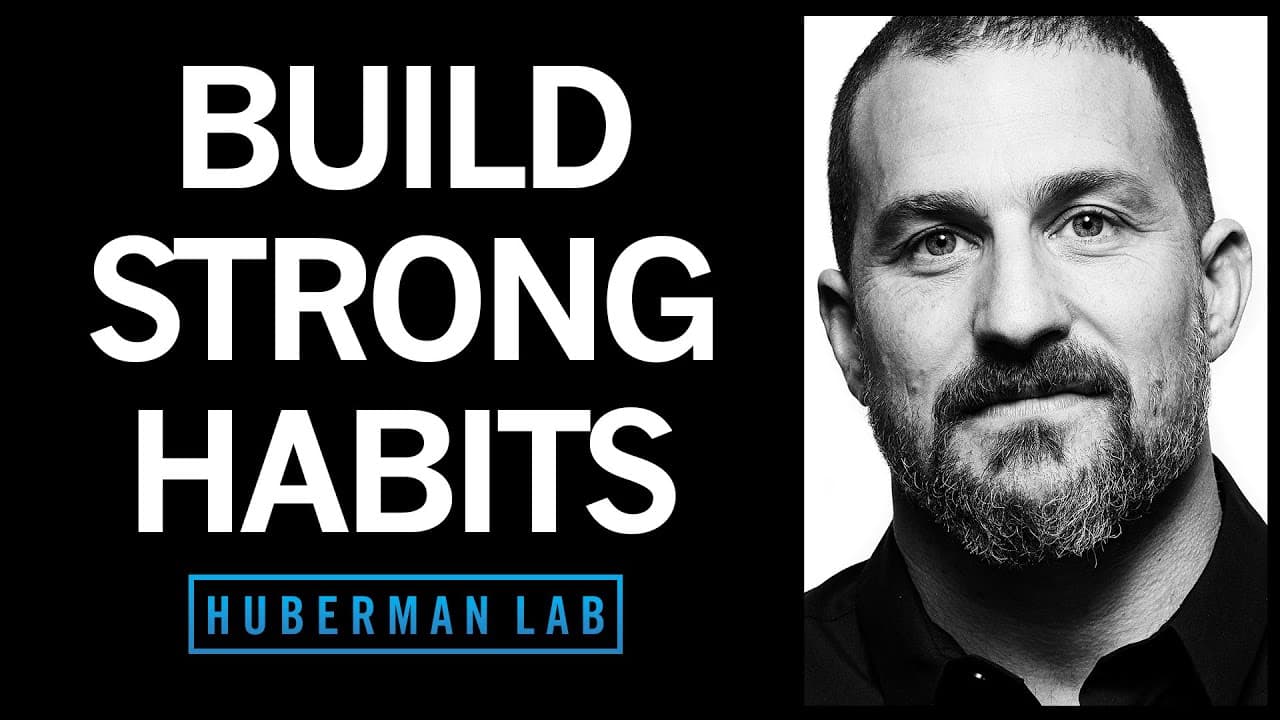
Habits form through learned behaviors and neuroplasticity, meaning they evolve as our brain's neural connections change. The time required to adopt a habit can vary significantly among individuals, taking anywhere from 18 to 254 days. Strategies like task-bracketing and understanding 'limbic friction'—the emotional resistance to changing behavior—are essential for successfully forming or breaking habits.
Transcript
- Welcome to the Huberman Lab Podcast, where we discuss science and science based tools for everyday life. [mellow music] I'm Andrew Huberman and I'm a Professor of Neurobiology and Ophthalmology at Stanford School of Medicine. Today we're talking all about habits. In particular, we're going to discuss the biology of habit formation and the biology... Read More
Key Insights
- 💱 Habits are learned behaviors that involve neuroplasticity and changes in neural connections.
- 🥳 The time it takes to form a habit varies between individuals and habits, ranging from 18 to 254 days.
- 💁 Limbic friction affects habit formation and can be influenced by states of anxiousness or fatigue.
- 🥳 Task-bracketing, placing habits in specific phases of the day, leverages neural circuits to increase habit formation success.
- ⌛ Phase one (0-8 hours after waking) is associated with increased norepinephrine and dopamine, making it ideal for overcoming limbic friction and performing challenging habits.
Install to Summarize YouTube Videos and Get Transcripts
Explore YouTube Video Summarizer or Get YouTube Transcript Extractor
Questions & Answers
Q: Is habit formation just like reflexes?
No, habits are learned behaviors that involve neuroplasticity and changes in neural connections. They are different from hard-wired reflexes.
Q: How long does it take to form a habit?
The time it takes to form a habit varies between individuals and habits. Research shows it can take anywhere from 18 to 254 days for different people to form the same habit.
Q: What is limbic friction?
Limbic friction refers to the effort required to overcome states of anxiousness or fatigue in order to engage in a particular behavior. It can be influenced by the autonomic nervous system and affects habit formation.
Q: What is task-bracketing?
Task-bracketing is a tool that leverages neural circuits in the basal ganglia to increase the likelihood of habit formation. It involves placing habits in specific phases of the day, such as 0-8 hours after waking and 9-14 hours after waking, to align with specific neurochemical states.
Key Insights:
- Habits are learned behaviors that involve neuroplasticity and changes in neural connections.
- The time it takes to form a habit varies between individuals and habits, ranging from 18 to 254 days.
- Limbic friction affects habit formation and can be influenced by states of anxiousness or fatigue.
- Task-bracketing, placing habits in specific phases of the day, leverages neural circuits to increase habit formation success.
- Phase one (0-8 hours after waking) is associated with increased norepinephrine and dopamine, making it ideal for overcoming limbic friction and performing challenging habits.
- Phase two (9-14 hours after waking) is associated with a more relaxed state, making it suitable for adopting habits that require less conscious override of limbic friction.
Summary & Key Takeaways
-
The episode discusses the value of habits and how they organize our behavior. It acknowledges that while some habits are beneficial, others can undermine our health and life goals.
-
The podcast explores the neuroscience and biology behind habit formation and breaking, highlighting the role of neuroplasticity and changes in neural connections.
-
It introduces the concepts of identity-based and goal-based habits, immediate goal-based habits versus identity-based habits, and linchpin habits that make other habits easier to execute.
Read in Other Languages (beta)
Share This Summary 📚
Summarize YouTube Videos and Get Video Transcripts with 1-Click
Try YouTube Summary with ChatGPT & Claude or YouTube Transcript Generator
Explore More Summaries from Andrew Huberman 📚


Summarize YouTube Videos and Get Video Transcripts with 1-Click
Try YouTube Summary with ChatGPT & Claude or YouTube Transcript Generator