How HappyRobot Automates Logistics Operations
TL;DR
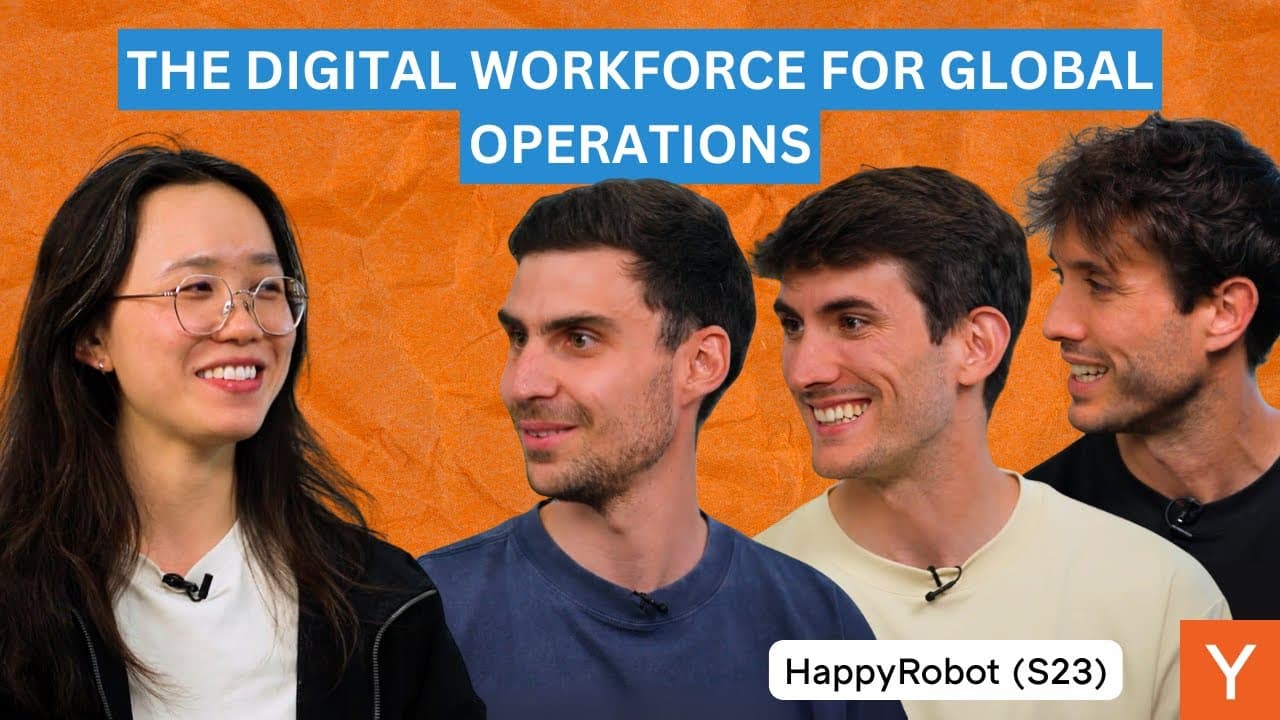
HappyRobot automates logistics communications and workflows with AI agents that can handle natural voice conversations, verify carriers, and coordinate freight activity. After abandoning a narrow computer vision product, the founders focused on complex real-world operations, grew revenue 10x in less than a year, and announced a $44 million Series B.
Transcript
So, I'm excited here to welcome Happy Robot announcing their series B for $44 million, which is really impressive. You guys just raised your series A not too long ago, less than a year. You grew 10x in revenue within the last year, less than a year. And you were in the batch not too long ago in summer 23. Yeah. So tell us what Happy Robot is. Yeah,... Read More
Key Insights
- HappyRobot is building a digital workforce for real-world operations companies, using AI agents to automate communications and workflows for organizations such as DHL, Uber Freight, and Flexport across logistics and supply chain activities.
- Freight brokers are intermediaries between companies shipping goods and carriers that own transportation assets, and they receive many calls from drivers asking about loads that have been posted for delivery.
- HappyRobot's voice agent can answer a driver, request a load reference number, collect a carrier identification number, check whether the carrier is registered, and respond naturally when the caller ends the conversation.
- Natural voice interaction is strengthened by conversational speech patterns and some background noise, which can make an agent sound less clinical than audio that is unnaturally clean or rigid.
- The founders abandoned their computer vision autolabeling platform after YC discussions clarified that they lacked a focused ideal customer profile and could not identify a market large enough to support their ambitions.
- The original product faced difficult build-versus-buy dynamics because some prospective customers developed computer vision infrastructure internally, while the satellite imagery market depended heavily on government buyers with slow sales cycles.
- Logistics conferences validated demand because companies with hundreds of call-center workers said they could quickly assign repetitive operational work to the product, even when the early demonstration had seven seconds of latency.
- HappyRobot grew revenue 10x in less than a year and announced a $44 million Series B, following progress from early pilots to seven-figure contracts and expansion beyond freight brokers into broader logistics operations.
Install to Summarize YouTube Videos and Get Transcripts
Explore YouTube Video Summarizer or Get YouTube Transcript Extractor
Questions & Answers
Q: What does HappyRobot automate in logistics operations?
HappyRobot uses AI agents to automate communications and workflows for real-world operations companies. In logistics, these agents can answer calls from drivers, identify a posted load through its reference number, collect carrier information, verify whether a carrier is registered, and support recurring coordination tasks. The broader goal is to provide a digital workforce for companies such as DHL, Uber Freight, and Flexport.
Q: How does HappyRobot's voice agent handle freight calls?
The voice agent acts as the freight broker when a driver calls about an available load. It asks for the posting's reference number, requests the driver's carrier identification number, checks whether the carrier is registered, and continues the conversation based on that information. If the driver needs to leave, the agent responds naturally and invites the driver to call again when ready.
Q: Why did the founders pivot away from computer vision?
The founders concluded that their computer vision autolabeling platform did not have a sufficiently clear customer or large market. Robotics and self-driving companies could build similar capabilities internally, creating a difficult build-versus-buy problem. Their move into satellite imagery also exposed them to government-centered purchasing and slow contract timelines, including prospective customers suggesting another conversation six months later.
Q: How did YC help HappyRobot identify its market problem?
YC discussions pushed the founders to define their ideal customer profile and determine exactly whom they were serving. They examined different customer groups one by one and found that none supported the large business they wanted to build. That process made the limitations of their existing revenue less important than the absence of a focused customer and substantial long-term market.
Q: Why did HappyRobot focus on logistics and supply chain?
The founders combined three relevant perspectives: technical experience in AI and computer vision, an interest in voice and large language models, and direct exposure to supply chain operations. One founder had worked as the CFO of a major olive oil distributor and understood late-delivery penalties, retailer requirements, and the extensive human coordination needed to secure transportation capacity and deliver shipments on time.
Q: What did logistics conferences reveal about demand for AI agents?
Conversations at logistics conferences revealed that companies were already employing or outsourcing hundreds of call-center workers for repetitive operational tasks. Some reported teams of 200 or 500 people and said they could transfer work quickly if the technology functioned reliably. Their interest persisted even though HappyRobot's early voice demonstration had about seven seconds of response latency.
Q: What logistics task did HappyRobot initially target?
HappyRobot initially focused on freight brokers and considered automating check calls made to drivers. These calls ask whether a driver will deliver on time and, if not, why the delay occurred and when delivery is expected. Although the task sounds simple, logistics businesses still rely on frequent human calls alongside GPS and digital tracking systems to coordinate shipments.
Q: How did HappyRobot grow after changing direction?
After pivoting around September 2023 and exploring voice, large language models, and vertical software, HappyRobot concentrated on logistics workflows. The company advanced from small pilots to seven-figure contracts, expanded its work beyond freight brokers to freight forwarders, ocean carriers, and trucking companies, and grew revenue 10x in less than a year before announcing a $44 million Series B.
Summary & Key Takeaways
-
HappyRobot builds AI agents for logistics and supply chain companies, including DHL, Uber Freight, and Flexport. Its digital workforce handles operational communications and workflows such as answering drivers, identifying posted loads, checking carrier registration, tracking delivery status, and supporting the coordination required to move goods through complex transportation networks efficiently.
-
The founders met at university in Madrid and spent years working together on technical projects. Their first YC product was a computer vision autolabeling platform, but customer analysis exposed a limited market, difficult build-versus-buy dynamics, and slow government sales. They abandoned that direction and explored voice, large language models, and logistics.
-
Industry conferences revealed strong demand from logistics businesses operating large call centers. Even an early voice demonstration with seven seconds of latency attracted interest because companies wanted to automate repetitive capacity and status calls. HappyRobot subsequently advanced from small pilots to seven-figure contracts and grew revenue 10x in less than one year.
Read in Other Languages (beta)
Share This Summary 📚
Summarize YouTube Videos and Get Video Transcripts with 1-Click
Try YouTube Summary with ChatGPT & Claude or YouTube Transcript Generator
Explore More Summaries from YC Root Access 📚





Summarize YouTube Videos and Get Video Transcripts with 1-Click
Try YouTube Summary with ChatGPT & Claude or YouTube Transcript Generator