What Is Pure Aloha and How Does It Work?
TL;DR
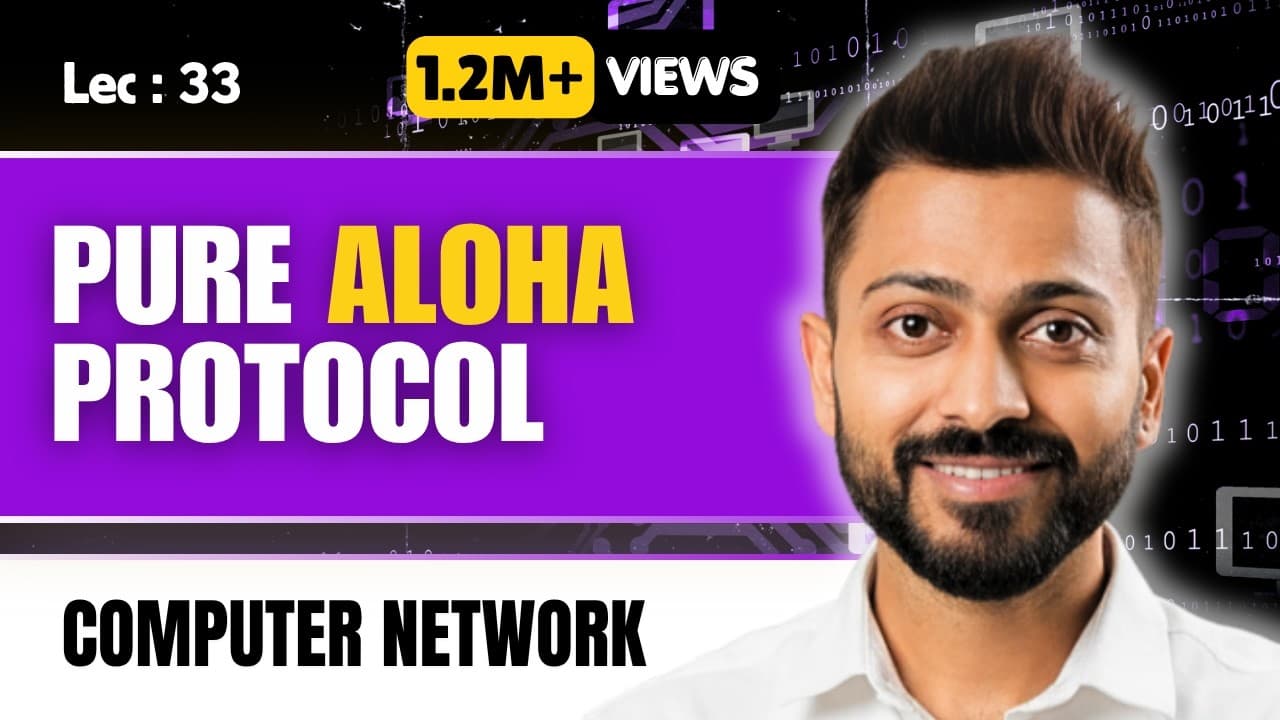
Pure Aloha is a random access protocol that allows stations in a LAN to transmit data at any time, which increases the risk of data collisions. It uses acknowledgments to confirm successful data receipt, and if no acknowledgment is received, a collision is assumed, prompting a retransmission. The protocol is considered obsolete but laid the groundwork for modern network protocols.
Transcript
Hello friends, welcome to Gate Smashers. In today's video we are going to discuss Pure Aloha. And in this video we will discuss all important points of Pure Aloha which will be very beneficial for your college/University or competitive exams. So the first important point is Pure Aloha is a Random Access Protocol. Random Access Protocol means that w... Read More
Key Insights
- 🥺 Pure Aloha is a LAN-based random access protocol where stations can transmit data at any time, leading to collisions.
- 💥 Acknowledgment is used in Pure Aloha to indicate successful data reception, and the absence of acknowledgment indicates collisions.
- 💥 Retransmission is necessary after collision, increasing the chances of further collisions.
- ⌛ Pure Aloha considers only transmission time and not propagation time in LAN-based networks.
- ⌛ The vulnerable time in Pure Aloha is calculated as 2 multiplied by the transmission time.
- ♊ Efficiency in Pure Aloha is determined by the formula G multiplied by e to the power -2G, with G representing the number of stations wanting to transmit.
- 🚉 The maximum efficiency in Pure Aloha occurs when half of the stations transmit.
Install to Summarize YouTube Videos and Get Transcripts
Explore YouTube Video Summarizer or Get YouTube Transcript Extractor
Questions & Answers
Q: What is Pure Aloha?
Pure Aloha is a random access protocol used in LAN-based networks where stations can start transmitting data at any time without a scheduled slot.
Q: How is collision detected in Pure Aloha?
Collision is detected when no acknowledgment is received after sending data. It indicates that the transmitted data has collided with another station's data.
Q: What happens when a collision occurs in Pure Aloha?
When a collision occurs, stations wait for a random amount of time and then retransmit the data. This retransmission can lead to an increase in collisions.
Q: What is the vulnerable time in Pure Aloha?
The vulnerable time in Pure Aloha is the duration, before and after a station's transmission, during which no other station should transmit to avoid collisions.
Key Insights:
- Pure Aloha is a LAN-based random access protocol where stations can transmit data at any time, leading to collisions.
- Acknowledgment is used in Pure Aloha to indicate successful data reception, and the absence of acknowledgment indicates collisions.
- Retransmission is necessary after collision, increasing the chances of further collisions.
- Pure Aloha considers only transmission time and not propagation time in LAN-based networks.
- The vulnerable time in Pure Aloha is calculated as 2 multiplied by the transmission time.
- Efficiency in Pure Aloha is determined by the formula G multiplied by e to the power -2G, with G representing the number of stations wanting to transmit.
- The maximum efficiency in Pure Aloha occurs when half of the stations transmit.
- The overall efficiency of Pure Aloha is typically low, with a significant portion of bandwidth wasted in collisions.
Summary & Key Takeaways
-
Pure Aloha is a random access protocol where stations can start transmitting data at any time, leading to the possibility of collisions.
-
Acknowledgment is used to indicate successful reception of data, and collision is detected when no acknowledgment is received.
-
Retransmission occurs after collision, which can further increase the probability of collisions.
Read in Other Languages (beta)
Share This Summary 📚
Summarize YouTube Videos and Get Video Transcripts with 1-Click
Try YouTube Summary with ChatGPT & Claude or YouTube Transcript Generator
Explore More Summaries from Gate Smashers 📚





Summarize YouTube Videos and Get Video Transcripts with 1-Click
Try YouTube Summary with ChatGPT & Claude or YouTube Transcript Generator