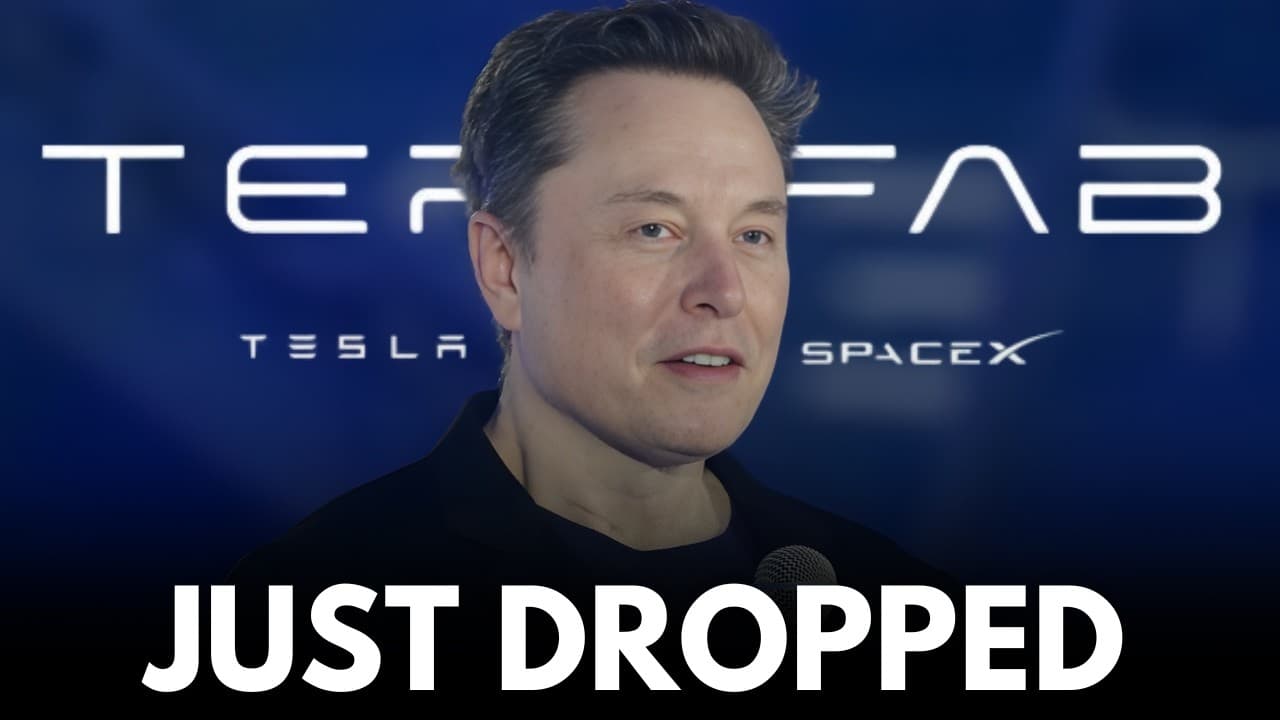
What is Elon Musk's TerraFab and Terawatt AI plan
TL;DR
Elon Musk outlines a plan to scale civilization by expanding power in space, building a Terawatt compute per year and a Terafab in Austin to accelerate chip design. The initiative aims to harvest solar energy in space, enable space-based compute, and support a multi-planet civilization with humanoid robots and SpaceX, XAI, and Tesla working together.
Transcript
We have a profoundly important announcement to make which is the most epic chip building exercised in history by far. This is really going to take things to the next level. So yeah, a level probably people aren't even contemplating right now. This is not in the I would call this an sort of an out of context problem. It's not in their context. So we... Read More
Key Insights
- A galactic civilization is the stated long term goal for expanding humanity beyond Earth.
- The sun provides the majority of solar energy, far exceeding what Earth uses, highlighting the need to scale power in space.
- Terawatt compute per year is identified as the key missing ingredient for ambitious AI and space projects.
- A Terafab would consolidate lithography, memory, testing, and mask making in one building for rapid iteration.
- Edge inference chips and space-hardened high power chips are planned for Optimus, cars, and space environments.
- Space has the advantage of constant sunlight, making it attractive for large-scale compute deployments.
- Current Earth-based fabs are insufficient to meet the terawatt compute targets, hence the Terafab drive.
- The collaboration between SpaceX, XAI, and Tesla is framed as essential to achieving these scale goals.
- More videos from this channel:
- More from this channel: Brighter with Herbert
Install to Summarize YouTube Videos and Get Transcripts
Explore YouTube Video Summarizer or Get YouTube Transcript Extractor
Questions & Answers
Q: What is the Terafab and why is it needed?
The Terafab is described as an advanced technology fab located in Austin that would house equipment to make logic, memory, and masks in a single building, enabling a fast iteration loop for chip design. It is needed because current Earth fabs cannot meet the required chip supply at the scale of a terawatt of compute per year, so a self-contained facility is proposed to accelerate development and reduce bottlenecks.
Q: How much compute per year is the target and how does this relate to space?
The target is a terawatt of compute per year, which is framed as a necessary scale to move civilization forward and to enable space-based infrastructure. The idea is that most of this compute will eventually come from space hardware due to power constraints on Earth, leveraging the sun’s abundance when in space to sustain such a massive compute output.
Q: Why is space considered crucial for AI compute according to the video?
Space is considered crucial because it allows for much higher power availability and less radiation and thermal constraints on the hardware when designed for space. The speaker notes that space environments enable higher energy budgets and that a sizable portion of the compute would reside in space, with the TerraFab enabling rapid design loops and testing.
Q: What role do SpaceX, XAI, and Tesla play in this plan?
SpaceX, XAI, and Tesla are presented as complementary partners essential to scaling energy, space transport, and AI compute. SpaceX would provide launch and access to space, XAI would supply compute capability and AI hardware, and Tesla would contribute vehicle-scale production and robotics to absorb edge inference chips, all working together to realize the Terawatt project.
Q: What is Optimus and how does it relate to the plan?
Optimus is described as a humanoid robot line that would require edge inference chips, which are part of the chip strategy for the Terawatt plan. The robots are expected to be produced at a scale between a billion and ten billion units per year, necessitating significant compute capacity and efficient hardware design optimized for edge deployment.
Q: What is meant by a planetary energy context and civilization type, according to the talk?
The speaker references a progression to Type 1 civilization by aligning civilization growth with planetary energy use and then scaling to space-based energy harnessing. By explaining that the sun provides vastly more energy than Earth currently uses, the talk frames the Terawatt plan as a step toward utilizing space energy to power civilization and space infrastructure.
Q: How does the speaker describe the current status of chip supply and what solution is offered?
The speaker notes that major chip suppliers will expand but at a rate far below what is needed, implying a chip shortage for the envisioned compute scale. The proposed solution is to build a Terafab capable of producing and testing chips rapidly with iterative masks, essentially creating an in-house, fast-cycle supply to achieve the terawatt target.
Q: What is the relationship between solar power and computing in the plan?
Solar power in space is highlighted as a key enabler because the space environment offers abundant, consistent sunlight, allowing a terawatt-level compute capacity without the terrestrial energy constraints. By harnessing solar energy in orbit and using it to power space compute, the plan seeks to overcome limits faced on Earth and accelerate AI progress.
Summary & Key Takeaways
-
A bold plan proposes accelerating civilization by increasing solar energy use and space-based compute.
-
The project centers on a Terawatt of compute per year and a Terafab in Austin to iterate chip design rapidly.
-
Space-based infrastructure is seen as essential to achieving a multi-planet civilization and massive AI deployment
Read in Other Languages (beta)
Share This Summary 📚
Summarize YouTube Videos and Get Video Transcripts with 1-Click
Try YouTube Summary with ChatGPT & Claude or YouTube Transcript Generator
Explore More Summaries from Brighter with Herbert 📚






Summarize YouTube Videos and Get Video Transcripts with 1-Click
Try YouTube Summary with ChatGPT & Claude or YouTube Transcript Generator