TCD1304-based spectrometer - Part 1
TL;DR
A DIY guide to building a compact spectrometer using a linear CCD and optical components.
Transcript
this video is sponsored by pcba welcome everyone in this video i'm going to show you one of my most interesting projects or at least in my opinion one of my most interesting projects and this will be a continuation of a project that i started some time ago but now i have some new parts and new stuff so i can basically continue working on that proje... Read More
Key Insights
- 🤗 The project combines education and hands-on learning, as viewers can engage with optics concepts through DIY assembly.
- 🎨 The optics system utilizes a Cerny-Turner configuration, showcasing an effective design for spectrometer applications.
- 💿 Understanding component alignment is crucial for optimally functioning optical systems and achieving accurate measurements.
- ⚡ CCD technology provides high sensitivity for detecting faint light signals, making it suitable for detailed spectral analysis.
- 🧡 Grating choices directly impact the spectrometer's performance, influencing both resolution and wavelength range.
- 🙂 Calibration is a critical step in spectrometry, establishing a foundation for reliable measurement comparisons of various light sources.
- 😘 The project emphasizes a low-cost approach to building scientific instruments, encouraging experimentation without extensive financial investment.
Install to Summarize YouTube Videos and Get Transcripts
Explore YouTube Video Summarizer or Get YouTube Transcript Extractor
Questions & Answers
Q: What is the primary function of the linear CCD in the spectrometer project?
The linear CCD (Charge-Coupled Device) functions as the detector that captures and processes the light signals diffracted through the optical system. It converts the incident light into an electrical signal, allowing for the analysis of different wavelengths by measuring the intensity and location of peaks in the output.
Q: How does the spectrometer determine the resolution based on the grating used?
The resolution of the spectrometer is influenced by the grating's characteristics, particularly the number of grooves per millimeter. A higher groove density results in greater diffraction and higher spectral resolution, allowing for more distinct separation of different wavelengths. This design decision is crucial when aiming to analyze closely spaced spectral lines.
Q: What challenges did the creator face while assembling the circuit boards for the project?
During the assembly of the circuit boards, the creator encountered challenges such as misalignment of components, difficulties in soldering, and the need for adjustments in wiring due to design oversights. These hurdles are common in DIY electronics projects but did not prevent the overall functionality of the PCBs from being achieved.
Q: How does one calibrate the spectrometer, as demonstrated in the video?
Calibration involves shining lasers of known wavelengths onto the spectrometer and recording their corresponding pixel positions from the CCD output. By establishing a linear correlation using at least two known points, one can create a calibration equation to determine the wavelengths of other light sources by analyzing their detected pixel positions.
Q: What are some potential applications of the home-built spectrometer?
The DIY spectrometer can serve various applications, including educational demonstrations of light properties, analysis of spectral lines for chemical samples, identification of light sources based on their wavelengths, and experimentation with optical phenomena. This versatility makes it valuable for both hobbyists and professionals in scientific fields.
Q: Why is it important to have a clean optical setup in spectrometer experiments?
A clean optical setup minimizes stray light interference that can distort measurements and create background noise. Proper alignment and shielding from external light sources ensure that the readings taken are accurate representations of the light being analyzed, allowing for reliable results during the calibration and testing phases.
Q: What future enhancements does the creator plan for the spectrometer?
The creator intends to refine the design by creating a more compact PCB layout for closer optical proximity, improving software for data capture, and constructing a sealed enclosure to prevent stray light from affecting the measurements. These enhancements aim to elevate the spectrometer's functionality and performance.
Q: What insights does the video offer about using CCD technology in optical systems?
The video illustrates the adaptability of CCD technology in DIY optical setups, showcasing how these devices can efficiently detect light intensity across various wavelengths. The integration of precision components, such as gratings and optical lenses, highlights their role in developing affordable and effective spectroscopic tools for experimentation and analysis.
Summary & Key Takeaways
-
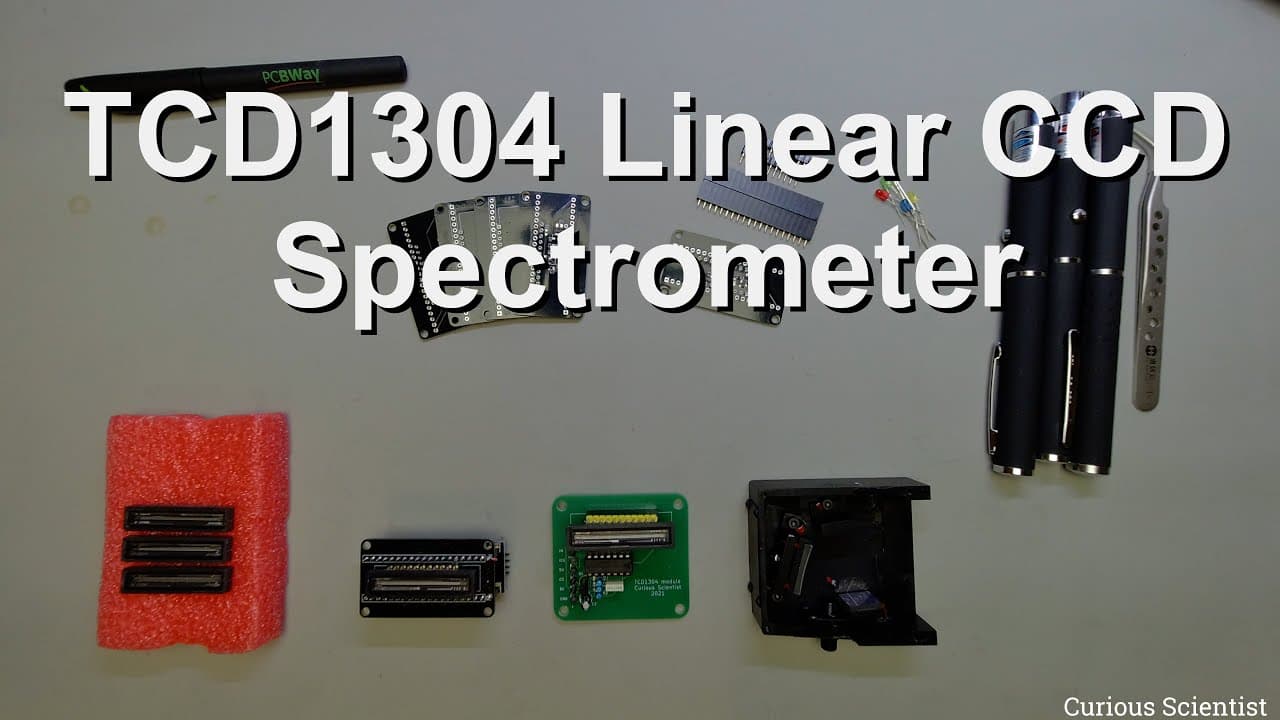
The video showcases the continuation of a previous project focusing on building a compact spectrometer using a linear CCD and optical components such as gratings and lenses.
-
The creator demonstrates how to assemble a circuit board, including a microcontroller, to drive and read signals from the CCD, enabling light manipulation and measurements.
-
Future videos will explore calibrating the CCD, measuring various light sources, and improving the spectrometer design to enhance its capabilities.
Read in Other Languages (beta)
Share This Summary 📚
Summarize YouTube Videos and Get Video Transcripts with 1-Click
Try YouTube Summary with ChatGPT & Claude or YouTube Transcript Generator
Explore More Summaries from Curious Scientist 📚
![Building a coil winder [Part 6] - A few improvements thumbnail](/_next/image?url=https%3A%2F%2Fi.ytimg.com%2Fvi%2F3eyxG_g2iUA%2Fhqdefault.jpg&w=750&q=75)
![Building a Peltier cooler-based cooling box - First iteration, improvements [Part 2/6] thumbnail](/_next/image?url=https%3A%2F%2Fi.ytimg.com%2Fvi%2F0YlNw0EGnzI%2Fhqdefault.jpg&w=750&q=75)
Summarize YouTube Videos and Get Video Transcripts with 1-Click
Try YouTube Summary with ChatGPT & Claude or YouTube Transcript Generator