How Do AI Data Centers Process ChatGPT Prompts?
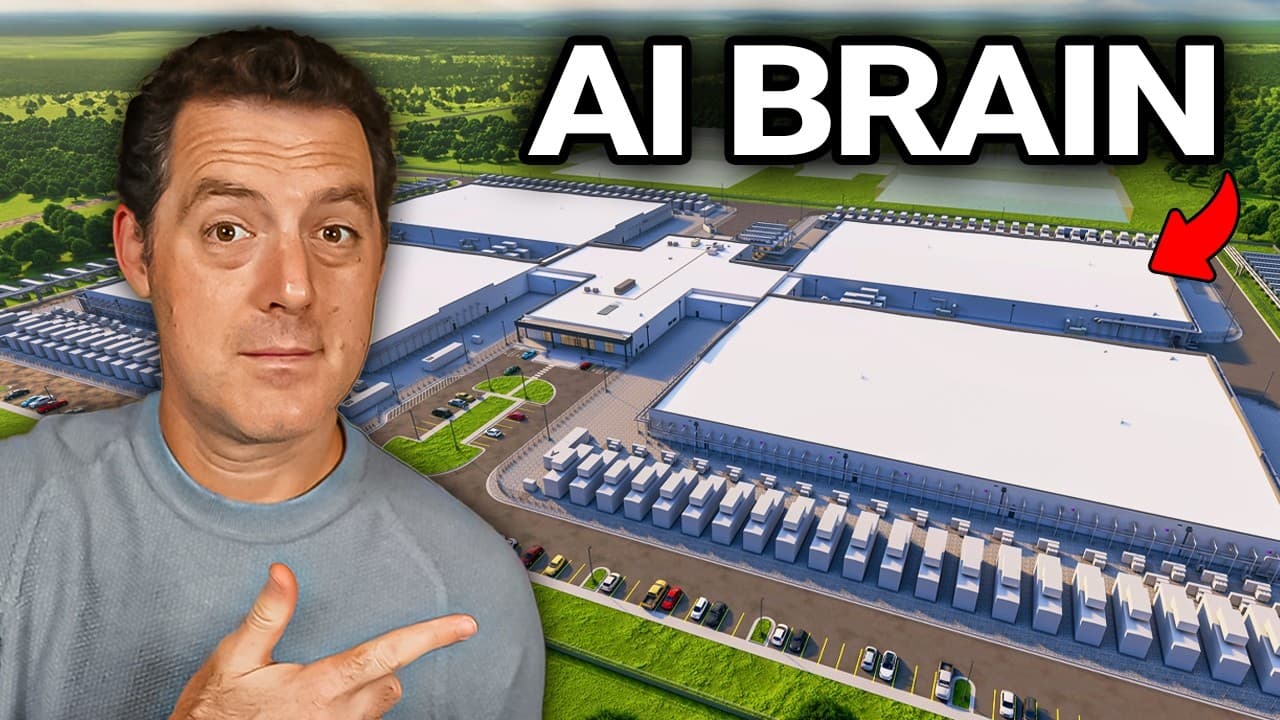
TL;DR
AI data centers process prompts by running models on dense clusters of GPUs connected through high-speed networks, storage, power systems, and cooling infrastructure. Training creates models through intense, limited-duration compute runs, while inference serves user requests continuously. Their enormous electricity and cooling demands shape rack design, facility locations, construction plans, backup systems, and relationships with surrounding communities.
Transcript
You open up Chad GPT. You type in your prompt and you hit enter. What happens then? Every AI response you see is powered by a hidden backbone. Billions of dollars of massive warehouses cooled by air, sometimes water with enough electricity to run entire cities. These massive highstakes machines don't actually live in the cloud. They live in buildin... Read More
Key Insights
- AI data centers are physical factories for computation that house racks of processors, high-speed networking, enormous storage arrays, power equipment, batteries, cooling systems, and layered security. The cloud is therefore a service delivered by buildings containing scaled-up versions of familiar computer components.
- AI workloads rely heavily on matrix multiplication, which is simple arithmetic repeated at an enormous scale. That repetition requires sophisticated and expensive GPUs, driving operators to order accelerators faster than suppliers can satisfy demand and motivating massive investments in specialized infrastructure.
- Training is a high-intensity but time-limited use of computing capacity, while inference runs continuously whenever deployed models answer user prompts. Serving ChatGPT, Google Gemini, Meta's Llama, and similar systems therefore creates a persistent need for available GPUs, electricity, networking, and cooling.
- Generative AI systems consume 10–30 times as much electricity as task-specific AI, according to the transcript. A ChatGPT query draws roughly 2.9 watt-hours compared with about 0.3 watt-hours for a traditional Google search, and billions of prompts make those small individual amounts significant.
- Data center electricity consumption represented an estimated 4.4% of total US electricity use in 2023 and could reach 7–12% by 2028. PJM forecasts roughly 30 gigawatts of new peak demand by 2030, largely associated with data centers clustered around suitable electrical infrastructure.
- AI racks are becoming dramatically denser and hotter. Current high-end clusters reach roughly 80–120 kilowatts per rack, compared with 10–15 kilowatts several years earlier, while Nvidia's Rubin-era systems may approach 600 kilowatts per rack later in the decade.
- Cooling design trades electricity consumption against water consumption. Direct liquid cooling can use less electricity than air cooling, while air-cooled and closed-loop liquid systems can conserve water but often require more power. Typical industry water usage effectiveness is about 1.9 liters per kilowatt-hour.
- Data center locations are selected according to available land, power, fiber connectivity, water, climate, policies, and community input. Facilities can generate substantial tax revenue, as illustrated by Loudoun County's reported 38% contribution to general fund revenue, but permanent operating employment may involve only dozens of people.
Install to Summarize YouTube Videos and Get Transcripts
Explore YouTube Video Summarizer or Get YouTube Transcript Extractor
Questions & Answers
Q: How does an AI data center process a ChatGPT prompt?
An AI data center processes a prompt through inference. Racks of GPUs perform the model's calculations, including repeated matrix multiplication, while high-speed switches move information between servers and storage arrays provide access to necessary data. Power distribution keeps the equipment operating, cooling removes heat from the chips, and security systems protect the physical facility and its digital infrastructure.
Q: What equipment is inside an AI data center?
An AI data center contains rows of servers and AI accelerators, high-speed network switches, storage arrays holding petabytes of information, and metal racks that organize the computing equipment. It also includes electricity generation and distribution components, batteries, emergency backup systems, cooling infrastructure, heavier power cables, reinforced floors, physical barriers, surveillance equipment, and cybersecurity protections.
Q: What is the difference between AI training and inference?
AI training is the process of creating or refining a model, described as baking the model. Initial training runs require bursts of high-intensity computing, but those runs are limited in duration. Inference begins after deployment and occurs whenever a person submits a prompt. Because customer requests arrive continuously, inference infrastructure must remain available 24 hours a day, seven days a week.
Q: Why do AI data centers consume so much electricity?
AI data centers consume large amounts of electricity because generalized generative systems repeat matrix multiplication across expensive GPU clusters and must support billions of prompts. The transcript states that generative AI can use 10–30 times as much electricity as task-specific AI. It also estimates roughly 2.9 watt-hours per ChatGPT query, compared with about 0.3 watt-hours for a traditional Google search.
Q: How are high-density AI racks changing data center design?
High-density AI racks require substantially more power delivery, heat removal, structural capacity, and specialized maintenance. High-end clusters already use roughly 80–120 kilowatts per rack, compared with 10–15 kilowatts several years ago. Nvidia's Rubin-era systems may reach about 600 kilowatts per rack later in the decade, prompting direct liquid cooling, heavier cables, thicker floors, and new service routines.
Q: How do AI data centers keep GPU systems cool?
AI facilities remove the intense heat generated as electricity passes through densely packed chips. Direct liquid cooling can transfer heat more efficiently and save electricity compared with air cooling, but some designs consume water. Air cooling and closed-loop liquid systems can reduce water use, although they often require more power. Fully closed-loop installations can aim for water usage effectiveness close to zero.
Q: How long does it take to build a hyperscale data center?
A hyperscale data center generally takes about 18–30 months from concept to commissioning. Planning and feasibility typically require 3–6 months, design and engineering take 6–12 months, and overlapping permits and approvals take 6–18 months. Construction takes 1–2 years, followed by another 3–6 months for testing and commissioning. XAI's Colossus was an exceptional 122-day project.
Q: What determines where an AI data center is built?
Operators choose sites based primarily on access to sufficient electricity, suitable land, and fiber connectivity, while also considering water, climate, local policies, approvals, and community input. Northern Virginia remains the largest market described in the transcript, while Phoenix, Chicago, Oregon, and Ohio are attracting investment because of available land, power, and water. Local tax benefits and limited permanent employment also affect decisions.
Summary & Key Takeaways
-
AI data centers are physical factories for computation, not an abstract cloud. They combine servers, GPU accelerators, switches, storage arrays, power distribution, batteries, cooling, and extensive security. Artificial intelligence has made these facilities denser, hotter, more electricity hungry, and more expensive than the data centers built primarily for earlier computing workloads.
-
Training and inference impose different operating patterns. Training involves high-intensity bursts that create or refine a model, while inference runs continuously to answer prompts from services such as ChatGPT and Google Gemini. Billions of daily requests turn modest per-query energy consumption into massive demand for GPUs, electricity generation, power distribution, and effective cooling.
-
Building a hyperscale data center generally takes 18–30 months from concept to commissioning, with planning, design, permits, construction, testing, and commissioning sometimes overlapping. Site selection depends on land, electricity, fiber, water, climate, policy, and community input. Construction creates many jobs, but completed facilities may require only a few dozen operators.
Read in Other Languages (beta)
Share This Summary 📚
Summarize YouTube Videos and Get Video Transcripts with 1-Click
Try YouTube Summary with ChatGPT & Claude or YouTube Transcript Generator
Explore More Summaries from Matthew Berman 📚






Summarize YouTube Videos and Get Video Transcripts with 1-Click
Try YouTube Summary with ChatGPT & Claude or YouTube Transcript Generator