How Does Genspark Match AI Models to Office Work?
TL;DR
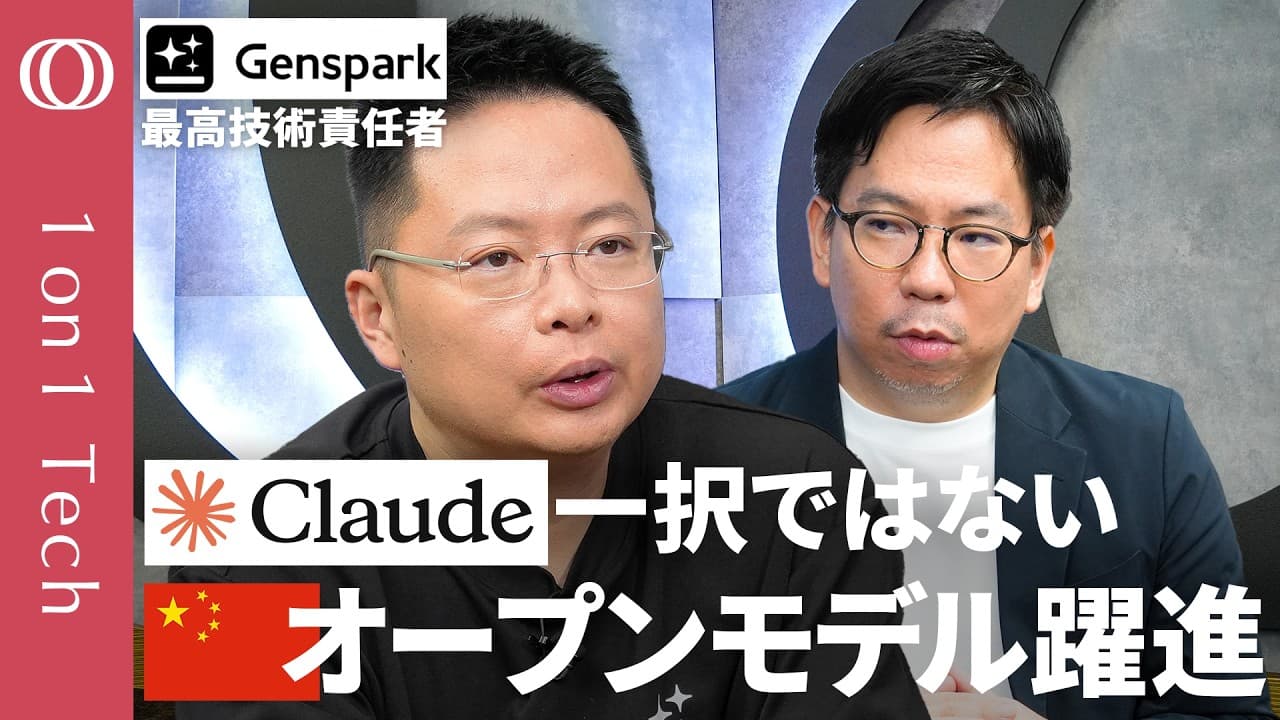
Genspark routes each office task to the AI model best suited to perform it, shielding users from the complexity of choosing among rapidly changing models. Its Super Agent coordinates research, spreadsheets, presentations, podcasts, and other deliverables, while automated grader agents evaluate outputs and use observed user revisions to help the system improve.
Transcript
Oneonone. [music] [music] [music] [music] [music] Super engineer. [music] [music] [snorts] Okay, we're joined by Ku, co-founder and CTO of Jensen [music] Spark. Thank you very much for being here. Hi, I'm K. Thank you very much for having [music] me. Yeah, thank you. So um before going to the details um I'm going to ask you a quick uh couple of que... Read More
Key Insights
- Genspark is an AI workspace designed for ordinary white-collar workers who may lack programming or computer-science training. It brings slides, spreadsheets, documents, meeting notes, translation, design, development, and chat into an environment intended to feel as approachable as familiar office software.
- The Super Agent is Genspark’s unified entry point for coordinating specialized agents. One instruction can initiate research, organize findings in a spreadsheet, produce presentation slides, and generate a short podcast, so users do not need to learn which individual tool handles every step.
- Genspark is model agnostic because it does not build a foundation model of its own. It works with OpenAI, Anthropic, Gemini, and open-weight model providers, then combines their capabilities into a product intended to deliver finished outputs for everyday business users.
- Different AI models are assigned according to demonstrated task strengths. The interview associates OpenAI models with writing, analysis, and planning, Anthropic models with coding, front-end work, and tool use, and Gemini models with multimodal tasks, image generation, and video generation.
- Open-weight models can provide lower-cost specialization for vertical tasks. Genspark fine-tunes them for uses such as slide writing and says that this combination can be more cost-efficient while, in its internal applications, performing better than closed-source alternatives.
- A mixture-of-agents approach combines multiple models for demanding assignments. Rather than expecting one system to excel at every activity, Genspark orchestrates several agents and models to improve the final result while selecting resources appropriate to each stage of the work.
- Genspark’s grader is an AI agent that evaluates another agent’s process and output. For slides, its assessment can include factual correctness, formatting, visual quality, clarity, and intuitive acceptability, providing a structured basis for identifying where future results should improve.
- User revisions provide an observable signal of dissatisfaction with generated work. Genspark’s grader examines whether users change an output, combines that behavior with its own evaluation, and passes the resulting knowledge into the system so it can continue improving while people use the product.
Install to Summarize YouTube Videos and Get Transcripts
Explore YouTube Video Summarizer or Get YouTube Transcript Extractor
Questions & Answers
Q: What is Genspark designed to do for office workers?
Genspark is designed as an AI workspace for everyday white-collar workers, including people without software engineering or computer-science training. It provides office-oriented tools for slides, spreadsheets, documents, design, development, meeting notes, translation, and chat. Its purpose is to let users delegate ordinary work through familiar interfaces and straightforward instructions instead of operating terminals or mastering professional AI tools.
Q: How does Genspark’s Super Agent handle a complex assignment?
Genspark’s Super Agent acts as the common entry point for its specialized agents and coordinates a sequence of related tasks. A user can ask it to research a topic, gather the resulting data in a spreadsheet, create presentation slides based on the research, and produce a short AI-generated podcast. The user requests outcomes without first selecting and learning each separate agent.
Q: Why does Genspark use several different AI models?
Genspark uses several models because the interview describes different systems as having different strengths. OpenAI models are associated with writing, analysis, and planning, Anthropic models with coding, front-end work, and tool use, and Gemini models with multimodal work, image generation, and video generation. Routing tasks lets Genspark select capabilities suited to each requested deliverable.
Q: What does model agnostic mean for Genspark?
Model agnostic means Genspark is not tied to a foundation model that it develops itself. The company works with OpenAI, Anthropic, Gemini, and providers of open-weight models, then orchestrates those systems inside its own product. This structure allows it to choose a suitable model for each use case as new models arrive and capabilities or costs change.
Q: How does Genspark evaluate the quality of AI output?
Genspark uses an automated evaluation system built around a grader agent, which observes another agent’s steps and assesses its completed output. For a slide, the grader can consider factual correctness, formatting, appearance, clarity, and whether the result feels intuitively acceptable. The company also compares automated judgments with human side-by-side ratings when developing its evaluation approach.
Q: How does user behavior help Genspark improve?
User behavior supplies a practical signal through edits to generated results. If users are dissatisfied, they are likely to change the output. Genspark’s grader examines those changes alongside the agent’s process and its own quality assessment, identifies areas for improvement, and feeds that knowledge back into the system. The CTO says continued product use can therefore make Genspark progressively smarter.
Q: What role do open-weight models play in Genspark?
Open-weight models give Genspark a cost-efficient foundation that can be fine-tuned for specialized applications. The CTO cites slide writing as an example of a vertical task for which the company can adapt an open-weight model. He says this approach can reduce costs and, after fine-tuning, produce performance in that application that exceeds the closed-source models Genspark evaluated.
Q: Why might an AI workspace be easier than choosing models manually?
Choosing models manually is difficult because, according to the interview, new systems appear almost every week and frontier labs release new versions frequently. Ordinary users may not know which model best fits writing, coding, multimedia, or another task. Genspark’s routing and Super Agent hide that decision, allowing users to describe the desired result while the workspace selects and coordinates the necessary resources.
Summary & Key Takeaways
-
Genspark is positioned as an AI workspace for everyday white-collar work rather than a professional tool requiring software engineering expertise. Its familiar applications include slides, spreadsheets, documents, design, development, meeting notes, translation, and chat, allowing users to complete common office tasks through accessible interfaces and natural-language instructions.
-
The Super Agent serves as a single entry point connecting Genspark’s specialized agents. A user can research a topic, place collected data into a spreadsheet, create a presentation from the research, and turn complex material into a short AI-generated podcast without determining which underlying tool or model should handle each stage.
-
Genspark remains model agnostic, combining commercial and open-weight systems according to their strengths, cost, and suitability for particular tasks. Its automated evaluation system scores agent behavior and finished work across factual accuracy, formatting, appearance, clarity, and user acceptance, then feeds the resulting knowledge back into continuing product improvement.
Read in Other Languages (beta)
Share This Summary 📚
Summarize YouTube Videos and Get Video Transcripts with 1-Click
Try YouTube Summary with ChatGPT & Claude or YouTube Transcript Generator
Explore More Summaries from TBS CROSS DIG with Bloomberg 📚

Summarize YouTube Videos and Get Video Transcripts with 1-Click
Try YouTube Summary with ChatGPT & Claude or YouTube Transcript Generator