How Does QwQ-32B Compare With DeepSeek R1?
TL;DR
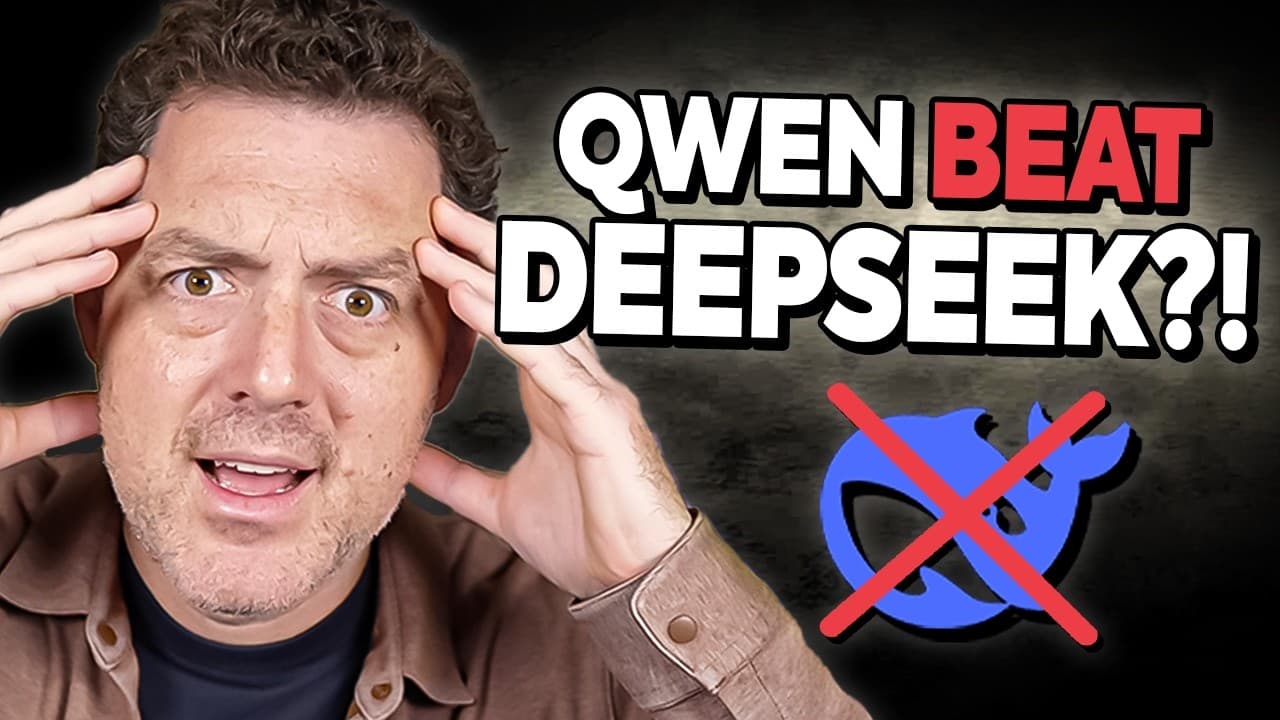
QwQ-32B delivers reasoning performance that approaches DeepSeek R1 on some benchmarks while using 32 billion parameters instead of 671 billion total parameters. Its reinforcement-learning recipe emphasizes verifiable math and coding outcomes, then improves general capabilities, instruction following, human-preference alignment, and agent performance through a second training stage. Independent results remain mixed, especially for scientific reasoning.
Transcript
a model was just released that is as good as deep seek R1 but much smaller to the point where you can actually run it on your computer it has comparable results it is a thinking model and runs insanely fast and the best part it is completely open source this is qwq 32b by Alibaba this is part of the quen series of models and it just dropped look at... Read More
Key Insights
- QwQ-32B is a 32-billion-parameter open-source reasoning model from Alibaba’s Qwen series. The transcript presents it as comparable to DeepSeek R1 on selected benchmarks despite DeepSeek R1 having 671 billion total parameters and 37 billion active parameters during inference.
- The model’s first reinforcement-learning stage is based on verifiable outcomes for mathematics and coding. An accuracy verifier checks final math solutions against ground truth, while a code execution server determines whether generated programs pass predefined test cases and supplies the corresponding reward signal.
- Outcome-based rewards judge whether the complete final solution is correct instead of assigning credit to individual reasoning steps. The presenter argues that process-based rewards may better preserve useful partial reasoning because a nearly correct solution still receives a negative signal when its final answer is wrong.
- The second reinforcement-learning stage targets broader capabilities with a general reward model. According to the Qwen team’s account, a small number of additional training steps improved instruction following, alignment with human preferences, and agent performance without causing significant declines in mathematics or coding.
- Agent capability is a deliberate focus of QwQ-32B’s training and future development. The model was designed to handle tool use, function calling, and critical reasoning, while the team is also exploring reinforcement learning for agents that perform long-horizon reasoning with greater inference-time scaling.
- Hosted QwQ-32B inference on Groq reached approximately 450 tokens per second in the demonstration. That speed allowed the model to produce extensive reasoning and revise a Python simulation rapidly, although the first generated bouncing-ball implementation still had flawed collision behavior and required iteration.
- Independent benchmark results are mixed across reasoning domains. Artificial Analysis reported 59.5 percent on GPQA Diamond, behind DeepSeek R1 at 71 percent, while its 78 percent result on AIME 2024 matched Qwen’s claim and placed QwQ-32B ahead of DeepSeek R1 in that evaluation.
- Native model size and effective compute are different considerations. QwQ-32B was released in BF16 and occupies about 65 GB, while DeepSeek R1 occupies about 671 GB natively, yet DeepSeek R1 may require less effective compute per forward pass on hardware with native FP8 support, such as Nvidia H100 systems.
Install to Summarize YouTube Videos and Get Transcripts
Explore YouTube Video Summarizer or Get YouTube Transcript Extractor
Questions & Answers
Q: What is QwQ-32B and why is it notable?
QwQ-32B is an open-source reasoning model from Alibaba’s Qwen series with 32 billion parameters. It is notable because its reported performance approaches the full DeepSeek R1 model on some evaluations even though DeepSeek R1 has 671 billion total parameters. Its smaller size, reasoning behavior, agent-oriented training, and very fast hosted inference make it attractive for local experimentation, coding, and tool-using workflows.
Q: How was QwQ-32B trained to perform reasoning tasks?
QwQ-32B began from a cold-start checkpoint and received reinforcement learning driven by outcome-based rewards. Its initial training concentrated on mathematics and coding because both domains provide verifiable correctness signals. A separate verifier assessed math solutions against ground truth, while a code execution server ran predefined tests against generated programs. A later reinforcement-learning stage addressed more general capabilities and agent behavior.
Q: What is the difference between outcome-based and process-based rewards?
Outcome-based rewards evaluate the correctness of the complete final solution. If a model completes nine reasoning steps correctly but makes an error in the final step, the entire response can receive a negative signal. Process-based rewards can instead recognize correct intermediate steps. The presenter favors process-based evaluation because it may help a model retain useful partial reasoning and improve only the remaining mistakes.
Q: How does QwQ-32B compare with DeepSeek R1 on benchmarks?
The comparison depends on the benchmark. Qwen reported an AIME 2024 score of 79.5 for QwQ-32B versus 79.8 for DeepSeek R1, along with better results on LiveBench, IFEval, and BFCL, although LiveCodeBench was lower. Artificial Analysis measured QwQ-32B at 78 percent on AIME 2024 but only 59.5 percent on GPQA Diamond, compared with DeepSeek R1 at 71 percent there.
Q: Can QwQ-32B run on a local computer?
The transcript presents QwQ-32B as small enough to run on a personal computer, but its native BF16 release occupies about 65 GB. That requirement is far below the approximately 671 GB cited for the native DeepSeek R1 release, yet it is still substantial. Whether local operation is practical therefore depends on the computer’s available memory and the specific model format being used.
Q: Why is QwQ-32B useful for agent and coding workflows?
QwQ-32B was trained with agent-related capabilities in mind, including tool use, function calling, function writing, and critical reasoning. These abilities are important for agentic coding because a model must do more than generate text. It must select tools, invoke functions, inspect results, and revise its work. The demonstration showed this iterative pattern by asking the model to repair a flawed Python simulation.
Q: How fast is QwQ-32B during hosted inference?
Groq hosted QwQ-32B at approximately 450 tokens per second in the demonstration. The presenter used that service to submit existing Python simulation code and request a correction to its collision behavior. The rapid output showed how high inference speed can compress the time needed for extended reasoning and repeated revisions, even though speed alone does not guarantee that the generated solution will be correct.
Q: What limitations and caveats apply to QwQ-32B?
QwQ-32B does not lead every benchmark, and independent results were weaker than Qwen’s claims on GPQA Diamond scientific reasoning. Its native BF16 release requires about 65 GB, while its context window is 132K, which the presenter described as not huge. DeepSeek R1 may also use less effective compute per forward pass on hardware with native FP8 support, despite its much larger total parameter count.
Summary & Key Takeaways
-
Alibaba’s QwQ-32B is an open-source reasoning model from the Qwen series. Despite having 32 billion parameters, it reportedly approaches the much larger DeepSeek R1 on AIME 2024 and exceeds it on several reported evaluations. Its smaller size, rapid hosted inference, and agent-focused training make it practical for local experimentation and iterative coding workflows.
-
The training process began with a cold-start checkpoint and reinforcement learning driven by outcome-based rewards. Math answers were checked through an accuracy verifier, while generated programs were evaluated by executing predefined tests. A second reinforcement-learning stage used a general reward model to improve instruction following, human-preference alignment, and agent performance without substantially reducing math or coding performance.
-
Independent testing presented a more qualified picture than the model creator’s benchmarks. Artificial Analysis measured QwQ-32B at 59.5 percent on GPQA Diamond, behind DeepSeek R1 at 71 percent, but found a 78 percent AIME 2024 result that matched Qwen’s claims. Native BF16 storage is about 65 GB, and the context window is 132K.
Read in Other Languages (beta)
Share This Summary 📚
Summarize YouTube Videos and Get Video Transcripts with 1-Click
Try YouTube Summary with ChatGPT & Claude or YouTube Transcript Generator
Explore More Summaries from Matthew Berman 📚






Summarize YouTube Videos and Get Video Transcripts with 1-Click
Try YouTube Summary with ChatGPT & Claude or YouTube Transcript Generator