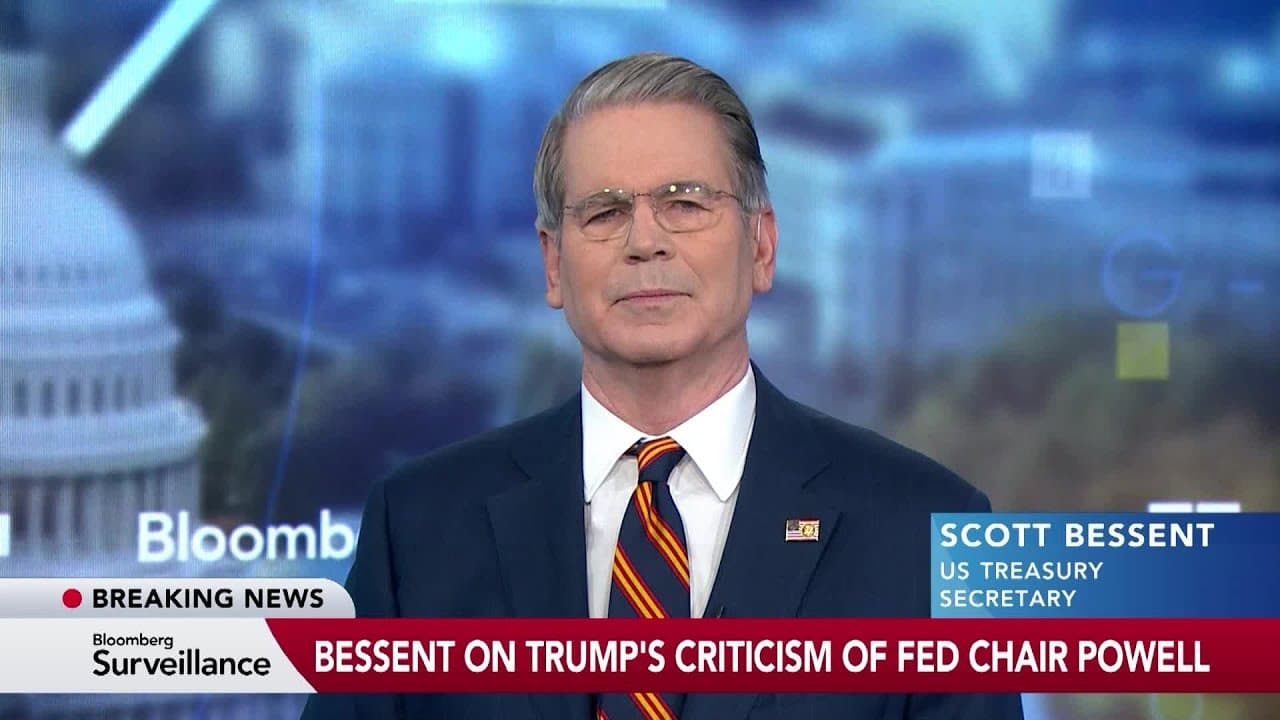
Scott Bessent on Inflation, the Fed, and Trade
TL;DR
Inflation should be judged by its persistent trend, not one report, and recent readings have been softer than expected without the substantial tariff-driven price increase many predicted. Scott Bessent also says the search for Jerome Powell’s successor has formally begun, while tariff pressure, chip export controls, and market access remain central to negotiations with China, Europe, and other partners.
Transcript
We've had a string of softer than expected inflation rates in this country. We've had four. We might get five at 830 Eastern time. Why do you believe that signal and not noise? Well, I mean, there's some persistence there, Jonathan. And look, I do have access to the number of the night before, but when I'm coming on TV, I don't look at it. So I don... Read More
Key Insights
- Inflation is best evaluated through persistent trends rather than a single data release. Bessent points to four softer-than-expected readings, with a possible fifth forthcoming, while cautioning against placing too much emphasis on any individual number.
- Tariffs have not produced the substantial increase in the price level that many Wall Street economists and market participants expected. Bessent says some Federal Open Market Committee members nevertheless remained concerned that tariff-related inflation could appear through the summer.
- An independent central bank is important for conducting monetary policy and maintaining financial confidence. Bessent connects Federal Reserve independence to financial markets, the term premium, and longer-term debt while declining to speculate about firing Chair Jerome Powell.
- The formal process of identifying Jerome Powell’s successor has already begun. Bessent says strong candidates exist both inside and outside the Federal Reserve, but the selection belongs to President Trump and will proceed according to the president’s preferred timetable.
- A former Federal Reserve chair remaining as a governor could create market confusion. Bessent notes that chairs traditionally step down from the board and warns that Powell staying after his chairmanship could complicate expectations surrounding a nominated successor.
- Nvidia’s H20 chip export status was part of broader negotiations with China. Bessent says sales could be permitted when Chinese manufacturers already offer an equivalent chip, while warning against allowing a Chinese-centered digital infrastructure network to expand globally at the expense of American manufacturers.
- US-China negotiations involve exchanges across multiple policy areas rather than a simple quid pro quo. Bessent describes chip restrictions and rare earth licenses as elements of a broader mosaic and expects to meet China’s vice premier within the next few weeks.
- The administration’s tariff strategy prioritizes improved trade agreements over short-term market reactions. Bessent says President Trump views trade reform as a generational opportunity and is willing either to collect higher tariffs or accept better proposals from negotiating partners.
Install to Summarize YouTube Videos and Get Transcripts
Explore YouTube Video Summarizer or Get YouTube Transcript Extractor
Questions & Answers
Q: How should recent US inflation readings be interpreted?
Recent inflation readings should be interpreted as a trend rather than judged individually. Bessent points to four consecutive softer-than-expected reports and says a fifth could follow, although he did not review the forthcoming figure before the interview. He argues that persistence matters most and that one release, whether lower, higher, or unchanged, should not receive excessive weight.
Q: Have tariffs caused the inflation increase economists expected?
Tariffs had not caused the substantial increase in the price level that many Wall Street economists and market participants expected, according to Bessent. He presents that outcome as an early forecasting error. However, he also notes that some members of the Federal Open Market Committee remained worried that tariff-related price effects could still emerge through the summer.
Q: Is President Trump planning to fire Jerome Powell?
President Trump is not looking to fire Federal Reserve Chair Jerome Powell, according to Bessent, who says the president has stated that position repeatedly. Bessent characterizes Trump’s public criticism as an effort to pressure officials. He declines to discuss possible future policy or future Federal Reserve mistakes, while saying that the central bank has made significant forecasting errors in the past.
Q: Why does Federal Reserve independence matter?
Federal Reserve independence matters because an independent central bank supports the effective conduct of monetary policy. Bessent says its importance can also be observed through financial markets, the term premium, and longer-term debt. His comments suggest that the consequences of changing Federal Reserve leadership extend beyond one official and can affect broader market expectations and financing conditions.
Q: How will the next Federal Reserve chair be selected?
The formal process for finding Jerome Powell’s successor has already started, according to Bessent. He says there are many strong candidates both inside and outside the Federal Reserve, without expressing a preference between those groups. The final selection is President Trump’s decision, and the process will advance at the speed determined by the president.
Q: Why might Powell staying as a Fed governor confuse markets?
Powell remaining on the Federal Reserve Board after his term as chair could confuse markets because a former chair might retain influence while a successor is being nominated or taking office. Bessent notes that Federal Reserve chairs traditionally step down as governors as well. He also refers to concerns about a shadow chair creating unclear or competing signals before a successor’s nomination.
Q: Why could Nvidia resume H20 chip sales to China?
Nvidia could resume selling H20 chips in China if Chinese manufacturers already provide an equivalent product, according to Bessent. He argues that restricting an American chip under those circumstances could encourage other countries to adopt Chinese alternatives. The administration does not want a Chinese-centered digital infrastructure network expanding globally while American chip manufacturers lose access and influence.
Q: How do tariffs and export controls support trade negotiations?
Tariffs and export controls provide leverage by giving the United States concessions that trading partners may want. Bessent says the earlier H20 restriction functioned as a negotiating chip during talks in Geneva and London, while China controlled items the United States wanted, including rare earth licenses. He describes these elements as part of a broader mosaic rather than a direct quid pro quo.
Summary & Key Takeaways
-
Bessent argues that several softer inflation reports indicate a meaningful trend, although no single release should receive excessive weight. He says the substantial tariff-driven increase in the price level anticipated by many economists and market participants has not occurred, while acknowledging that some Federal Reserve officials remained concerned about inflationary effects emerging through the summer.
-
President Trump is not seeking to fire Jerome Powell, according to Bessent, who emphasizes the importance of central bank independence for monetary policy, financial markets, the term premium, and longer-term debt. A formal search for Powell’s successor has started, with candidates being considered from both inside and outside the Federal Reserve.
-
Trade negotiations rely on maximum pressure and reciprocal concessions, according to Bessent. Nvidia’s potential H20 chip sales to China formed part of a broader negotiating mosaic that included rare earth licenses. The administration is also pressing Europe and other partners for improved agreements without allowing market deadlines or short-term fluctuations to dictate its strategy.
Read in Other Languages (beta)
Share This Summary 📚
Summarize YouTube Videos and Get Video Transcripts with 1-Click
Try YouTube Summary with ChatGPT & Claude or YouTube Transcript Generator
Explore More Summaries from Bloomberg Television 📚


Summarize YouTube Videos and Get Video Transcripts with 1-Click
Try YouTube Summary with ChatGPT & Claude or YouTube Transcript Generator