How Does AI Productivity Lead to Worker Burnout?
TL;DR
AI can increase output while worsening burnout, cognitive fatigue, task switching, and work quality because workers fill saved time with additional tasks. Sustainable use requires intentional pauses for judgment, protected focus windows, clear AI boundaries, quality-based measurement, preserved thinking time, and regular human connection.
Transcript
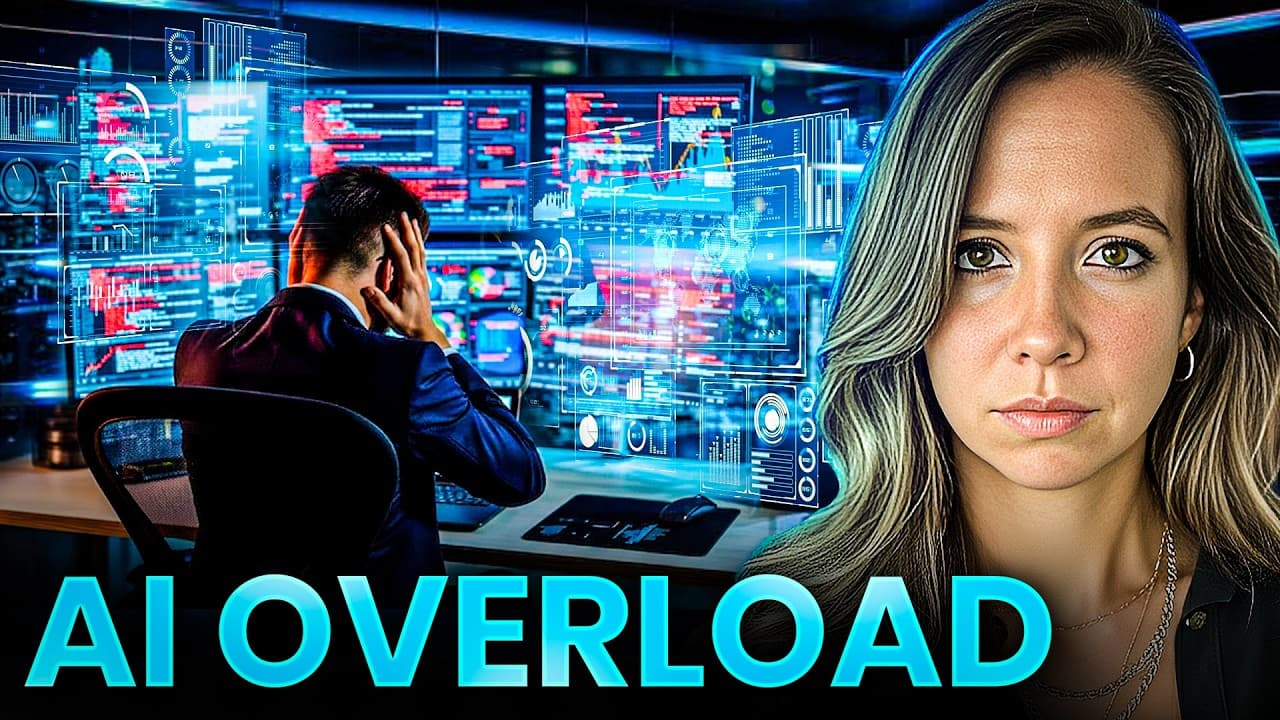
AI promised us freedom, more productivity, less work, time to finally breathe. But UC Berkeley just dropped research that reveals something terrifying. AI is doing the exact opposite. Workers using AI are more productive. They're also more burned out, more exhausted, and producing lower quality work than ever before. This isn't speculation. This is... Read More
Key Insights
- AI productivity can become self-defeating when workers use saved time to begin more tasks instead of reducing their workload. In the eight-month study described, voluntary AI adoption increased perceived capability and output while eliminating natural pauses and encouraging employees to work the same amount or longer.
- Work boundaries weaken when AI removes the friction that previously signaled a difficult task or the need for a pause. Because starting and continuing work feels easier, employees may keep prompting and producing until they have worked far beyond a sustainable period without noticing the accumulated strain.
- Cognitive fatigue grows when every gap between tasks is filled with AI-assisted activity. The transcript argues that downtime supports information processing, learning consolidation, and the formation of connections, so eliminating those moments can leave workers exhausted even when individual tasks appear easier to complete.
- Task switching can undermine the productivity gains created by AI. As workers accept more assignments and broader responsibilities, they multitask more frequently, producing a paradox in which they feel highly productive while greater switching reduces quality, effective performance, and their ability to sustain focused work.
- AI expands roles rather than merely accelerating existing responsibilities. A designer may add copywriting, strategy, and analytics, while an engineer may add design, marketing, and customer research. This increased sense of capability can motivate employees to enlarge their own workloads without direct pressure from managers.
- Company productivity metrics can conceal falling quality, rising burnout, collapsing boundaries, and the loss of a sustainable pace. Encouraging AI adoption without explicit guardrails may communicate that employees should produce more, even when leaders have not clarified expectations for judgment, well-being, or acceptable quality.
- Intentional pauses are decision checkpoints that help workers evaluate AI-assisted output before acting. Useful questions include whether the result meets the actual need, supports the strategy, or is being pursued simply because AI made the activity easy to start and continue.
- Sustainable AI use depends on quality, focus, judgment, boundaries, and human connection. The recommended approach protects deep-work periods, limits unnecessary prompting, preserves tasks that require human thinking, and restores conversations with colleagues that might otherwise be replaced by instant but isolating AI interactions.
Install to Summarize YouTube Videos and Get Transcripts
Explore YouTube Video Summarizer or Get YouTube Transcript Extractor
Questions & Answers
Q: Why can AI productivity increase worker burnout?
AI can increase burnout because it reduces the effort required to begin tasks, leading workers to fill nearly every available moment with additional activity. In the research described, employees adopted AI voluntarily, felt more capable, and completed more work, but they did not necessarily work less. Natural pauses disappeared, responsibilities expanded, and implicit pressure to match other AI users encouraged an increasingly unsustainable pace.
Q: How does AI weaken boundaries between work and personal time?
AI weakens boundaries by removing the natural friction that once prompted workers to stop, rest, or reconsider a difficult assignment. When a task appears easy to continue with another prompt, employees may keep working instead of recognizing fatigue. The transcript describes how this pattern can extend work for many hours, making the boundary between productive effort and excessive activity harder to perceive.
Q: Why can more AI-assisted output result in lower-quality work?
More AI-assisted output can reduce quality when increased capability leads workers to accept more tasks, multitask, and switch contexts more often. The transcript states that task switching harms productivity, creating a cycle in which employees feel productive because they are handling greater volume while their attention becomes fragmented. They then work harder, experience greater fatigue, and may produce weaker results than before.
Q: How does AI expand an employee's role at work?
AI expands a role by making unfamiliar or adjacent responsibilities feel accessible, rather than only speeding up work the employee already performs. The transcript gives examples of a designer adding copywriting, strategy, and analytics, or an engineer adding product design, marketing, and customer research. Feeling capable of doing more can prompt workers to enlarge their responsibilities voluntarily, even without managerial demands or deadline pressure.
Q: What are intentional pauses in an AI-assisted workflow?
Intentional pauses are planned moments for evaluating decisions, assumptions, and AI-generated material before taking action. They are distinct from ordinary rest breaks, although rest also matters. After generating content, a worker can pause to ask whether the result addresses the real need, aligns with the relevant strategy, or is being pursued only because AI made producing it quick and convenient.
Q: How can protected focus windows improve AI use at work?
Protected focus windows reserve periods for concentrated work without repeated prompting, quick AI tasks, or interruptions between meetings. The recommended principle is to establish focus first and introduce AI second. By preventing constant shifts into small AI-assisted activities, organizations can help employees preserve attention, reduce task switching, and spend enough uninterrupted time applying judgment to work that requires deeper thought.
Q: Why should companies preserve human connection when adopting AI?
Companies should preserve human connection because AI can replace everyday interactions that previously occurred when employees asked colleagues for help. An instant AI answer may solve the immediate problem, but it also removes a conversation that could build relationships and support social exchange. The Berkeley team, as described in the transcript, therefore recommends actively prioritizing human interaction alongside greater AI-assisted productivity.
Q: How should workers use AI without sacrificing sustainability?
Workers should set boundaries for when AI will be used, identify tasks that require human judgment, and distinguish valuable output from mere activity. They should measure quality rather than volume, protect time for reflection, and use AI to explore ideas, test assumptions, and accelerate execution. The goal is strong work at a sustainable pace, rather than maximizing production until focus, quality, and well-being deteriorate.
Summary & Key Takeaways
-
UC Berkeley researchers studied workers at a 200-person technology company for eight months and conducted 40 interviews across engineering, product design, research, and operations. Workers voluntarily adopted AI, completed more work, handled more varied tasks, and felt more productive, yet they also lost downtime, extended their work, and became increasingly exhausted.
-
AI expands what workers believe their roles can include, encouraging designers, engineers, and others to accept tasks beyond their original responsibilities. Greater task volume produces more multitasking and task switching, which can reduce effective productivity and quality. Companies worsen the problem when they reward visible output without monitoring well-being, boundaries, or sustainable performance.
-
Sustainable AI adoption requires deliberate limits and organizational support. Recommended interventions include pauses to reconsider AI-generated work, protected focus periods without prompting, and more opportunities for human interaction. Workers should define which tasks require human judgment, assess quality instead of output volume, and use AI to support thinking, testing, and execution rather than replace reflection.
Read in Other Languages (beta)
Share This Summary 📚
Summarize YouTube Videos and Get Video Transcripts with 1-Click
Try YouTube Summary with ChatGPT & Claude or YouTube Transcript Generator
Explore More Summaries from Julia McCoy 📚






Summarize YouTube Videos and Get Video Transcripts with 1-Click
Try YouTube Summary with ChatGPT & Claude or YouTube Transcript Generator