How to Become a More Effective Marketing Thinker
TL;DR
Transformative marketing results begin with a marketer who can genuinely adopt the customer’s perspective. Before changing copy, images, forms, or software, clarify what customers receive, why they should care, and only then how they can respond, while translating experience and expertise into specific, credible value.
Transcript
good afternoon everyone it's a pleasure to be connected with you again let's get right down to some application take a look at the page this was submitted by Dave Fogle Dave's a regular attendee he studies our work and he applies it in his his own work and so I want to look at a page submitted by Dave and discuss it with you in order to set up what... Read More
Key Insights
- Transformative marketing results are produced by transformed marketers who improve how they perceive, reason, and communicate. New software, artificial intelligence, isolated tactics, or optimization tools cannot correct a marketer’s underlying inability to understand the customer’s experience and construct a coherent value proposition.
- A landing page must quickly answer whether visitors are in the right place, what they can do there, and why they should do it. These questions should be addressed within the first seven seconds and the first four inches of the page.
- Empathy is the marketer’s ability to experience a page from the customer’s viewpoint. It requires mentally leaving the organization’s perspective, recognizing the visitor’s pain and uncertainty, and evaluating whether every statement communicates value in language the customer can understand and appreciate.
- The burden of communication begins with the person doing the communicating. If a marketer cannot translate an idea into language the customer understands, the marketer cannot reasonably hold the customer responsible for failing to respond in the intended way.
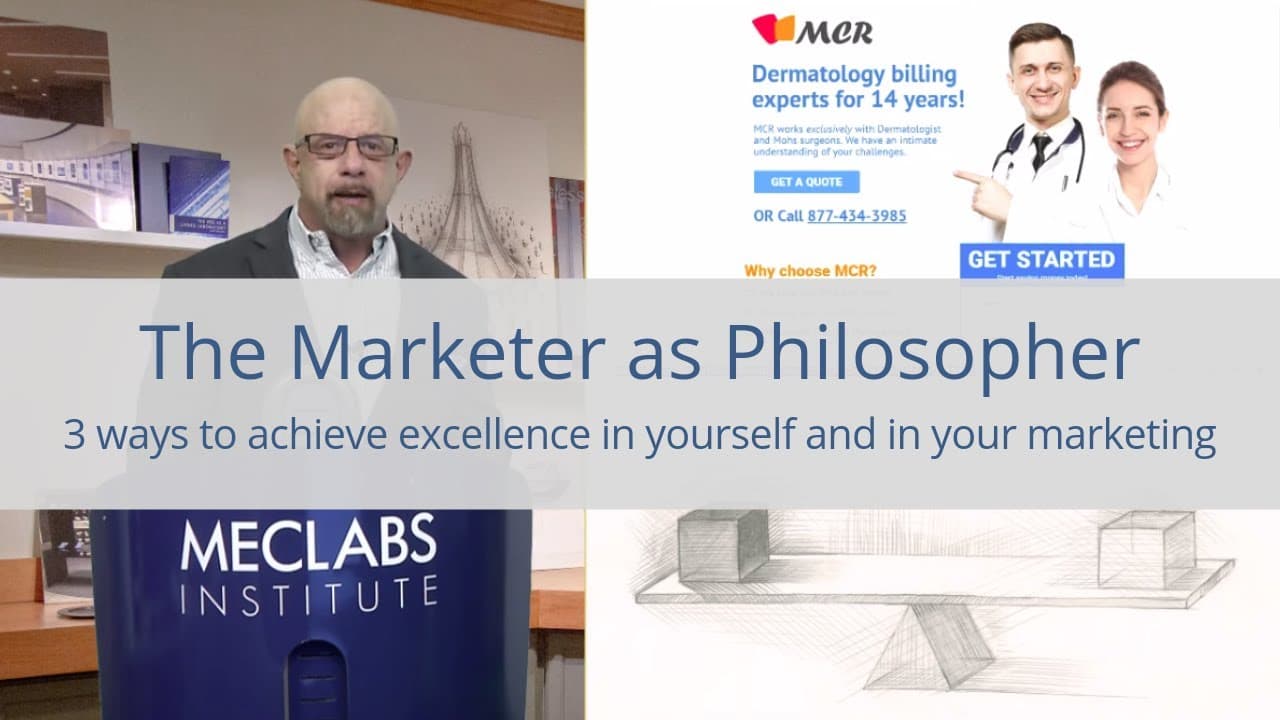
- A headline should lead with the value the customer receives. The phrase about being dermatology billing experts for 14 years supplies useful evidence, but it becomes more compelling when that experience is translated into a specific customer benefit rather than left as an implied claim.
- Evidence builds trust more effectively when it supports a clear reason to believe. Fourteen years of experience can increase credibility, but the marketer must explain what the organization achieved or learned during that period and how it enables the organization to serve customers better.
- The what and the why should come before the how in a marketing sequence. Calls to get a quote, make a call, or get started describe response mechanisms, but visitors first need to understand precisely what they are considering and why it deserves action.
- Haphazard marketing methods produce weak decisions when teams apply disconnected tips, compete for dominance, or compromise until a page reflects the lowest common denominator. A coherent methodology gives marketers a principled basis for evaluating copy, calls to action, evidence, and customer value.
Install to Summarize YouTube Videos and Get Transcripts
Explore YouTube Video Summarizer or Get YouTube Transcript Extractor
Questions & Answers
Q: How can marketers achieve transformative results?
Marketers can achieve transformative results by changing how they perceive and approach the customer’s experience. Before adjusting copy, images, forms, or calls to action, they should adopt the customer’s viewpoint, identify the customer’s pain and uncertainty, and build a coherent communication sequence. The central principle is that better methods depend on a marketer who can apply empathy, disciplined reasoning, and clear value communication.
Q: What questions should a landing page answer immediately?
A landing page should quickly answer three visitor questions: Am I in the right place, what can I do here, and why should I do it? The transcript states that these questions should be answered within the first seven seconds and within the first four inches of the page. Addressing them helps visitors recognize the page’s relevance, understand the available offer or action, and see a reason to continue.
Q: Why is customer empathy important in marketing?
Customer empathy allows a marketer to experience a page as the customer experiences it, rather than viewing it through the organization’s assumptions. The marketer must mentally move into the customer’s position, recognize the customer’s pain, and assess whether the message is understandable and valuable. Without this shift, a page may contain accurate information while still failing to address the visitor’s actual questions and motivations.
Q: How should marketers use years of experience in a headline?
Years of experience should serve as evidence for a meaningful customer benefit, not remain an isolated credential. Saying that a company has been a dermatology billing expert for 14 years may increase trust, but the stronger question is what the company learned or achieved during that time. The headline should connect that accumulated expertise to a specific reason the organization can serve the customer better.
Q: Why should a headline lead with customer value?
A headline should lead with customer value because visitors need to understand what they receive before organizational credentials become persuasive. A phrase describing expertise may imply value, but it leaves the customer to complete the reasoning. Point-first communication makes the benefit explicit, then uses evidence such as specialization, experience, or an intimate understanding of customer challenges to support the conclusion and strengthen trust.
Q: Why should the what and why come before the how?
The what and why should come first because visitors need to understand the offer and its value before being told how to respond. Buttons such as get a quote or get started explain the response mechanism, but they do not clarify precisely what the visitor is considering. Presenting a call to action too early can create uncertainty and ask for commitment before sufficient motivation or understanding exists.
Q: Can marketing software solve weak landing-page communication?
Marketing software cannot by itself solve weak communication because the underlying problem may be the marketer’s perspective and methodology. Tools can support execution, testing, and optimization, but they cannot independently supply empathy or determine how expertise translates into customer value. If the marketer cannot see through the customer’s eyes, adding a software suite or artificial intelligence leaves the central communication limitation unresolved.
Q: Why do haphazard marketing methods weaken performance?
Haphazard methods weaken performance because marketers apply disconnected tips without a consistent principle for deciding what the page needs. In group settings, competing ideas may turn the page into a battleground where the dominant person wins, or into a compromise reduced to the lowest common denominator. A coherent methodology helps the team evaluate each element according to customer understanding, value, credibility, and sequence.
Summary & Key Takeaways
-
Marketing excellence depends on the marketer’s perspective, not merely on tactics, software, or page elements. A marketer must move beyond haphazard collections of tips and develop a coherent methodology rooted in empathy, disciplined reasoning, and personal transformation. Better marketing emerges when the person creating the communication learns to experience it as the customer does.
-
The dermatology billing page partially answers three immediate visitor questions: whether they are in the right place, what they can do, and why they should act. Its headline establishes specialization and 14 years of experience, but it does not clearly translate that experience into a concrete benefit customers can understand and value.
-
Effective communication should establish what the offer is and why it matters before presenting how to respond. Asking visitors to get a quote, call, or get started too early creates uncertainty when the service and its value remain unclear. The marketer bears responsibility for making the intended meaning understandable, credible, and personally relevant.
Read in Other Languages (beta)
Share This Summary 📚
Summarize YouTube Videos and Get Video Transcripts with 1-Click
Try YouTube Summary with ChatGPT & Claude or YouTube Transcript Generator
Explore More Summaries from Flint McGlaughlin 📚

Summarize YouTube Videos and Get Video Transcripts with 1-Click
Try YouTube Summary with ChatGPT & Claude or YouTube Transcript Generator