What Is the Difference: Data Scientist vs AI Engineer?
TL;DR
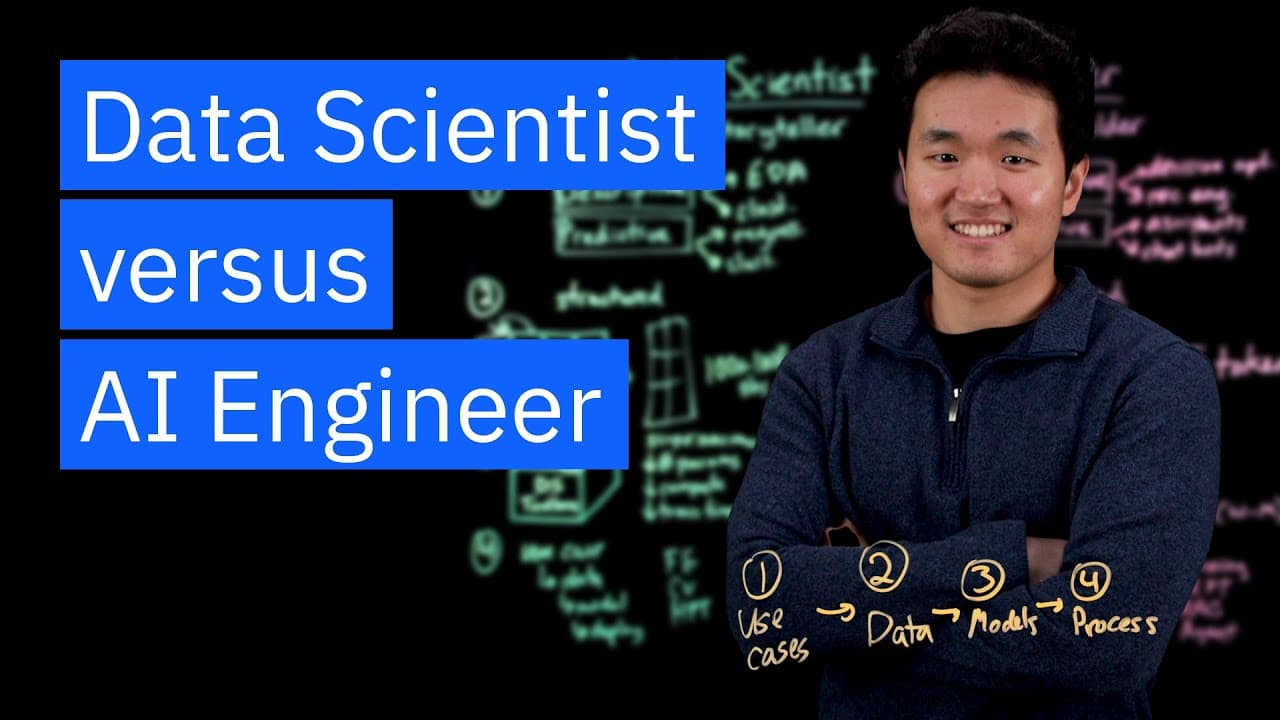
AI engineers build generative systems using foundation models to transform business processes, while data scientists analyze data to extract insights with descriptive and predictive analytics. The video compares use cases, data types, models, and workflows, highlighting how the two roles differ and where they overlap in practice.
Transcript
For many years, data science has been called the sexiest job of the 21st century. But in recent years, it seems like there's a new job vying for that title. The AI engineer. So who even are these new kids on the block? Are they just data scientists in disguise? What's up y'all? I'm Isaac Ke, and I'm a former data scientist turned AI engineer at IBM... Read More
Key Insights
- AI engineers focus on building generative systems using foundation models
- Data scientists primarily perform descriptive analytics and exploration to understand data
- Foundation models enable broad generalization across tasks for AI engineers
- Data scientists rely on structured data and traditional models with smaller scale
- AI engineers depend on large scale, unstructured data and extensive compute
- Prompt engineering and RAG are common tools for constructing AI applications
- AI democratization makes pre trained models accessible for development
- There is overlap between roles in prescriptive use cases and structured data handling
Install to Summarize YouTube Videos and Get Transcripts
Explore YouTube Video Summarizer or Get YouTube Transcript Extractor
Questions & Answers
Q: What is the core difference between the two roles according to the video?
The core difference is that AI engineers act as AI system builders who use foundation models to create generative systems that transform business processes, while data scientists are data storytellers who analyze data to produce descriptive and predictive insights. This distinction shapes their typical data, models, and workflows, though overlaps remain in certain use cases.
Q: How do use cases differ for data scientists versus AI engineers?
Data scientists focus on describing the past and predicting outcomes using descriptive analytics and predictive models like regression and classification. AI engineers focus on prescriptive and generative use cases, creating systems such as intelligent assistants, chat bots, and recommendation engines that guide actions and automate processes.
Q: What type of data is central to data scientists compared to AI engineers?
Data scientists primarily work with structured tabular data, performing cleaning and feature engineering before modeling. AI engineers mainly work with unstructured data such as text, images, videos, and audio, leveraging foundation models that require large scales of data and compute for training.
Q: What is a foundation model and why is it important in the video?
A foundation model is a large, generalizable model that can handle a wide range of tasks without retraining for each use case. It is central to the AI engineer workflow because it enables building diverse AI applications through prompt engineering, chaining prompts, fine tuning, or retrieval augmented generation.
Q: How do the modeling approaches differ between the fields?
Data science uses a toolbox of hundreds of traditional models and algorithms, each suited to specific tasks and data domains, often requiring separate training and validation. Generative AI relies on foundation models that generalize across tasks, with larger parameter counts and heavier training requirements.
Q: What tools or processes are highlighted for AI engineers?
AI engineers use prompt engineering, PEFT, RAG, and may build autonomous agents to reason through complex problems. They interact with foundation models via natural language instructions and assemble larger systems through frameworks that connect prompts, data, and outputs to deliver end to end AI-enabled applications.
Q: Is there any overlap between data scientists and AI engineers?
Yes, there is overlap in areas like prescriptive use cases or working with structured data in certain contexts. The video notes that both fields continue to evolve rapidly, with new research, models, and tools emerging, and professionals from each side can contribute to overlapping projects such as decision optimization and data driven automation.
Q: What overarching message does the video convey about the two roles?
The video emphasizes that breakthroughs in generative AI are reshaping the landscape, creating distinct roles while preserving some shared foundations. It encourages recognizing both the differences and the overlap, and staying adaptable as new models, data types, and workflows continue to emerge in AI and data science.
Summary & Key Takeaways
-
The video contrasts the two roles by use case focus, showing data scientists as storytellers describing the past and AI engineers as system builders guiding action.
-
It explains data versus unstructured data as data scientists typically handle structured data and AI engineers work with text, images, and other unstructured sources.
-
It highlights the shared space and evolving nature of both fields, with ongoing advances and overlap in techniques, models, and tools.
Read in Other Languages (beta)
Share This Summary 📚
Summarize YouTube Videos and Get Video Transcripts with 1-Click
Try YouTube Summary with ChatGPT & Claude or YouTube Transcript Generator
Explore More Summaries from IBM Technology 📚


Summarize YouTube Videos and Get Video Transcripts with 1-Click
Try YouTube Summary with ChatGPT & Claude or YouTube Transcript Generator