How Does Andrew Wilkinson Pick Startup Ideas That Won’t Fail?
TL;DR
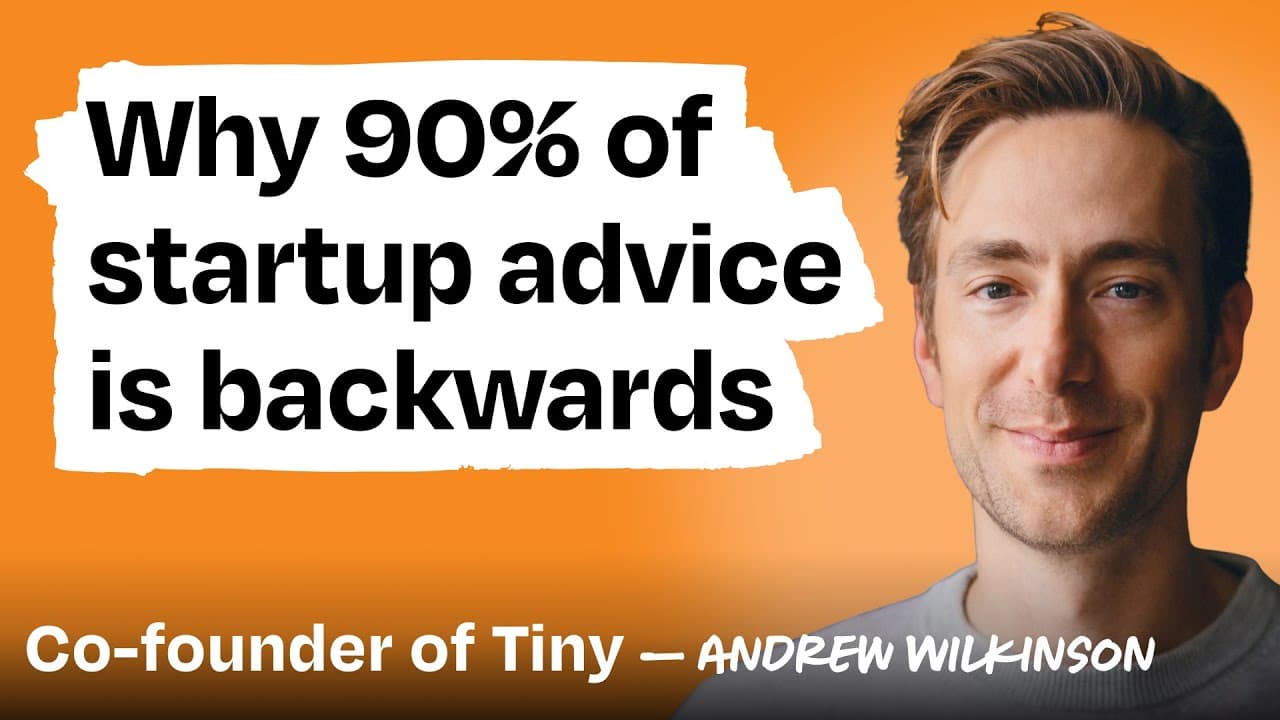
Andrew Wilkinson recommends choosing a startup idea you find interesting in a niche with demand but little competition. Drawing on involvement in about 75 projects or businesses, he warns first-time entrepreneurs against starting with complicated ambitions like the next great AI company and advises pursuing an achievable early win instead. Read on for his framework, examples, and biggest idea-selection mistakes.
Transcript
You don't want to walk into the gym on day one and try and deadlift 300 pounds. So when someone comes to me and they're a first time entrepreneur and they say, "I'm going to make the next great AI company," I think that is the equivalent. I feel like you've actually started and run more companies than maybe anyone else in the world. What is... Read More
Key Insights
- Charlie Munger's rule 'fish where the fish are' means seeking small niches with plenty of demand and little competition, because more competitors force lower prices and thinner margins, making the whole business harder to win.
- Boring, unglamorous businesses like pest control, funeral homes, or government form-filling software face far less competition than exciting ideas like cafes or restaurants that millions of people dream about starting every morning.
- First-time entrepreneurs should not chase highly complex, regulated, competitive ventures such as launching a new bank or 'the next great AI company,' which Andrew compares to trying to deadlift 300 pounds on day one at the gym.
- An initial business win matters because it builds a personal narrative of competence; Andrew's early web design agency succeeded immediately and convinced him he was good at business, fueling him to keep going despite later failures.
- Andrew has been a primary contributor to about 75 different projects or businesses, calling his tendency to start too many an Achilles heel of being 'an inch deep and a mile wide,' though it exposed him to nearly every business model.
- After his first win, Andrew lost money almost immediately on a pizzeria, a designer cat furniture business, an online DJ school, and a skin cream business, showing that even experienced founders repeatedly fail on wrong ideas.
- A business can make money and still trap you in work you hate; Andrew cites a coffee shop owner who realized his real job was just buying and replacing milk all day rather than the creative venture he imagined.
- Andrew describes AI as 'the world's most reliable employee who costs $200 a month and works 24/7,' predicting many knowledge work jobs will change massively and questioning whether all jobs eventually become a single prompt.
Install to Summarize YouTube Videos and Get Transcripts
Explore YouTube Video Summarizer or Get YouTube Transcript Extractor
Questions & Answers
Q: How do you come up with a great startup idea?
Andrew Wilkinson says to choose something you will be interested in while avoiding business models where others have repeatedly failed. He applies Charlie Munger’s advice to “fish where the fish are,” seeking opportunity without crowding from competitors.
Q: What does “fish where the fish are” mean for startup founders?
It means looking for a business opportunity where demand exists rather than entering a model with a long record of failure. Wilkinson uses Charlie Munger’s phrase as a rule for choosing where to compete.
Q: Why should first-time entrepreneurs avoid overly ambitious startup ideas?
Wilkinson compares building the next great AI company as a first-time entrepreneur to trying to deadlift 300 pounds on your first day at the gym. His point is that beginners should first pursue a business where they can achieve an attainable early win.
Q: What is Andrew Wilkinson’s biggest startup-idea mistake?
His biggest mistakes came from entering business models where other people had repeatedly failed and assuming he could execute them better. He also calls his tendency to get excited and start too many businesses an Achilles heel.
Q: How much business-building experience does Andrew Wilkinson have?
Wilkinson estimates that he has started or participated as a primary contributor in about 75 projects or businesses. Although he describes himself as “an inch deep and a mile wide,” that experience exposed him to almost every business model.
Q: What is Tiny, Andrew Wilkinson’s company?
Tiny is the holding company co-founded by Andrew Wilkinson, and it is often called the Berkshire Hathaway of the internet. It owns more than 40 businesses, including Dribbble, WeCommerce, and the AeroPress coffee maker, and focuses on buying profitable companies from founders and holding them for the long term.
Q: What does Andrew Wilkinson say about using AI at work?
Wilkinson compares AI to the world’s most reliable employee, costing $200 per month and working 24/7. He expects many knowledge-work jobs to change massively and asks whether jobs could eventually become a single prompt.
Q: What startup topics does Andrew Wilkinson’s conversation cover?
The conversation examines strategies for finding good business ideas, common ideas to avoid, and Wilkinson’s experience automating work and life with AI. It also discusses employment, the relationship between happiness and money, and the effects of his ADHD diagnosis and taking SSRIs.
Summary & Key Takeaways
-
Andrew Wilkinson is co-founder and CEO of Tiny, a bootstrapped holding company called the Berkshire Hathaway of the internet that owns over 40 profitable businesses, including Dribbble, WeCommerce, and the AeroPress coffee maker, held for the long term.
-
The core startup advice is to pick something you find genuinely interesting but that most people overlook. Crowded, exciting markets like cafes and restaurants carry brutal competition and low margins, while boring niches such as pest control offer real money and room to profit.
-
New entrepreneurs should start with an easy business that produces a fast win, like Andrew's early web design agency, rather than tackling complex, regulated ventures. He also warns that profitable ideas can trap founders in daily work they hate, so pick carefully.
Read in Other Languages (beta)
Share This Summary 📚
Summarize YouTube Videos and Get Video Transcripts with 1-Click
Try YouTube Summary with ChatGPT & Claude or YouTube Transcript Generator
Explore More Summaries from Lenny's Podcast 📚
Summarize YouTube Videos and Get Video Transcripts with 1-Click
Try YouTube Summary with ChatGPT & Claude or YouTube Transcript Generator